Ancient Fragment Connects Modern Worship to the Early Church in 'The First Hymn' Documentary
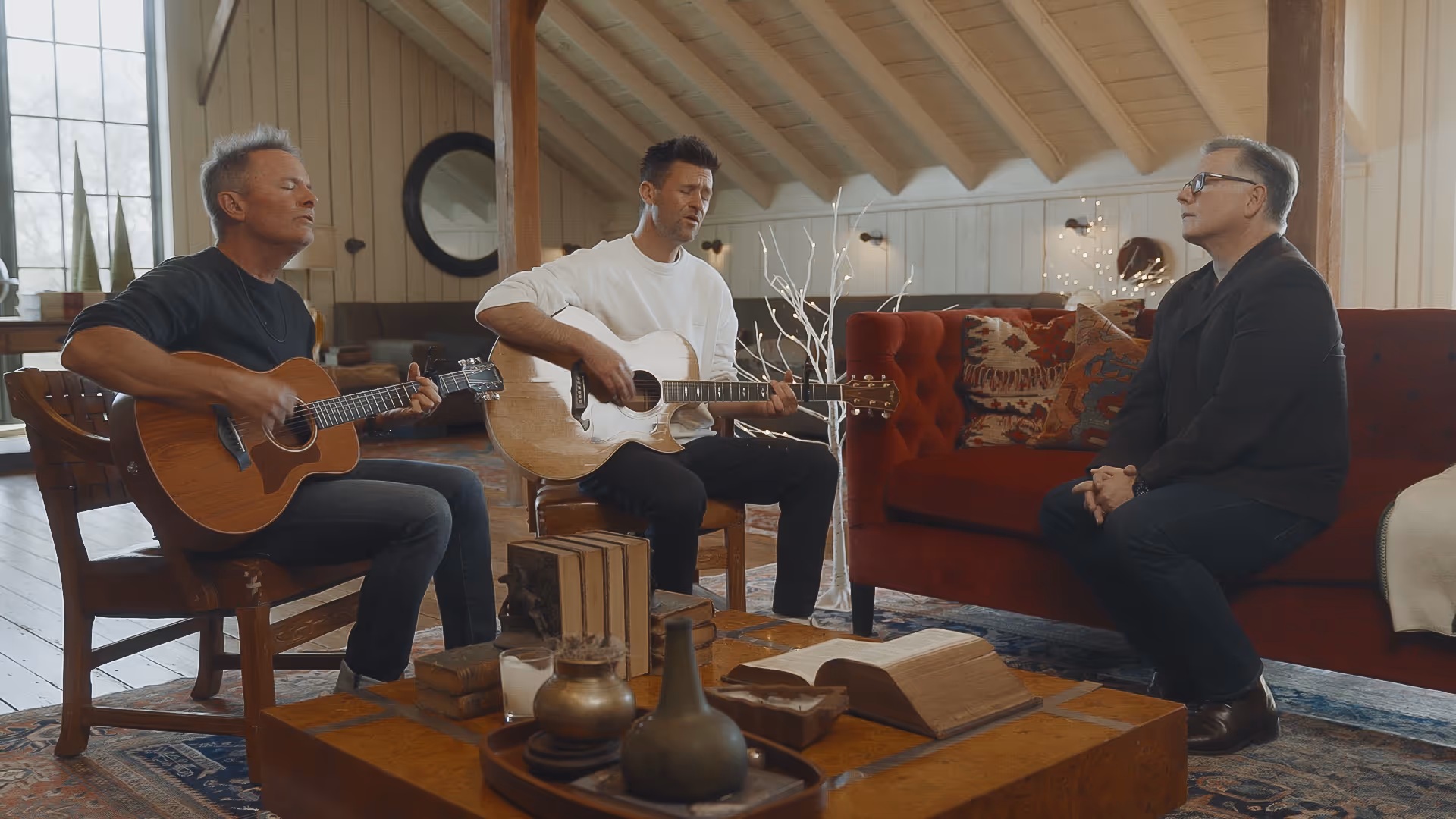 Chris Tomlin, Ben Fielding, John Dickson in 'The First Hymn'. Photo image courtesy of Undeceptions
There have been many archeological discoveries over the years that have left an indelible imprint on how people have come to understand the modern world.
As a prime example, the Dead Sea Scrolls, uncovered in a cave by a young shepherd boy in 1947, had a profound effect on Christians by providing a deeper understanding of the Biblical texts and their historical context.
For historian and author John Dickson, the possibilities for an ancient fragment containing what is believed to be a portion of the first Christian hymn were endless. Found among thousands of ancient documents in the ruins of Oxyrhynchus (Egypt), the fragile relic not only represented the origins of Christian music, but more importantly served as an important reminder that expressing faith through song has stood the test of time.
In the new documentary, The First Hymn, available through Fathom Movie Events (March 24, 26), Dickson takes viewers on a journey to discover how this simple expression of musical worship from 1,800 years ago found its way from ancient Egypt to the modern worship services of the 21st Century.
To do this, Dickson enlisted the help of acclaimed Australian songwriter Ben Fielding (“Mighty to Save”) and beloved worship leader Chris Tomlin, to re-imagine the ancient hymn for contemporary audiences. This collaboration was eventually released last year on Fielding’s latest album; The King Is Still the King.
I recently sat down with Fielding to discuss this remarkable discovery, the challenges he and Tomlin faced in modernizing the hymn, and why faith, theology, and the worship practices of the early church remain profoundly relevant today.
For every creative person, there always seems to be a moment where you say to yourself, “I have to be a part of this film! It is non-negotiable!” For The First Hymn, what was that moment for you?
I sat down with John Dickson, who is a friend and has been for many years. I've got a lot of respect for him as an academic, as a pastor, and as a thinker. He sat me down and was telling me over coffee about this discovery that he had made at Oxford University of the earliest discovered Christian hymn. He began to tell me about it and read me some of his translated lyrics from ancient Greek. He said to me, “I want to bring this to life. I want to tell people the story of what the early Christians were singing.” And I thought this is an amazing idea because theologically it's rich. As a matter of church history, it's rich. And I was sitting there going, why is he telling me this? And then he said, “The reason I want you to be involved is because I want you to help bring this back to life in a way where not just the story of the hymn is told, but perhaps the modern Church could actually sing the same words that our brothers and sisters were singing nearly two millennia ago. There would be unity not just in the church today as we sing these theological truths, but we'd have unity with our brothers and sisters.”
For the sake of our conversation, could you please give me a bit of the backstory of The First Hymn?
The papyrus was found in Oxyrhynchus, Egypt. It was an archeological discovery in ancient Asia. It was basically this little piece of papyri that was compressed in what was basically a third century dumpster. And in it, there were a whole lot of other documents. There were corn contracts. Apparently, there was a wrestling contract in there. And quite interestingly, there was an arrest warrant for a Christian in there. You begin to see that the Third Century period for the early Church was one where they were persecuted. They were being arrested. It wasn't easy to profess Christianity. And yet the Church is singing of a Trinitarian God, nearly a hundred years before the Council of Nicaea.
And they're singing about this God, who is the only giver of all good gifts. So, here's a persecuted group of people who we know. Also, there was a lot of internal division in the Church at the time. Different parts of the church were wrestling with doctrine and core beliefs. This is before the creeds, which I think helped to unify the Church in their beliefs. But the Church still had this faith in a God who was the only giver of all good gifts, this resurrected Jesus. And so, to think that these people, the archeologists at the time, have looked back at that period and said, “Well, we know Christians came in to Oxyrhynchus and that part of Egypt, because we noticed that people started to get buried facing a different direction in expectation that Christians had, that Jesus was coming back again. These people had a profound belief in the power of the resurrection of Jesus. I love the fact that their song that has been dead and buried for nearly 2,000 years has been brought back to life. Their story is being told again, and we can now take encouragement from them.
Why do you think it was so important to document this process and turn it into a documentary?
Firstly, I think the story is one that needs to be told. And I think if we hadn't modernized the hymn and tried to create something that people could sing, I think it would still be a fascinating piece of church history and discovery like the Dead Sea Scrolls, like any archeological find that deepens our understanding of what our brothers and sisters have believed in their practices. It also speaks to just the profundity and the tenacity of Christian teaching and Christian truth. When you look at the lyrics of this hymn, I'm a hymn writer. I've spent most of my adult life writing hymns. I look at those lyrics and I think we would write those today. We would sing those today. And I think that's a profound thing. There have been changes of empire, there's industrial evolution, all these historical changes, but the message of the Gospel and the message of the Church is basically identical.
At its heart, this documentary explores continuity — how the faith, theology, and worship practices of the early church remain profoundly relevant. And one of the most fascinating parts of this film for me is taking this ancient hymn and bringing it into the 21st Century. How did you approach transforming an ancient hymn into a contemporary worship song?
That was a really interesting part of the proposition that John made because immediately, you start sort of wrestling with how do you pay homage to the original hymn writer or hymn writers? How do you do justice to their song? I was saying to John, how much of that first hymn should we use lyrically? I think you want to use all of it. There was about 80% of the original lyric that was intact. And it had a little musical notation and musicologists were able to essentially transcribe that into the modern state. So, you could play this sort of ancient Egyptian, Coptic kind of melody. But it's difficult for modern Christians to sing, at least western modern Christians to sing.
And so I said to John, what do we do there? I could try to write about some of those motives, but it will be challenging for people to sing them. And he said, “You need to know and understand the history.” The musicologists have looked at this the way that the hymn writers wrote this melody, and they've said, essentially the melody was like a pub song of the time, a tavern song. It was a pop song. At the heart of that original hymn writer or hymn writers was that people coming into the church gathering, a Christian gathering where they were singing this hymn, would have a familiarity with the musical structure, such that they might be able to join in and sing along. So, the point was theological truth, but expressed through music in a way that was accessible where people could sing along. The point was participation and unity. And that gave me confidence to go, okay, that almost justifies the intent of the original in writing it today. And bringing that back to life in a way where we wanted to present this ancient hymn in a way where a worship leader in their church today could say, “I could bring that to our church, and I think they could sing along with it.”
Your main collaborator on this was none other than Chris Tomlin. What was the experience of working with perhaps the most well-known praise and worship artist out there today like? What did he bring to the table?
I've had so much respect for Chris for a long time. I think he is a statesman, not just in America, but around the world. He brings songs that the Church can sing and helps to shape the sound of worship. He's obviously written so many songs that are staples in churches all around the world. So, when John said to me, “I'd love you to invite somebody into this process,” my dream was to contact Chris and hope that he would say yes. This is because I think apart from his gift and his talent, which is undeniable, what he's been able to do in the Church in terms of bringing unity amongst the body of Christ is pretty unique. He is quite neutral in the sense of different camps within the Church. Unfortunately, we do have our penchant for finding reasons for division, and our differences can sometimes win out.
But I think in worship, there is a unity where you look across the breadth of the Church and our different denominations, our different pockets, and we're often singing the same songs. And we're often singing Chris Tomlin songs. I think he's had this sort of unique ability to where people will say, “Because Chris Tomlin sung the songs, it's not a reason that I wouldn't sing it. It's a reason that I would sing it.” He's been a really unifying figure across the Church. And so, to have him in the process was such a gift on that level. Creatively too, I've written with Chris a lot over the years and he's a good friend. So, to be able to just bounce back and forward, he brought this sort of enthusiasm to the creative process, which was really infectious. I would send him notes overnight. He would send me back notes because we're living in two different time zones. I would wake up to messages from Chris and vice versa. It was awesome.
If the early Church could hear this modern version, what do you think they would say?
I am torn on this and, and we've talked about it because these original hymn writers or even these early Christians who had been singing this song, I suspect they would kind of go, “Wow, I can't believe that our song has been sung nearly 2,000 years later.” I think they would marvel at that. And yet at the same time, I also think they did have such a deep belief in the message that they were singing and the God who they were singing about, that perhaps they wouldn't be that surprised that He's the sort of God that could do that. He is a God that could bring back to life a soul that's been dead and buried. I think they would celebrate the fact that their lyrics had been put to music that now people could engage with again, in a way that was common in the day and age that it was being presented. I hope that they would feel like we had tried to honor them in the process.
WATCH A TRAILER FOR THE FIRST HYMN: