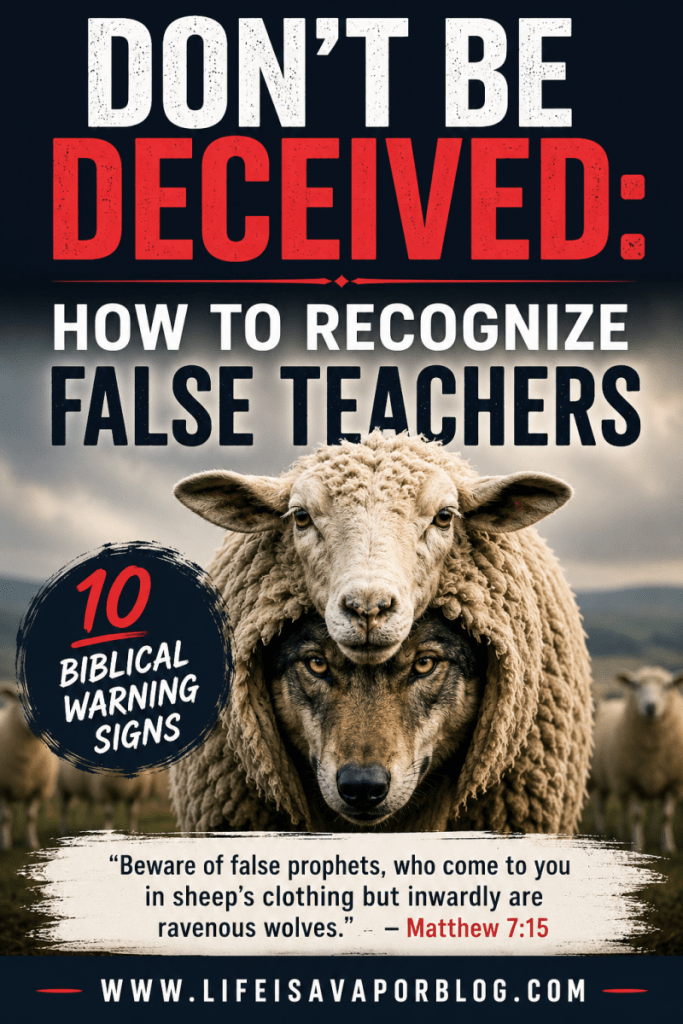
Don’t Be Deceived: How to Recognize a False Teacher
False teachers are nothing new.
From the beginning of the church, Christians have been warned about people who distort God’s Word, corrupt the gospel, and lead others away from the truth. Jesus Himself warned His followers:
“Beware of false prophets, who come to you in sheep’s clothing but inwardly are ravenous wolves.”
—Matthew 7:15, ESV
Notice what Jesus said. False teachers don’t always look like wolves.
They come in sheep’s clothing.
They may use Christian language, quote Scripture, have large ministries, write bestselling books, or attract thousands of followers. They may even appear sincere and compassionate.
That’s what makes false teaching so dangerous.
The Bible doesn’t tell Christians to blindly trust everyone who claims to speak for God. Instead, we’re commanded to exercise discernment and test what we hear against God’s Word.
The apostle John wrote:
“Beloved, do not believe every spirit, but test the spirits to see whether they are from God.”
—1 John 4:1, ESV
So how can you recognize a false teacher?
The answer isn’t by becoming suspicious of everyone who teaches the Bible. It’s by becoming so familiar with the truth that you can recognize error when you encounter it.
Related: Why is God’s Holiness Important?
What Is a False Teacher According to the Bible?
A false teacher is someone who claims to teach spiritual truth while teaching something that contradicts God’s revealed Word.
This doesn’t mean that every Christian who makes a theological mistake is a false teacher. Faithful Christians can misunderstand or incorrectly explain a passage. The issue is whether someone persistently teaches serious error, particularly concerning God, Christ, salvation, sin, and the gospel.
The New Testament repeatedly warns about such people.
Paul told the elders at Ephesus:
“And from among your own selves will arise men speaking twisted things, to draw away the disciples after them.”
—Acts 20:30, ESV
Peter likewise warned:
“But false prophets also arose among the people, just as there will be false teachers among you, who will secretly bring in destructive heresies.”
—2 Peter 2:1, ESV
False teaching can be subtle. It may begin with a small distortion and eventually lead people toward a completely different gospel.
That’s why Christians need biblical discernment.
“False doctrine and false teachers aren’t just misleading; they’re soul-endangering.” – John Piper
Why Are False Teachers So Dangerous?
False teaching isn’t merely an intellectual problem. Eternal truth is at stake.
Paul was so concerned about distorted teaching that he wrote to the Galatians:
“But even if we or an angel from heaven should preach to you a gospel contrary to the one we preached to you, let him be accursed.”
—Galatians 1:8, ESV
Changing the gospel changes everything.
A false teacher may tell people they can be saved without genuine repentance. They may minimize sin, redefine grace, deny essential truths about Christ, promise earthly prosperity, or make human happiness the center of Christianity.
People can become convinced that they are following Christ when they have actually embraced a message that cannot save them.
This is why discernment isn’t optional.
We aren’t called to believe something simply because it sounds Christian. We are called to test it against Scripture.
“«False teachers» are the enemies of sound doctrine and, therefore, of God and His people. – John MacArthur
10 Biblical Warning Signs of a False Teacher
The Bible gives us several ways to recognize false teaching. These warning signs can help us evaluate pastors, authors, podcasters, social-media personalities, and anyone else claiming to teach God’s Word.
1. They Teach a Different Gospel
This is perhaps the most serious warning sign.
The gospel is the good news that sinful people can be reconciled to God through Jesus Christ. Christ lived the righteous life we could never live, died for our sins, and rose again. Salvation is God’s gracious gift, received through faith—not something we earn through our own goodness.
False teachers change that message.
They might say that salvation requires Christ plus our works. They may teach that Jesus came primarily to make us prosperous or successful. They may promise salvation without repentance or make human effort the foundation of our acceptance with God.
The details vary, but the problem is the same: the biblical gospel has been altered.
Paul didn’t tell the Galatians to overlook these differences because the teachers were sincere. He told them to reject the false gospel.
2. They Distort the Person of Jesus Christ
What someone believes about Jesus is central to Christianity.
Jesus isn’t merely a good teacher, moral example, or spiritual guide. He is the eternal Son of God who became man.
John wrote:
“In the beginning was the Word, and the Word was with God, and the Word was God.”
—John 1:1, ESV
And:
“And the Word became flesh and dwelt among us.”
—John 1:14, ESV
False teachers may deny or distort fundamental truths about Christ. Some deny His deity. Others minimize His humanity. Some present a Jesus who never confronts sin, demands repentance, or speaks about judgment.
But we don’t get to invent our own version of Jesus.
We must believe in the Christ revealed in Scripture.
John warned about deceivers who did not confess the truth about Christ (2 John 7). A teacher’s view of Jesus is therefore one of the first things Christians should examine.
Related: Can We Trust the Bible?
3. They Twist or Misuse Scripture
False teaching frequently begins with a wrong approach to God’s Word.
Instead of submitting to Scripture, false teachers make Scripture submit to them. They may take verses out of context, ignore passages that contradict their message, or build entire doctrines around isolated verses.
Sometimes they don’t deny Scripture outright. They simply redefine what it says.
Paul instructed Timothy:
“Do your best to present yourself to God as one approved, a worker who has no need to be ashamed, rightly handling the word of truth.”
—2 Timothy 2:15, ESV
Faithful teachers don’t merely quote the Bible. They explain it accurately.
So don’t ask only:
“Does this teacher quote the Bible?”
Ask:
“Does this teacher accurately explain what the Bible actually says?”
4. They Put Human Experience Above God’s Word
False teachers may appeal heavily to personal experiences, visions, revelations, or claims such as, “God told me…”
But Christians aren’t instructed to make personal experience the final authority for truth.
Scripture is our authority.
The Bereans provide an excellent example. When Paul preached to them, they didn’t simply accept everything he said. They examined the Scriptures:
“Examining the Scriptures daily to see if these things were so.”
—Acts 17:11, ESV
If the Bereans examined Paul’s teaching against Scripture, how much more should we examine the teaching we encounter today?
Experience may be powerful, but God’s Word must have the final word.
5. They Promise What God Hasn’t Promised
False teachers often appeal to people’s desires by promising things God never promised:
- Wealth
- Perfect health
- Constant happiness
- Success
- A trouble-free life
- Guaranteed earthly blessings
But Jesus never promised His followers an easy life.
He said:
“In the world you will have tribulation. But take heart; I have overcome the world.”
—John 16:33, ESV
Paul similarly warned:
“Indeed, all who desire to live a godly life in Christ Jesus will be persecuted.”
—2 Timothy 3:12, ESV
Christianity isn’t a promise that everything will go well. It is the promise that Christ will never abandon His people.
A teacher who guarantees earthly comfort is promising something Scripture never does.
6. They Minimize Sin and Repentance
The biblical gospel doesn’t merely tell people that God loves them. It tells them why they need salvation.
Romans 3:23 says:
“For all have sinned and fall short of the glory of God.”
Yet some teachers avoid talking about sin because it is uncomfortable. They present Christianity primarily as a path to self-improvement, emotional fulfillment, or personal success.
But Jesus came to save sinners.
He began His public ministry proclaiming:
“Repent and believe in the gospel.”
—Mark 1:15, ESV
A message that never confronts sin is not the message Jesus preached.
Grace is good news precisely because sinners need grace.
7. Their Teaching Appeals Primarily to Human Desires
Paul warned Timothy:
“Having itching ears they will accumulate for themselves teachers to suit their own passions.”
—2 Timothy 4:3, ESV
People naturally gravitate toward messages that affirm what they already want to believe.
Tell people they’re basically good, that God exists primarily to fulfill their dreams, that sin isn’t serious, and that judgment isn’t real—and you’ll probably attract an audience.
But popularity isn’t evidence of truth.
A biblical teacher doesn’t exist to tell us what we want to hear. A biblical teacher exists to tell us what God has said.
8. Their Life Doesn’t Match Their Message
Jesus taught that false teachers can be recognized by their fruit:
“You will recognize them by their fruits.”
—Matthew 7:16, ESV
This doesn’t mean faithful teachers will be sinless. They won’t be. Every Christian continues to struggle with sin.
The question is whether someone’s life consistently contradicts the message they proclaim.
Peter described false teachers as people driven by sinful desires and greed (2 Peter 2:1–19).
A teacher who repeatedly manipulates people for money, lives in open and unrepentant sin, abuses authority, or uses ministry primarily to build a personal empire should not be ignored simply because that person can preach well.
Doctrine matters. Character matters.
9. They Make Themselves the Center
A faithful Christian teacher points people toward Christ.
A false teacher often points people toward himself.
Watch for teachers whose ministry constantly revolves around their own greatness, special revelations, accomplishments, wealth, platform, or authority.
Paul’s approach was completely different:
“For what we proclaim is not ourselves, but Jesus Christ as Lord.”
—2 Corinthians 4:5, ESV
The faithful teacher doesn’t need to become the hero of the story.
Jesus is the hero.
10. They Create Division by Distorting the Truth
False teachers can also be recognized by the division they create.
Paul warned:
“Watch out for those who cause divisions and create obstacles contrary to the doctrine that you have been taught; avoid them.”
—Romans 16:17, ESV
Not every disagreement among Christians is evidence of false teaching. Faithful Christians can disagree over secondary matters while remaining united in Christ.
But when someone repeatedly twists essential Christian doctrine, causes people to reject biblical truth, or demands loyalty to themselves rather than submission to Scripture, Christians should take notice.
Biblical unity cannot be built on abandoning biblical truth.
Related: What is the Purpose of Worship?
False Teachers Often Look More Biblical Than You Expect
Perhaps the most important lesson about false teachers is this:
They don’t always look false.
That’s why Jesus used the imagery of wolves in sheep’s clothing.
Paul made a similar point:
“For even Satan disguises himself as an angel of light.”
—2 Corinthians 11:14, ESV
A false teacher may use Christian vocabulary, talk about Jesus, quote Scripture, pray, and even say things that are completely true.
The danger comes when truth is mixed with error.
A message doesn’t become trustworthy simply because it contains biblical statements.
The question is whether the teaching as a whole is faithful to God’s Word.
So don’t evaluate teachers primarily by personality.
Don’t ask only:
“Do I like this person?”
Ask:
“Is this person faithfully teaching Scripture?”
How to Test a Teacher Against Scripture
How should you evaluate someone who claims to teach God’s Word?
Ask these questions:
Does this teaching agree with Scripture?
Read the passages being used. Don’t simply trust the teacher’s interpretation. Read the surrounding verses and consider the context.
What does this teacher believe about Jesus?
Is Jesus presented as the eternal Son of God, fully divine and fully human, who died for sinners and rose from the grave?
What does this teacher say about salvation?
Is salvation centered on God’s grace and faith in Christ? Is repentance present? Or is salvation made dependent upon human achievement, prosperity, or religious performance?
What does this teacher say about sin?
Does the teacher take sin seriously and explain why humanity needs a Savior? Or is sin minimized to avoid offending people?
Does the teacher handle Scripture in context?
Anyone can make the Bible say almost anything by pulling verses out of context. Faithful teachers explain passages according to their intended meaning.
Does the teacher’s life demonstrate godly character?
Perfection isn’t the standard. But persistent, unrepentant, scandalous behavior should concern us—especially when it contradicts the teacher’s public message.
Who receives the glory?
Does the teacher continually direct attention toward Christ, or does everything ultimately point back to the teacher?
These questions help us develop biblical discernment without becoming cynical or suspicious of every Christian teacher.
“A pastor who does not submit to the Bible as his final authority is a menace to the kingdom of God.” —R.C. Sproul
What Should Christians Do About False Teaching?
The answer isn’t to become obsessed with false teachers.
It’s to become deeply grounded in truth.
Paul told Timothy:
“Preach the word; be ready in season and out of season; reprove, rebuke, and exhort, with complete patience and teaching.”
—2 Timothy 4:2, ESV
The best defense against counterfeit teaching is familiarity with the genuine article.
A bank employee learns to recognize counterfeit money by becoming familiar with real currency.
Likewise, Christians develop discernment by becoming deeply familiar with God’s Word.
Read Scripture.
Study Scripture.
Know the gospel.
Understand what the Bible teaches about God, Christ, salvation, sin, grace, and judgment.
And don’t be afraid to ask questions.
You don’t have to accept a teaching simply because someone speaks confidently. You don’t have to follow a teacher because everyone else does. And you don’t have to remain loyal to a teacher when Scripture demonstrates that the teaching is wrong.
Our ultimate loyalty belongs to Christ.
How to Protect Yourself From Spiritual Deception
If you want to become better at recognizing false teachers, don’t begin by studying every false teacher.
Begin by knowing your Bible.
Read Scripture consistently and in context. Learn the central truths of the gospel. Study the life and teachings of Jesus. Listen carefully to biblical preaching. Compare what you hear with God’s Word.
And pray for wisdom.
James writes:
“If any of you lacks wisdom, let him ask God, who gives generously to all without reproach.”
—James 1:5, ESV
Discernment also requires humility.
It’s possible to become so focused on identifying everyone else’s errors that we fail to examine our own hearts.
The goal isn’t to become someone who is constantly saying, “That person is a false teacher!”
The goal is to become a Christian who loves truth enough to recognize error and loves people enough to warn them when necessary.
Three Common Misunderstandings About False Teachers
“A false teacher must be obviously evil.”
Not necessarily.
Jesus said false teachers would come in sheep’s clothing. Some may appear kind, sincere, intelligent, compassionate, and deeply spiritual.
That’s why character alone isn’t enough.
We must examine both doctrine and fruit.
“If a teacher says something wrong, they’re automatically a false teacher.”
Not necessarily.
Faithful Christians can make mistakes. The question is whether the teaching represents a serious or persistent distortion of biblical truth.
We should practice discernment without becoming unnecessarily judgmental.
“I don’t need to worry about false teachers if I go to church.”
Every Christian needs discernment.
Church attendance is important, but Christians are still responsible for knowing God’s Word and testing what they hear.
The Bereans searched the Scriptures to determine whether Paul’s teaching was true. We should do the same.
FAQ: How Can I Recognize a False Teacher?
What is the biggest sign of a false teacher?
One of the clearest signs is a distortion of the gospel or essential biblical truth about Jesus Christ. False teachers may also misuse Scripture, minimize sin, promise things God hasn’t promised, pursue personal glory, or display persistently ungodly character.
How can I tell if a Bible teacher is trustworthy?
Compare what they teach with Scripture. Examine their interpretation of biblical passages, their understanding of the gospel, their teaching about Christ and salvation, and whether their life demonstrates biblical character.
Can a false teacher use the Bible?
Yes. False teachers can quote Scripture while misinterpreting or twisting it. The important question isn’t simply whether someone uses Bible verses but whether they faithfully explain God’s Word.
Should Christians name false teachers?
There are times when Scripture calls Christians to warn others about false teaching and false teachers. However, this should never become an excuse for gossip, slander, or personal attacks. The focus should remain on biblical truth and protecting people from spiritual deception.
How can new Christians develop discernment?
Start with Scripture. Read the Bible consistently, learn the central truths of the gospel, study the life and teachings of Jesus, and compare what you hear with God’s Word. Ask mature Christians and faithful pastors for help when you encounter difficult teachings.
Conclusion: Know the Truth So You Can Recognize the Lie
Jesus didn’t warn us about false teachers because He wanted His followers to live in fear.
He warned us because He loves His people.
False teachers will come. Scripture makes that clear. But Christians don’t have to be defenseless against deception.
God has given us His Word. He has given us the gospel. He has given us the Holy Spirit. And He calls us to exercise wisdom and discernment.
The answer to false teaching isn’t paranoia.
It’s truth.
The more familiar you become with Scripture, the easier it becomes to recognize teaching that doesn’t belong.
So don’t simply ask whether a teacher is popular.
Don’t ask whether they are charismatic.
Don’t ask whether their message makes you feel good.
Ask the most important question:
Is this true according to God’s Word?
As Paul wrote:
“Test everything; hold fast what is good.”
—1 Thessalonians 5:21, ESV
Know the truth.
Love the truth.
Stand on the truth.
And don’t be deceived.
If this article was helpful, please share it!