How the Seed Reached My Hands
There was a strong wind off the lake that day.
The water of Galilee slapped against the hull. The crowd on the shore had pressed in until there was nowhere left to stand, so He got into a boat, sat down, and spoke to them across a stretch of water. They stood on the sand, dried fish scales and torn nets under their feet. The first thing He told them was not about a throne, or judgment, or glory. He said: a sower went out to sow.
A farmer, a cloth bag, a handful of seed flung wide — falling on the path, on rocky ground, among thorns, and also on good soil. The whole history of the kingdom begins with that one handful.
The people listened standing up. Like the night of the Passover — belt fastened, sandals on, staff in hand, eat it in haste — because when the meal was over, they were leaving. Hearing the word has never been something you finish sitting down. It is something you finish and then set out.
The Handful Sown in Tears
To understand what is in a sower's heart, you have to go back to another scene.
After seventy years in exile, a group of people walked home from Babylon. They remembered how they had left: the ropes, the dust, the last look back over the shoulder. Now they were standing in fields that had lain waste for seventy years, holding the last of their seed — food, actual food. Sow it, and you go hungry this year.
They sowed it anyway. And they wept while they sowed.
Psalm 126 preserved that moment: they that sow in tears shall reap in joy; he that goes out weeping, bearing precious seed, shall come again rejoicing, bringing his sheaves with him.
Those were double tears. Half of them were the tears of released captives — I am somehow still standing on this land. The other half were the tears of a man handing over his own rations — tonight I go home with empty hands.
A Grain of Wheat
The Lord Himself gave away the secret of that seed: unless a grain of wheat falls into the ground and dies, it remains alone; but if it dies, it brings forth much fruit.
Down in the dark soil, the husk has to split first. That splitting is its only way to live.
Later, at Golgotha, the sky went dark for three hours. The grain of wheat fell into the ground.
The Ones Who Went by Sea
From then on the seed began to move across the world, and almost always by the hardest roads.
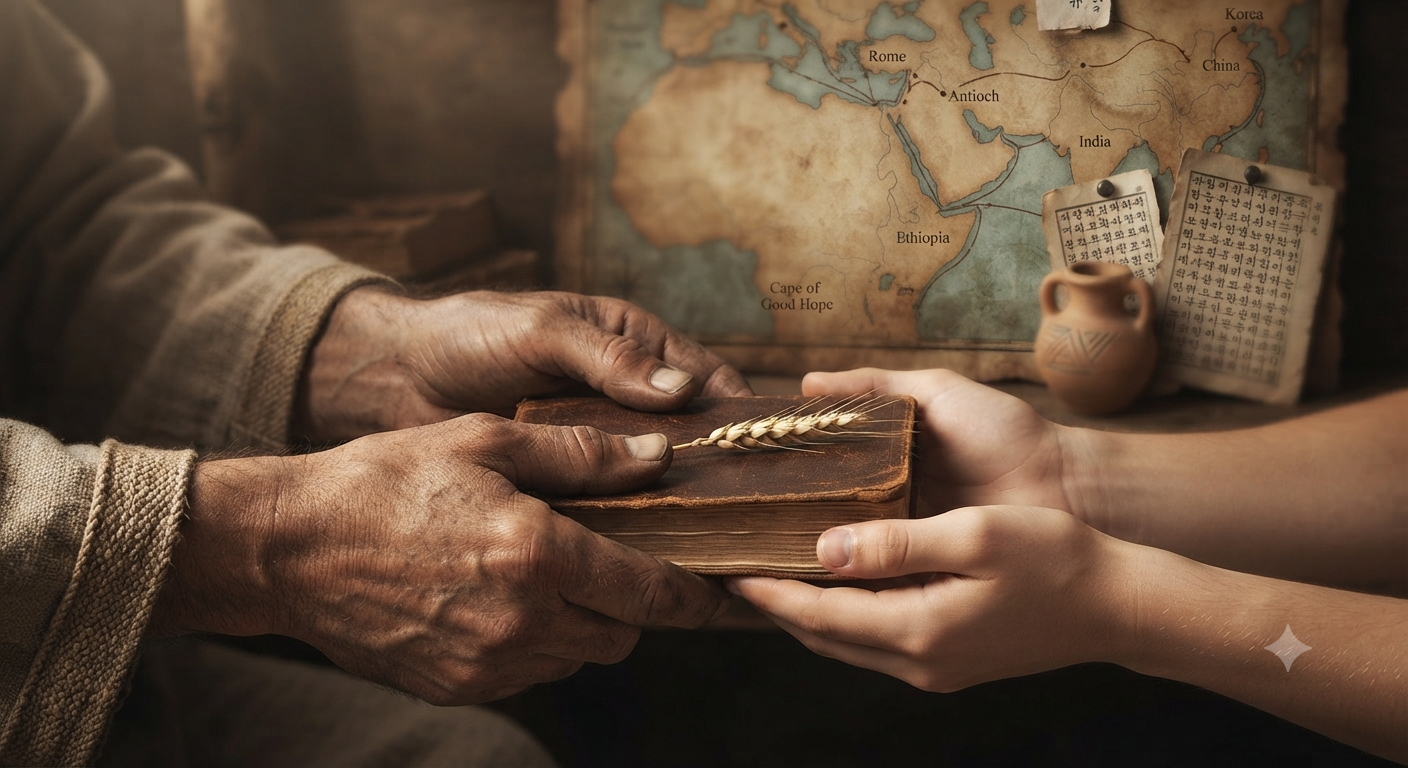
The first to carry it were fishermen. Calloused hands. Not one line anywhere records that they went to school. They scattered to Antioch, to Rome, to Ethiopia; tradition says Thomas walked as far as the southern coast of India. They could not write treatises. They only understood one thing — that someone had loved them that far, and had said to them, feed my sheep.
Paul kept his ledger this way: three times shipwrecked, a night and a day adrift in the deep; perils of rivers, perils of robbers, perils from his own countrymen, perils in the wilderness, perils among false brothers; cold and nakedness. In Damascus they put him in a basket and let him down through a window in the wall.
Then came the age of sail. A voyage took half a year. There were no lemons in the hold; the gums began to bleed; men were sewn into canvas and dropped over the side one by one. And young people still boarded those ships. In 1807, a twenty-five-year-old named Robert Morrison rounded the Cape of Good Hope to Canton, hiding in a warehouse by day to learn Chinese, and it was seven years before he baptized his first Chinese convert — seven years, one man. Hudson Taylor put on a Chinese gown and grew a queue, and was mocked by his own countrymen for it, so that people would stay long enough to let him finish saying the Name.
At the end of August 1866, a ship ran aground on the Taedong River and caught fire. Robert Thomas, twenty-six years old, came ashore carrying a bundle of Chinese Bibles and walked toward the men with the blades. Korean churches have told what happened next for generations: he held the Bible out, and then he fell. The story goes that someone on that riverbank took the pages home and pasted them to the walls of his house — and years later, people who came in read those walls, panel by panel, and believed what they read. Nineteen years after that, on an Easter morning, two young Americans stepped onto the dock at Chemulpo. Look out over Seoul at night now and the city is full of red crosses; the poorer the mountain village, the thicker they stand. The seed fell into ground that had been watered with blood.
A Drum, and a Notebook
Some seed gets sown in ways that look ridiculous.
People tell of a missionary who arrived somewhere the language was completely closed to him. Nothing he said landed, and there was no one to translate. So he strapped on a big drum and walked into the street, striking it with every step, shouting one word: Jesus. Children trailed behind him laughing; dozens of people gathered to look at this foreigner making a clown of himself. But that night the whole village was talking about that name.
And there was a preacher in Japan who could only repeat, Jesus, Jesus. He stopped people to ask if they would read the Bible with him; most of them walked around him. One man came back later — and discovered at once that this foreigner could not speak Japanese at all. The preacher handed over his notebook, filled with Japanese, and said: read it to me. The man was stunned. I came here to listen. Why am I the one reading? He read it anyway. When he finished, the preacher said: now say it again, in your own words. Explain it to me.
And so the gospel came out of his own mouth and went into his own heart.
And Then It Reached Me
The road ran two thousand years, around the Cape, through plague and blades, and finally turned into a very small room and came to where I was sitting.
Maybe the one who handed it to me was a mother, a classmate, someone whose name I can no longer remember. He did not say much. He may even have stumbled over it. But the seed in his hand had come all the way down from the shore of Galilee.
The question I owe myself is not have I heard it, but: has it split open inside me? Is there still that gratitude in me, the kind that comes out through the eyes — like those people standing in a wasted field with their last food in their hands?
A Hundredfold, Sixtyfold, Thirtyfold
But other seed fell into good ground, and brought forth fruit, some a hundredfold, some sixtyfold, some thirtyfold.
Matthew counts down from a hundred; Mark counts up from thirty. Read it from either end and the hope He holds out is not three or five. These are working numbers: a hundred people. If not a hundred, then sixty. At least thirty — thirty spiritual descendants, a family line with your name on it.
At the Beautiful Gate, Peter said: silver and gold have I none, but such as I have, I give you. We have nothing else in our hands either — only a treasure in a clay jar. Clay cracks; there is still unwashed appetite and pretense inside. So the sower scatters with one hand and asks to be cleansed with the other — blessed are the pure in heart, for they shall see God.
Someone asked three men working on a building site: what are you doing? The first said, I'm laying bricks. The second said, I'm putting up a very large building. The third said, I'm building a house for God.
Same bricks. Same hands. Different eyes.
Now the Seed Is in My Hands
How many people have never heard this name. How many souls are sitting in the dark. How many peoples know Him only through hatred and misunderstanding. How many are riding a train toward death, asleep against the window.
The ones ahead of me have already fallen into the ground — the ones on the ships, the one at the river, the one with the drum, the one who couldn't finish a sentence. They handed over what was in their hands and went home empty.
Now it's my turn. Do I close my fist around it and celebrate my own eternal life — or do I sow it?
They that sow in tears shall reap in joy.
He that goes out weeping, bearing precious seed, shall come again rejoicing, bringing his sheaves with him.
Scripture: Matthew 13:1–9, 23; Psalm 126:5–6; John 12:24; 2 Corinthians 11:23–33; Acts 3:6
#ParableOfTheSower #Matthew13 #SowInTears #Psalm126 #GrainOfWheat #MissionsHistory #GreatCommission #GospelLegacy