What do you do with the worst version of yourself?
A story from two thousand years ago — about a rooster, a man who ran, and a love that did not walk away.
You don't have to believe anything to read this. No prior knowledge required. No membership, no background check. You only need one thing to understand this story: you need to have failed at something that mattered — and carried the weight of it afterward.
Most of us have.
A teacher, a zealot, and a young man who kept running away
Two thousand years ago, in the ancient world, there was a teacher named Jesus who gathered around him a group of followers. Among them were two who went on to change the Western world: Peter — a fisherman, impulsive and deeply loyal — and Paul — a former religious enforcer, brilliant and driven, who became a missionary after a dramatic conversion.
And then there was Mark. A younger man, well-connected in the early community, who kept — well — running away. Twice. Once on a desperate night when things turned dangerous. Once partway through a missionary journey when the road got hard. He simply turned back.
Here is what makes this story worth sitting with: Paul refused to let Mark come on the next journey. He had proven unreliable. The mission was too important. That decision made sense — and it came from a certain kind of love for the work.
But Peter? Peter took Mark in. Called him "my son." Gave him everything.
Why did Peter — of all people — become the one who could restore Mark?
The answer is not complicated, but it is profound.
Peter had already been in Mark's position. Not a lesser version — a worse one.
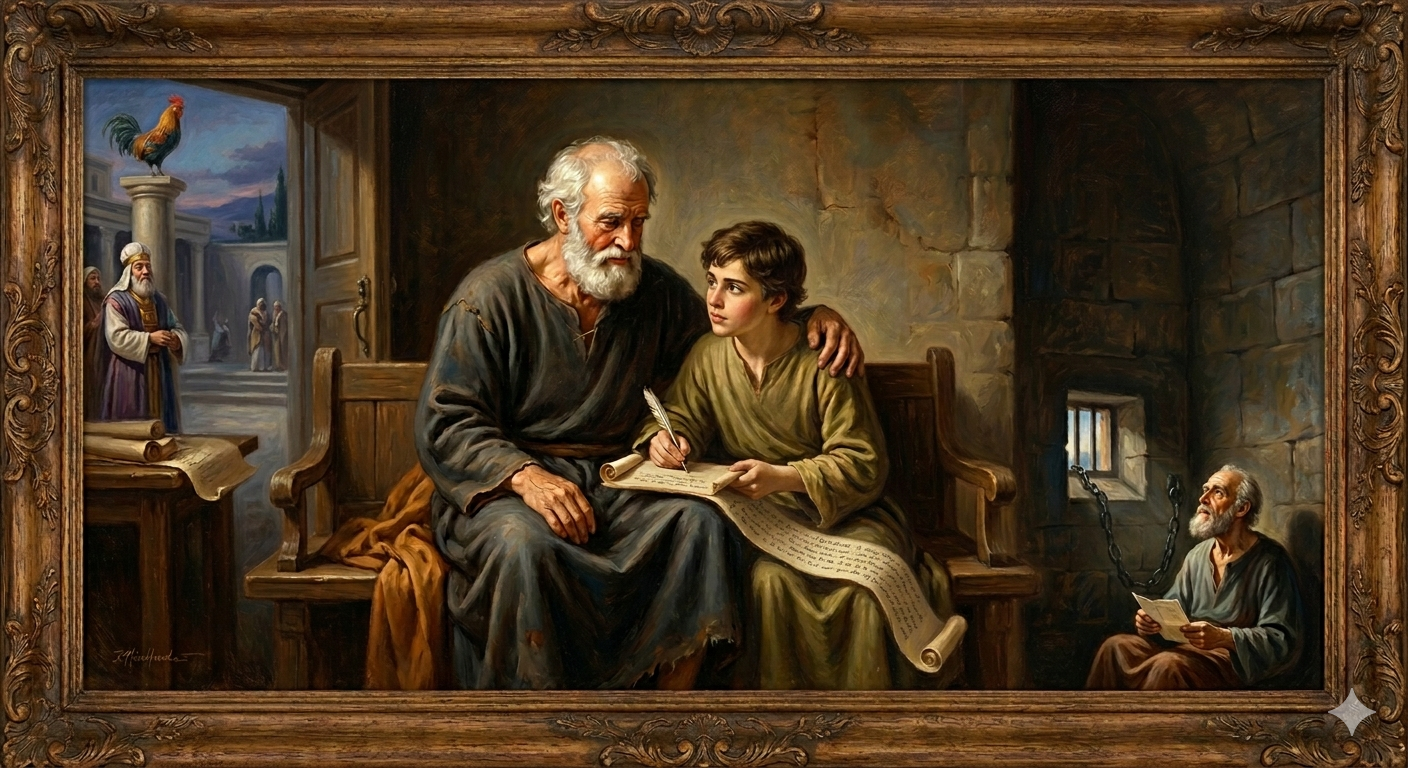
On the night Jesus was arrested, Peter followed at a distance to the courtyard of the high priest's house. Someone recognized him near a fire. "You were with him," they said. Peter denied it. A second person said the same. He denied it again, with an oath. A third person said his accent gave him away. Peter — the closest friend, the one who had promised he would never abandon Jesus — called down curses and swore: "I don't know the man."
And then — a rooster crowed.
The Lord turned and looked straight at Peter. Then Peter remembered what had been said to him. And he went outside and wept bitterly. Luke 22:61–62
Think about what that moment was. Jesus — in the middle of being arrested, tried, about to be sentenced to death — turned and looked at Peter.
And in that look, the text tells us, Peter did not see anger. He did not see contempt or "I told you so." He saw something that broke him open completely. The Greek verb used for his weeping is one of the most intense in the New Testament. He did not shed a polite tear. He collapsed.
What breaks a person that completely is not being condemned. It is being seen with compassion when you deserve condemnation — and knowing you do not deserve it.
Later, after the resurrection, Jesus appeared to Peter on a lakeshore and asked him — three times, once for each denial — "Do you love me?" Not to humiliate him. To restore him. Three times he was reinstated. Three times he was given back his purpose.
Peter carried that experience inside him for the rest of his life. He knew — not theoretically, but in his bones — what it meant to be at your worst and be met with love rather than dismissal.
So when Mark came to him — a young man whose history included two occasions of running away — Peter did not see an unreliable worker. He saw a soul that looked like himself, at his worst moment. And he knew exactly what that soul needed.
He told him his own worst story — on purpose
In Rome, near the end of his life, Peter told Mark stories about Jesus. Everything he had witnessed. The healings. The crowds. The miracles. The Transfiguration, when he had seen Jesus transformed in light on a mountaintop.
And he told him about the rooster.
There is a detail scholars have puzzled over for centuries: the Gospel of Mark — which early church historians unanimously called "the memoirs of Peter" — does not protect Peter's reputation. His failures are recorded with striking honesty. Given that Peter was a revered figure in Rome by the time this was written, there is almost no way to explain this except one: Peter insisted on it.
He required that his worst moment be written down and preserved for all time.
Why would someone do that? Because Peter understood that his failure was not a footnote to his story — it was the hinge on which everything turned. The rooster. The look. The tears. The restoration. Without those things, he would have had no foundation on which to receive Mark.
He was saying, without words: "You ran. I ran too. He did not give up on me. He has not given up on you."
That is a specific kind of love. It is the love of someone who has already been through the thing they are trying to help you through. It does not offer advice from a safe distance. It offers itself — including its most embarrassing chapters — as evidence that recovery is possible.
You already know this story. You've lived parts of it.
Here is what I want to say to someone who has never read a Bible, who is not religious, who maybe finds the whole idea of faith distant or suspicious:
The mechanism at the center of this story is not supernatural. It is deeply, recognizably human.
You know what it is to carry something. A betrayal of someone who trusted you. A moment of cowardice you can't take back. A chapter in your life you would rather skip over when telling your own story. The version of yourself that showed up on the worst night and fell short.
You know what it is to have someone — after they've seen that version of you — still look at you with something other than disgust. A parent who didn't disown you. A friend who stayed. A stranger who extended grace when they had no obligation to. That look. That moment. If you have ever received it, you know it changes something.
What Peter experienced was that same thing — but from someone he believed was more than human. And what it produced in him was a lifelong compulsion to offer the same thing to others. He could not hold back from Mark what had been given to him. Received grace flows outward. That is simply what it does.
There is also Paul's story — and it is honest to include it. Paul, at first, refused to give Mark a second chance. His reasoning was not cruel; it was principled. Missions have standards. Reliability matters. He was right about that — and he was also, as the years revealed, incomplete in that understanding. Near the end of his life, facing execution in a Roman prison, Paul wrote to a friend: "Bring Mark with you. He is useful to me."
The man who had once shut the door on Mark now, dying, wanted him near. Something had opened in Paul too — a slower, harder lesson than Peter's, but the same lesson: the person who once failed you may become someone you cannot do without.
Falling is not the end of the story
Mark — who ran from Gethsemane. Who turned back at Pamphylia. Who was rejected by Paul as unfit for the work — went on to write what many scholars believe is the oldest, most vivid, most human of the four Gospels. The one that smells of dust and wind. The one where Jesus sighs, gets angry, holds children. The most immediate portrait of an extraordinary life.
It was written by someone who knew what failure felt like. Who had been received by someone who also knew. And who had been told, again and again, through the stories of an old fisherman's life, that falling is not the final word.
Whether or not you believe in what Peter believed in — there is something here worth sitting with.
The people most able to restore others are almost always those who have already been restored. Not the people who have never failed, but the ones who have failed and been met with something larger than their failure. They become, without trying to, a kind of proof. Their very life says: there is a way through this. I know because I came through it.
What was in that look — the one Jesus gave Peter across the courtyard — became a Gospel that has outlasted every empire since.
A rooster crowed. A man wept. And somehow, from that — from a moment of complete collapse in a cold courtyard — something that has been read by billions of people across two thousand years found its way into the world. Not despite the failure. Because of what came after it.