What If the Church Was Never Meant to Stay on the Margins?
From Gutenberg's press to Calvin's Geneva, from the Puritan universities to the Great Awakening — a look at what happens when a community of faith takes history seriously.
"The church is his body,
the fullness of him who fills
everything in every way."
Ephesians 1:23 — written by Paul, c. 60 AD
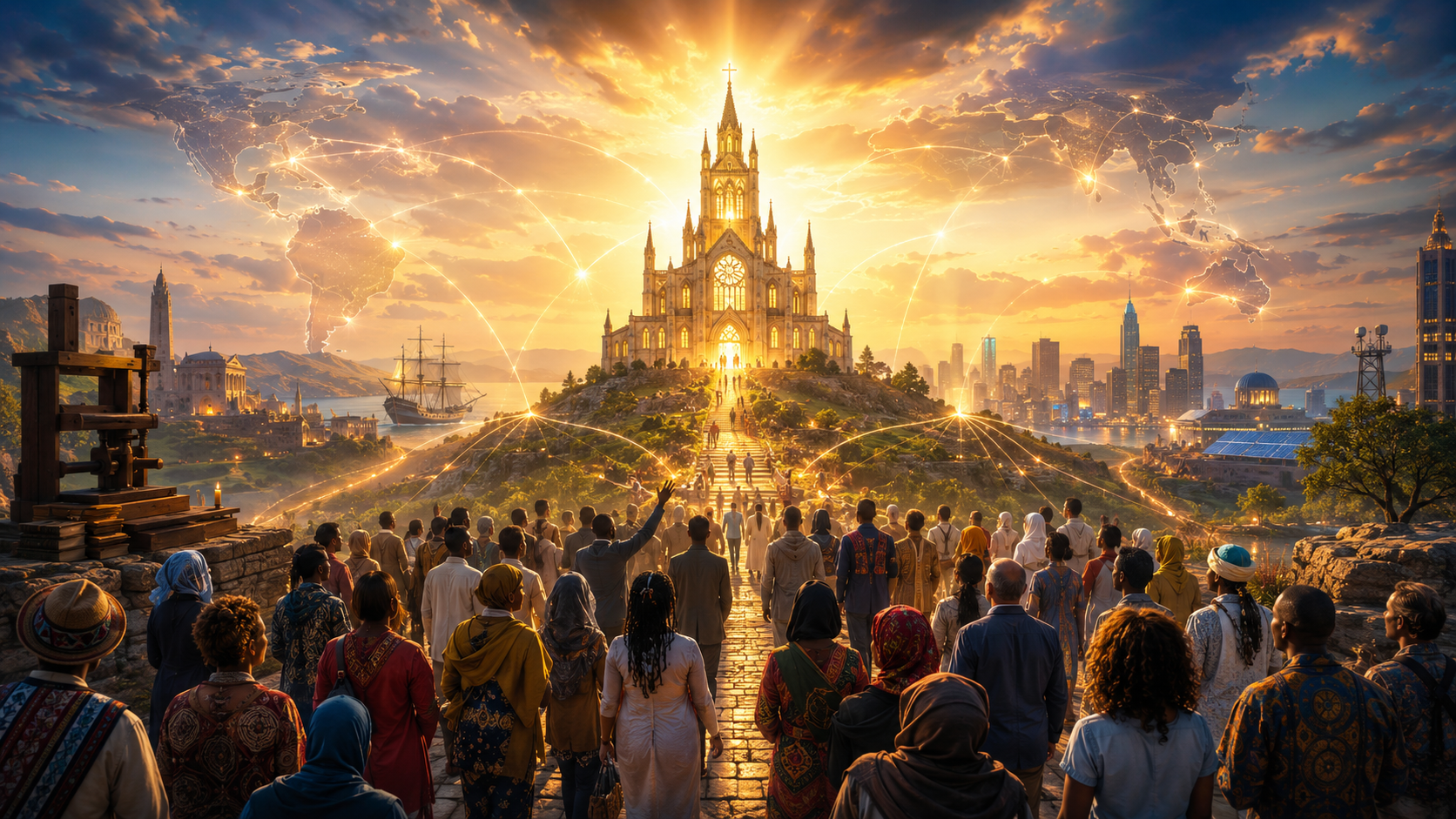
I Most people today think of the church as a place people go on Sundays — or don't go at all. A private matter. A cultural relic. Possibly irrelevant.
But history tells a different story. For much of the last two thousand years, communities of Christian faith were not retreating from the world — they were building it. Hospitals, universities, legal frameworks, literacy movements, and some of the most consequential social reforms in history trace their origins, at least in part, back to people motivated by a specific set of beliefs about what human life is worth and where history is heading.
This is worth examining — not as a defense of religion, but as a historical question. What gave these communities their energy? And why does so much of that energy seem absent today?
II Two Convictions That Shaped Everything
Historians of Christianity have long noted that the most transformative periods of church history tend to share two common threads. When these two convictions were held clearly and together, remarkable things happened. When they faded, so did the energy.
Conviction One
Every person has inestimable worth
The Christian doctrine of salvation — that every human being is loved by God and can be restored — carries a radical implication: no one is expendable. This drove early Christians into plague zones when others fled, and later drove abolitionists, educators, and hospital founders into action.
"In him was life, and that life was the light of all mankind." — John 1:4
Conviction Two
History is going somewhere
The belief that God's kingdom is coming — that justice will ultimately prevail, that the arc of history bends toward restoration — gave Christians an unusual combination: urgency without despair. They built institutions not just for today, but for generations they would never meet.
"Your kingdom come, your will be done, on earth as it is in heaven." — Matt. 6:10
Together, these convictions answered two of the most paralyzing questions any reformer faces: Does the individual matter enough to sacrifice for? And is there any point, given how broken everything seems? Christian faith, at its most vital, answered both with a clear yes.
III Five Moments When the Church Moved History
The historical record is not uniformly flattering to institutional Christianity — there are chapters of violence, corruption, and hypocrisy that deserve full accounting. But alongside those chapters are others that are rarely taught with the same emphasis.
1455 · The First Information Revolution
Gutenberg's Press — and Why It Spread So Fast
Before Gutenberg, every text in human history — on bone, papyrus, or parchment — was copied by hand. Johannes Gutenberg, a goldsmith by trade, developed movable type and in 1455 produced the first printed Bible. The technology shattered the monopoly on knowledge held by the literate elite. What is less often noted is why it spread so rapidly: demand was driven first and foremost by religious communities hungry to read Scripture themselves. The Reformation gave the printing press its mass market — and the printing press gave the Reformation its reach.
Luther called it "the greatest gift God has given to humanity." Between 1518–1525, his writings made up a third of all books sold in Germany.
1541 · Geneva
Calvin's Experiment — A City Reorganized Around Shared Responsibility
When John Calvin returned to Geneva, he drafted the Ecclesiastical Ordinances — a document that reorganized civic and church life around four functions: preaching, education, community oversight, and care for the poor and sick. Hospitals were administered by deacons. Schools were mandatory. The model was neither theocracy nor democracy in any modern sense, but it embedded a principle that proved durable: institutions exist to serve people, not to protect themselves. John Knox, who studied there, called it "the most perfect school of Christ since the days of the apostles." The model spread across Europe and left deep marks on constitutional thinking in Scotland, the Netherlands, and eventually America.
Calvin's Geneva Academy (1559) trained Europe's first generation of Protestant missionaries and educators — later becoming the University of Geneva.
1620s · The New World
The Puritans — Refugees Who Built a Civilization
The Puritans were religious refugees. Driven out of England for refusing to conform to the established church, they crossed the Atlantic not simply to survive, but to build something. Before landing, John Winthrop preached what became one of the most quoted sermons in American history: a call to mutual accountability, shared sacrifice, and the idea that their community would be watched by the world. In a colony where fewer than 30% of people in England could read, they legislated universal education — because each person must be able to read and think for themselves. They drafted America's first written constitution in 1639.
1636–1769 · The Ivy League's Origins
Harvard, Yale, Princeton — Founded to Serve Society, Not Just the Church
The Puritans founded Harvard in 1636 with a stated fear: that when their current ministers died, the church — and the colony — would be left without educated leadership. The mission was explicitly civic as well as religious. Yale's 1701 founding charter aimed to prepare students "for public employment both in Church and Civil State." Eight of the nine colonial colleges were founded by Christians motivated by revival movements. Harvard's early motto: Veritas Christo et Ecclesiae — Truth for Christ and the Church. These institutions, among the most influential in the world today, began as acts of faith in the future.
"Every student shall consider the main end of his life and studies to be to know God." — Harvard's founding rules, 1636
1730s–1740s · The Great Awakening
A Revival That United a Nation Before It Existed
The Great Awakening was a wave of religious revival that crossed denominational and colonial lines in ways that little else had. Benjamin Franklin — a skeptic who admired its effects — wrote that it seemed "as if all the world were growing religious — one could not walk through the town in an evening without hearing psalms sung in every street." Historians have argued that the Awakening did something politically significant: it gave thirteen very different colonies a shared emotional and moral vocabulary, one that proved essential when they needed to act together. Princeton, Brown, and Dartmouth were all founded in its aftermath. Revival generated institutions.
IV Why Does So Little of This Seem Visible Today?
If the church once founded universities, abolished slavery, built the first public hospitals, and drove some of the most significant literacy movements in history — why does it so often feel, today, like a spent force? Why do so many people inside and outside the church sense that something has gone quiet?
Part of the answer may be structural: the institutions the church founded have largely become independent, which is not itself a bad thing. But part of it may be something deeper — a loss of the two convictions that once made those institutions possible in the first place.
When a community loses its belief that every person has irreducible worth, and its sense that history is heading somewhere meaningful, it tends to turn inward. It manages itself. It performs its rituals. It stops initiating.
The most consequential Christian communities in history were not the ones most focused on their own survival. They were the ones most convinced that the world — the whole world, all nations — was their concern.
V All Nations as the Center
The verse from Ephesians that opens this essay describes the church as "the fullness of him who fills everything in every way." Whatever one makes of the theology, the vision is striking: a community defined not by its own boundaries, but by the scope of its concern. Everything. Every way. All nations.
That is a very different self-understanding from a club, a cultural tradition, or a heritage site. It is the self-understanding of a community that believes it exists for the world — not to dominate it, but to serve it, build it, and fill it with something it cannot generate on its own.
The historical record suggests this vision, when genuinely held, produces remarkable things. The question for any generation of Christians is whether they hold it — or whether they have settled for something smaller.
History does not wait. And the communities that shaped it most were the ones who believed they had something urgent to offer — not just to themselves, but to everyone.
"And God placed all things under his feet
and appointed him to be head over everything for the church,
which is his body,
the fullness of him who fills
everything in every way."
Ephesians 1:22–23