When the World Crushes You — and Why Some People Don't Break
On suffering, sacrifice, and the one difference that changes everything
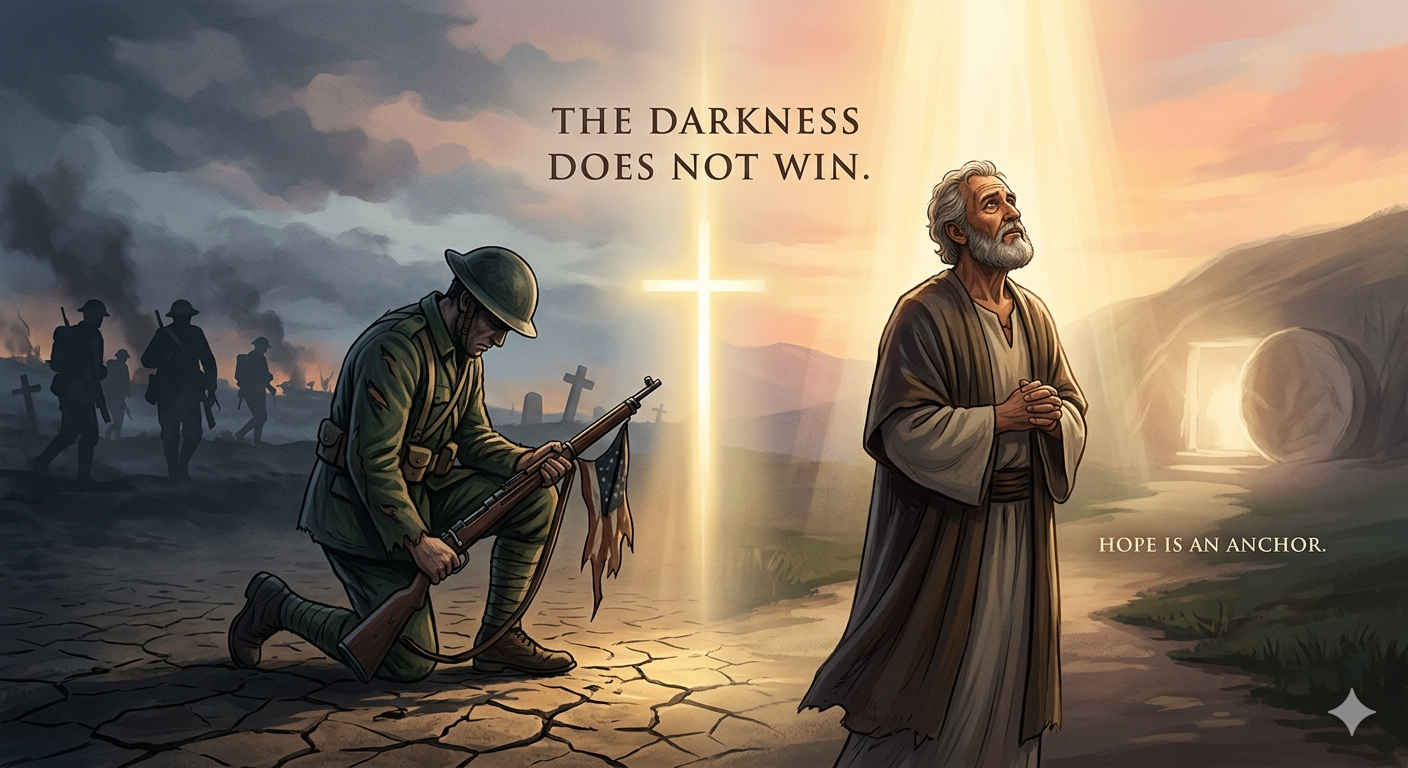
We have all watched people walk into fire.
Soldiers who threw themselves on grenades to save their squadmates. Mothers who gave up everything for children who never thanked them. Activists who went to prison for a cause they believed in. Apostles who were crucified upside-down and called it an honor.
From the outside, it all looks the same: someone chose suffering when they didn't have to. We call them heroes. We build monuments. We tell their stories.
But here is the question no monument ever answers: what were they holding onto, in the moment before the end?
Peter knew fear. He also knew something else.
The Apostle Peter was told, plainly, how he would die. Not in vague terms — Jesus told him directly that when he was old, someone would take him where he did not want to go (John 21:18). He would be martyred. It was a prophecy, not a metaphor.
And Peter was grieved by it. Don't let stained glass windows fool you — this was a man who once wept bitterly in a courtyard because his fear made him deny the person he loved most. He understood what suffering costs. He was not numb to it.
Yet he went. And tradition tells us he was crucified upside-down in Rome, insisting he was not worthy to die in the same position as his Lord.
"Since Christ suffered in his body, arm yourselves also with the same attitude."
— 1 Peter 4:1
Notice what Peter calls it: an attitude. Not a technique. Not a strategy. Not bravado. He is not saying be tougher than pain. He is saying: carry the same orientation toward death that Jesus carried — which was not the absence of grief, but the presence of something that transcended it.
The soldier and the saint: two kinds of courage
Now here is where it gets important — and where the world may misread what Christians are actually claiming.
The Soldier's Courage
Dies for something greater than himself — country, comrades, a cause worth more than one life.
Faces death knowing his sacrifice may not be remembered, may not change anything, may simply be swallowed by history.
The meaning he chooses is real. The courage is genuine. The love is true.
But the story ends at the grave. He gives everything — and then there is nothing left to give, and no one left to give it to.
Peter's Courage
Dies for the same reasons — love, conviction, something beyond the self.
But Peter is not betting on history remembering him. He is betting on a resurrection he personally witnessed.
His grief is real. His fear is real. But he is not gripping life with both hands while walking toward death.
He is walking toward Someone he has already seen on the other side of death. That changes the math entirely.
This is not a claim that Peter was braver than soldiers. It is a claim about what he knew — or rather, what he had seen.
Every human being who chooses suffering for love is doing something genuinely noble. Peter would not deny that. Christianity does not have a monopoly on courage or sacrifice. What it claims is something different: that Jesus Christ walked into death and came out the other side — and that this fact, if true, transforms what death means for everyone.
Do you have to suffer to be free from sin?
This is the question someone reading 1 Peter 4:1 might ask — and it deserves a careful answer, because it is easy to misread.
Peter is not saying: go find suffering so you can earn freedom from sin. He is not prescribing pain as a spiritual discipline. He is describing an orientation — a posture of the heart — that changes everything else.
When you are no longer gripping at comfort, safety, and self-preservation as your highest priorities — when you have placed those in God's hands and decided that obedience matters more than ease — then sin loses its most powerful leverage over you. Because most sin works by threatening you: if you don't take what you want now, you'll never get it. If you don't protect yourself, no one will. If you tell the truth, you'll lose everything. A person who has, in their soul, already died to those threats, cannot be controlled by them.
This is also what Paul means in Romans 6 — dead to sin, alive to God. It is the same truth from a different angle. The death is not something you manufacture through willpower. It is something you receive through union with Christ — through trusting that His death and resurrection have already changed your fundamental status before God.
And 1 Peter 4:6 carries this further: "judged in the body as men judge, but living by the Spirit as God wills." In the world's eyes, the suffering Christian looks like a loser — someone who could have avoided pain and chose not to, which makes no sense. But in the Spirit, they are the most alive people in the room. They are not controlled by what they might lose.
Where is the hope?
Maybe you've read this far and you're not a Christian. You never planned to be.
But you know what it feels like when something breaks — the end of something you built, the loss of someone you loved, or that quiet, nameless feeling that no matter how hard you hold on, things still slip through your hands.
When Peter wrote this letter, his readers were losing everything — their safety, their belonging, in some cases their lives. He didn't tell them to think positively. He didn't tell them the pain wasn't real. He told them something else entirely: there is a man who walked through death and came out the other side.
This is not a message that asks you to forget your suffering. It is a message that says — your suffering is not the end.
Jesus did not go around pain. In the garden, he sweated blood. On the cross, he cried out, "My God, my God, why have you forsaken me?" He went further into darkness than any of us have gone. And then he rose.
If that is true — even if you're not sure yet, even if you're only at "maybe it's true" — then it means this: nothing you have lost is the final word. Nothing that has broken you gets to define you forever. The darkness does not win.
The light shines in the darkness, and the darkness has not overcome it.
— John 1:5
Hope is not optimism. It is not telling yourself things will work out. Hope is an anchor — fixed to something more real and more permanent than your circumstances. It holds even when you can't feel it holding.
Peter faced death afraid and grieving. He didn't pretend otherwise. But he had something no empire could take from him — he had seen the risen Lord with his own eyes.
You can see Him too. Not because you already believe, but because He is already looking for you.