A Tribute to His Teacher: Liszt’s Transcendental Études
Some dedications express gratitude. Others preserve a connection across time. Franz Liszt’s (1811–1886) dedication of his Transcendental Études to Carl Czerny may have done both.
Liszt dedicated the 1837 version of the études to his former teacher, and he retained the dedication when he published a substantially revised version in 1852. The music changed, but Czerny’s name remained on the title page. What did Liszt wish to acknowledge through this lasting tribute?

From Student to Virtuoso
Liszt studied with Czerny in Vienna as a child. A former student of Ludwig van Beethoven, Czerny was an accomplished pianist, composer, and teacher. He recognized Liszt’s talent and helped him develop the technical foundation that would support his remarkable career.
The Transcendental Études are among the most demanding works in the piano repertoire. Their rapid passages, sweeping leaps, and powerful chords showcase Liszt’s extraordinary technique and imagination, turning technical challenges into expressive music.
The video above features No. 11, Harmonies du soir (Evening Harmonies), one of the most lyrical pieces in the collection.
Compared with the exceptionally demanding 1837 version, Liszt’s 1852 revision made some passages more manageable while refining the musical expression. The études nevertheless remained among the most challenging works in the piano repertoire.
Compared with the exceptionally demanding 1837 version, Liszt’s 1852 revision made some passages more manageable while refining the music’s expression. Even so, the études remained among the most challenging works in the piano repertoire.
What a Teacher Leaves Behind
Czerny gave Liszt a strong foundation, but Liszt eventually developed a musical voice of his own. His dedication to Czerny shows that independence and gratitude can go hand in hand.
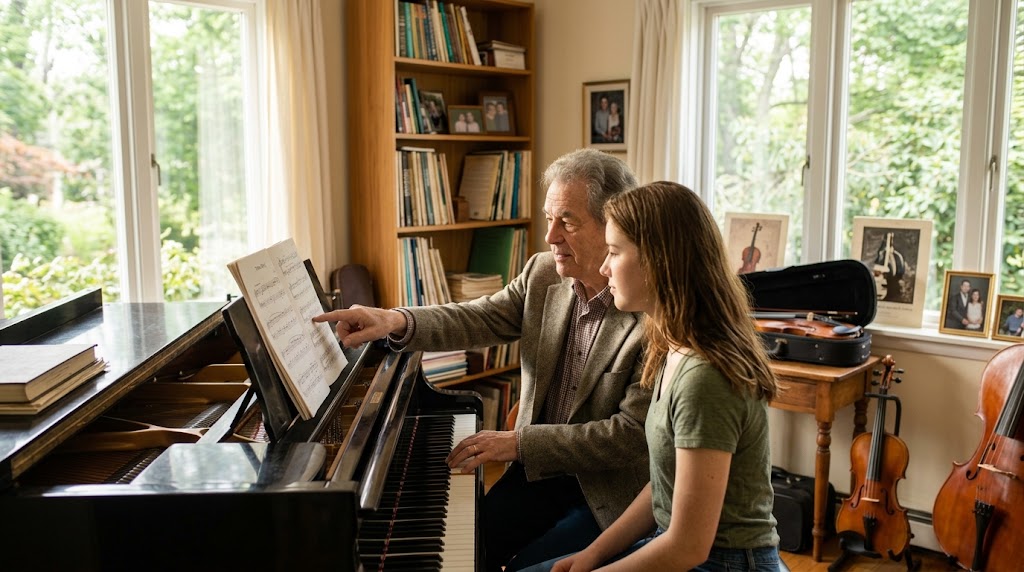
A teacher’s influence may live on in the way a student approaches challenges, develops new skills, or gains the confidence to explore. The goal is not to create a copy of the teacher, but to help each student grow independently.
This extends beyond music. Teachers and mentors often shape us in ways we carry into our work and relationships. In time, we may pass their guidance on to others.
Learning and Growing
“The student is not above the teacher, but everyone who is fully trained will be like their teacher.” — Luke 6:40
Jesus is speaking here about discipleship and the formative relationship between teacher and learner. Applied more broadly, his words invite us to reflect on how teaching shapes not only what we know, but also how we think and act.
We may never know how far our influence will reach. But the patience, knowledge, and encouragement we offer can continue to shape others long after the original lesson has ended.
Explore Liszt’s complete Transcendental Études here. (affiliate link)
Read previous: When One Musician Honors Another: Chopin’s Études, Op. 10