'Legends of the Lost Ark' Fathom Event an Exploration into Solving One of History's Most Enduring Mysteries
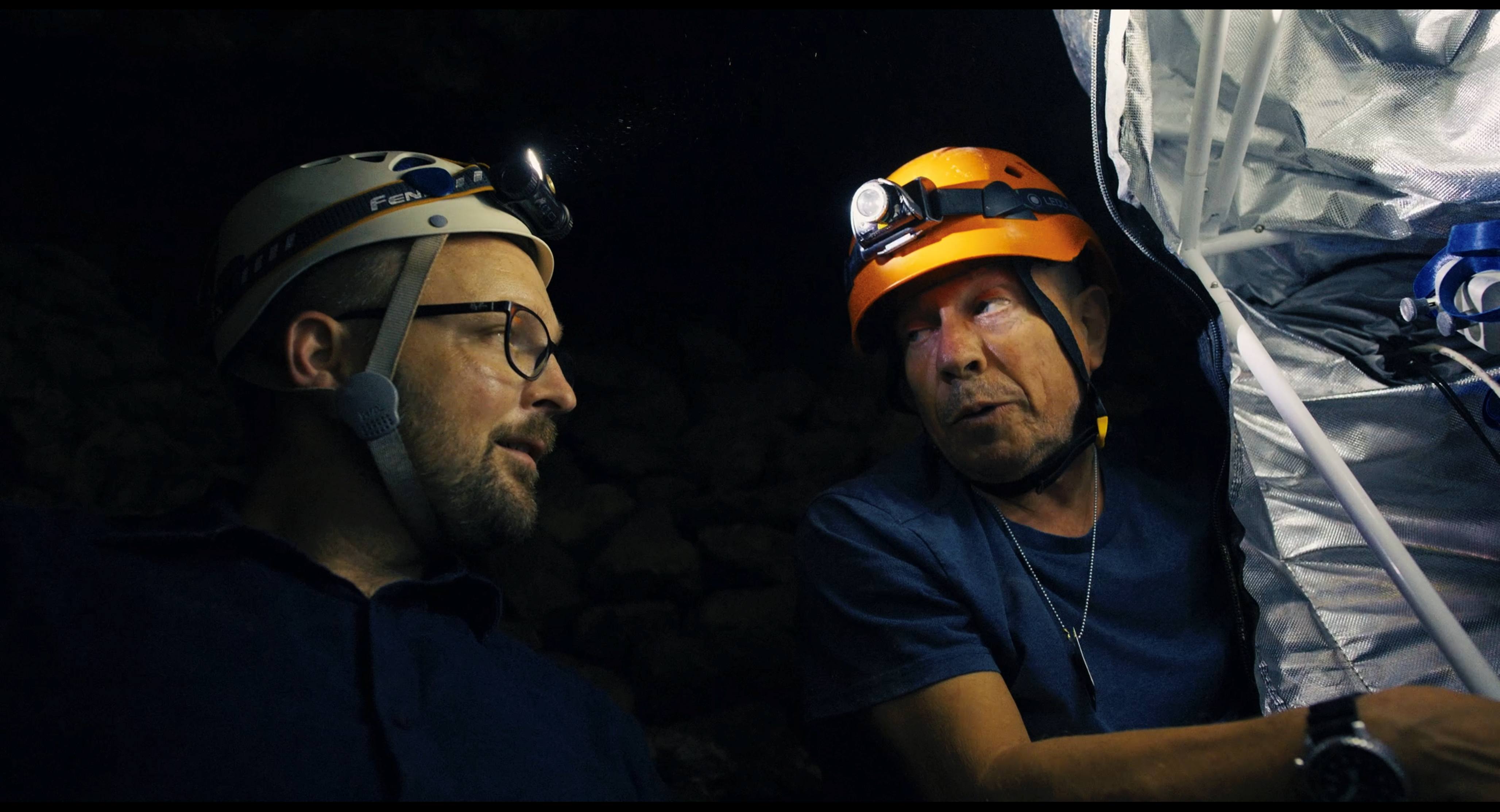 Dr. Chris Mckinney in 'Legends of the Lost Ark'. Photo image courtesy Fathom Entertainment.
NASHVILLE - For so many, the mere thought of what the Ark of the Covenant is and represents, naturally draws people to images of Indiana Jones, dusty, decaying crypts, and an unbridled desire to own a valuable relic from long ago.
But what exactly does this relic represent?
Dr. Chris McKinney, a Lipscomb University professor, has devoted his adult life to pursuing Biblical archeology. Paramount to his research has been uncovering new evidence in the ongoing quest for the Ark of the Covenant’s whereabouts. It is his contention that the answer to one of history’s most enduring mysteries is closer than we think.
Blending scholarship with cinematic storytelling, Dr. Mckinney hosts a new Fathom Movie event, Legends of the Lost Ark, a cinematic experience that takes audiences on a fascinating journey through ancient history, Biblical tradition, and modern-day exploration, all rooted in the enduring legend of the Ark of the Covenant.
Available in theaters April 12th, 14th and 15th, Legends of the Lost Ark is a global investigation that at times feels like a Raiders of the Lost Ark movie, grounded not in fiction but historical inquiry instead.
I recently sat down with Dr. McKinney to discuss the Ark of the Covenant’s origins, significance, and why this big-screen experience matters to modern day audiences.
This is a topic that's fascinating to so many people, but for you to be passionate enough to chase this as a filmmaker, to make a movie about this, there had to be something leading up to it. Please share a little bit about your background and what led you to want to make this film?
I've always been interested in the history of the world and the Bible. I grew up in the Church. My granddad was a pastor. I remember being on many tractor combine rides, sitting there and listening to him tell stories about Israel. And I was able to go to Israel as a teenager back in the late 1990s. I wrote in my freshman year in high school that I wanted to be a Biblical archeologist. I remember doing it and I remember seeing it at some point. And then everything I've done as an adult is in pursuit of Biblical archeology. That sort of led to all of this.
It's always been my passion. But a few years ago, I had an interview request right in the middle of COVID to come and interview for a film about a related subject. And we hit it off. And in this process, as we're working on this film and very the difficult circumstances of COVID, and the events of October 7th in Israel, we finally coalesced onto this topic of the Ark. I'd say I never really set out to do a film or even a deep study on the Ark. The more we focused on it, the more we realized that this is a story that hasn't really been told before, that needs to be delved into, and closely looked at.
The film takes audiences on a global investigation into one of history’s greatest unsolved mysteries: the fate of the Ark of the Covenant. Why was it so important to you to capture this search and turn it into a documentary?
The fate of the world's most significant object is relevant to any topic. I think that part of the process is if we were making this film a different film, we would need to shift to this. And the more you study, the more you realize not only is this worth my investigation alone in trying to figure out what these stories mean, but this object is really at the root of society. What is the Ark of the Covenant? What is an ark? We don't use that word today. It's a chest that has the 10 Commandments inside. So, it’s pretty important.
If you go into a synagogue today, they have a Torah ark shrine in every synagogue that is the same embodiment of this idea. And so, all of these concepts of Christianity and Judaism are still present with us. Therefore, it’s worth our investigation of not only what things have we kept in our faith communities, but also what did the loss of the Ark mean for people living it? What part of the story does the Ark tap into? As my investigation went on, it became clear that, if you were to boil the Ark of the Covenant down as a story, if you were to boil down the entire story of the Bible, and you were going to try to tell a story through one object, the only object that you could tell the story through is the Ark.
This film blends historical research, on-location exploration, and theological reflection. How did you work with the filmmakers to ensure the mystery of the Ark was presented responsibly and accurately?
It's a great question, and I would answer it with two points. One is to understand that everything that exists has a cultural background. We're speaking English right now. In Sinai, they were speaking a Semitic language, Hebrew. We accept that the Bible was written in Hebrew and Greek, which has cultural ideas. I would say that the accuracy of the Ark that we had, that's completely new, based on archeological evidence, is based on a cultural representation through archeology, and through ancient Egypt, where they have these same types of objects. And so, we have this high level of expertise, but also diligence in trying to present it in as accurate a way as possible.
And the second point is, I think that it's actually incredibly important that God has invested Himself into humanity. He not only created us to live in this world and culture, but in the New Testament, He incarnates as culture. Jesus comes to earth and becomes a man. I like to think of the story of the Ark as the incarnation of the Old Testament, where God comes with us into this fallen world. The cherubim we find in Genesis, we find them again in Sinai. And He takes on the flesh of the tabernacle and resides among his people. John 1 for instance, uses the same imagery when Jesus takes on flesh. It echoes Exodus 40, where God takes up residence in the ark and dwells among them. It's explicit. So, I would say the accuracy of the Ark, the accuracy of the story, and reading it well, is the number one thing I'm aiming for.
Beyond its physical existence, what did the Ark represent to the ancient Israelites — politically, spiritually, and culturally?
It has two functions. The one function is one that we know pretty well. It was a container, that's what an ark is. It's a chest. It has the 10 Commandments inside. And depending on how you understand it, it also has the urn of the manna and Aaron's staff, whether that's inside or connected with it, we leave for now. But the other function, which is the more important one, is it’s a throne. The Ark itself is the throne of God. This is described in the Biblical text as Yahweh, who is enthroned above cherubim. And so this concept of the inexpressible, because you're not supposed to make them into an idol residing in either invisibility or in the form of the pillar of fire, in the pillar of cloud, like in the burning bush, it is set to reside on this throne. And it's this thing that keeps coming back.
For instance, in Isaiah 6, when Isaiah comes into the temple, he sees the hymn of the robe of the Lord, who's sitting on His throne. And the serif comes out; that's in the Holy of Holies in Solomon's temple. He's looking at the Ark and the hem of God's robe. There is this context that fits in with the ancient world in which the gods have thrones and they have idols. And yet Israel's God has a throne, but He's real, and He's not something that you make depictions of. So, it's taking a concept that's consistent, but also showing the distinction between this God and all the others.
The documentary seems to walk a careful line between faith tradition and historical inquiry. How does it navigate that tension, and why was that balance important to you?
It in some ways is the fundamental problem in archeology. It's the fundamental problem of this film. You have the problem on the one hand of how do you take something that's so big as the whole story of the Bible, and you have so many ideas about what it might mean, and only talk about the stuff that we can know that's nuanced and built upon archeology, as well as our interpretation of the Bible. How do you have nuance while also being entertaining? And so, what we've come up with is epic academia. That is, trying to walk that line where we are true to the facts of science, of archeology, as far as we know, while also being open to telling the story the way the Biblical text is meant to be presented. And I think the beauty of it is in putting those two things together. Too often we have films or ideas about the ancient world, which are not based on anything except people's ideas. And we also have scholars who live in ivory towers that don't want to present the information. And so we're trying to walk that line.
After audiences have a chance to see Legends of the Lost Ark what would you like them to take away from the viewing experience? What is your greatest hope for the film?
My greatest hope is that people start to understand that this is not just a film or an idea that's happened in the past. This is their story. Paul writes in First Corinthians 10, to the gentile Christians in Corinth, people whose lore is Poseidon, Zeus, and the Greek world of, of Mythology. He says to them that Moses went through the sea and the Israelites passed through the sea. And these things were written for you if you are a Christian or Jewish, or even if you're just someone who's in the West. The traditions that we have in the Bible, ultimately, are the most important part of how we are where we are. And if you are a person of faith, seeing yourselves as the continuation of that story, right there with Israel, or in the destruction, or right there with Jesus, who talked about the coming destruction, it's all part of the same story. And as humans, we have built inside of us to be part of this meta narrative. It's not something that's just biological, it's something built into us by God. And the Ark, as I said, is that one object that can tie the whole story together.
WATCH A TRAILER FOR LEGENDS OF THE LOST ARK: