Reformation Day: Martin Luther’s Conversion
By Elizabeth Prata
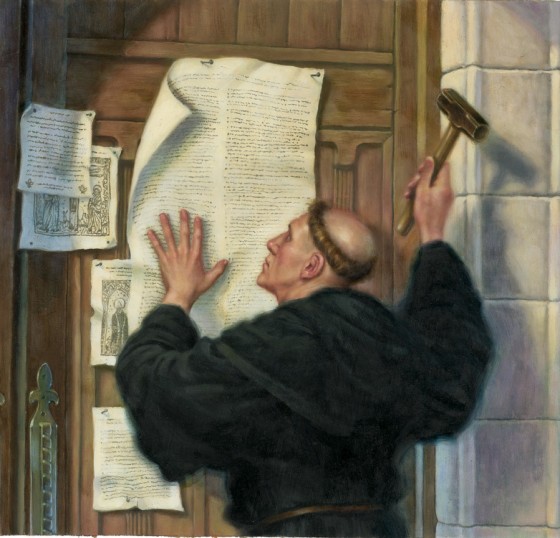
It’s Reformation Day! The famous day in 1517 when monk Martin Luther nailed his 95 theses titled “Disputation on the Power and Efficacy of Indulgences” to the church door at Wittenberg Germany. Initially Luther was not seeking to break with the Catholic Church, he just wanted some answers about Indulgences.
Indulgences were (and still are) a sale of indulgences because he believed highly commercialized system of salvation that funded both local church debt and major papal construction projects. If a person paid money and had confessed their sin to a priest for forgiveness, the money was a surety that the person’s time spent in purgatory would be eased or entirely wiped out. Martin Luther objected to indulgences on three fronts:
-they turned salvation into a commercial transaction,
-they undermined true repentance, and
-indulgences preyed on the poor.
The money gained from this transaction paid for church repairs and the building of St. Peter’s Basilica.
The Roman Catholic Church (RCC) used people as salesmen to gain more from indulgences. One such was Dominican friar Johann Tetzel, who was aggressive in marketing tactics. These tactics deeply disturbed Luther. Tetzel, like any salesman, famously used advertising slogans to especially target grieving relatives who were worried about the finals state of their loved one. In RCC dogma, one can never be sure where a deceased person lands, heaven? Hell? Or purgatory (which doesn’t exist). Tetzel allegedly made up the slogan: “As soon as the coin in the coffer rings, the soul from purgatory springs.”
As Luther tangled with the Church and eventually the Pope, he never received the answers he sought Tired of Luther poking holes in their dogma, the Pope excommunicated Luther.
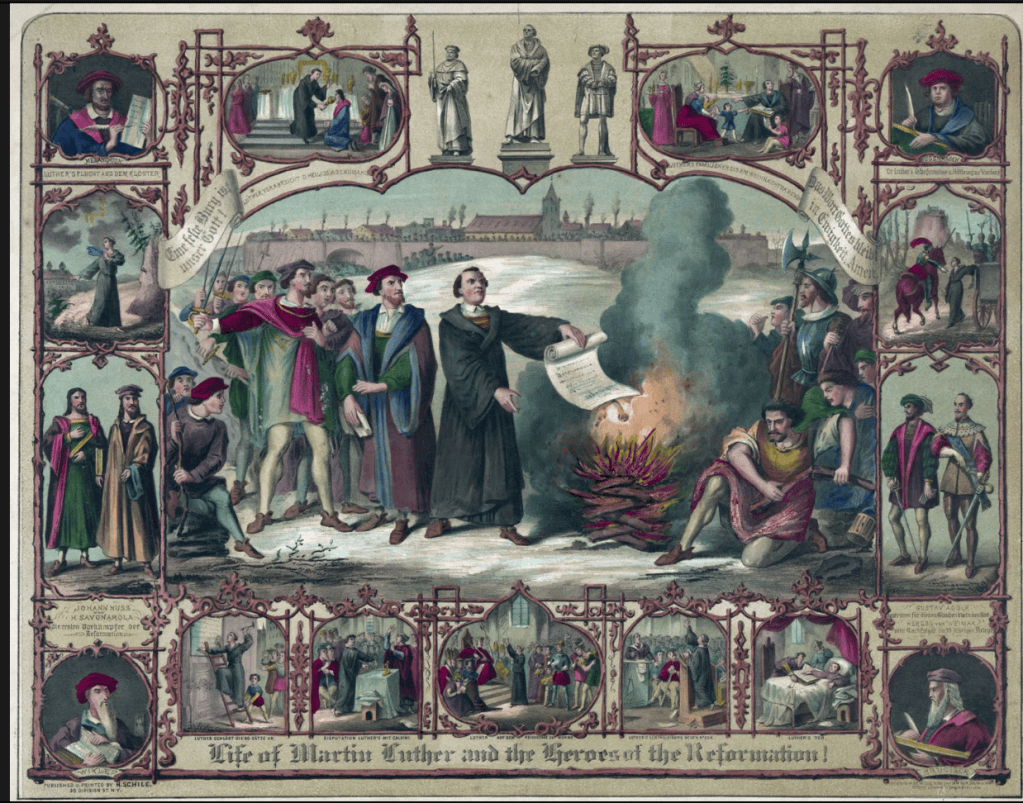
What happened on Reformation Day?
Ligonier.org writes: On October 31, much of the culture will be focused on candy and things that go bump in the night. Protestants, however, have something far more significant to celebrate on October 31. It’s Reformation Day, which commemorates what was perhaps the greatest move of God’s Spirit since the days of the Apostles. But what is the significance of Reformation Day, and how should we consider the events it commemorates?
At the time, few would have suspected that the sound of a hammer striking the castle church door in Wittenberg, Germany, would soon be heard around the world and lead ultimately to the greatest transformation of Western society since the apostles first preached the Gospel throughout the Roman empire. Martin Luther’s nailing of his Ninety-Five Theses to the church door on October 31, 1517, provoked a debate that culminated finally in what we now call the Protestant Reformation.
At the same time, Luther was becoming increasingly aware of his own sin. This is a grace of God, a working of the Spirit’s ministrations in a person’s soul. Normally, people are not that aware of their sin. The entire earth is sin, do the fish know they are wet? Do the birds know they fly in air? Our sin is similarly all around us and in us, we only begin to feel the weight of it when Jesus presses upon our conscience that we are actually in opposition to God. We no longer swim with the current but feel the current against us and begin to resist its push. This is a painful and tormenting time for a soul that is in agony.
Horatius Bonar wrote about Martin Luther’s conversion. The short treatment of the subject is here at Chapel Library. The first paragraphs are excerpted for you below-
Luther’s Conversion By Horatius Bonar
When first awakened to a sense of sin, Luther became unspeakably troubled. Once and again deep anguish took hold of his soul, and it seemed as if he would sink under it. On one occasion he had been conversing with a friend upon the things of God. No sooner had the conversation ended, than the truths of which they had been speaking struck home with awful power to the tossed soul of Luther. He left the room and sought the nearest chamber to give vent to the feelings of his bursting heart. He threw himself upon the bed and prayed aloud in agony; repeating over and over again these words of the apostle, “He hath shut them all up in unbelief, that He might have mercy upon all” (Rom. 11:32).
Luther now began to try to make himself holy. He fasted for days together. He shut himself up alone in his cold cell. He passed many nights, sometimes for weeks, without sleep. He read, he studied, he prayed, he wept, he watched, he strove, but all in vain! He found himself as far from holiness and peace as ever! If ever anyone could have gained heaven by his own merits, Luther would have gained it.
To those around him, he seemed the holiest man alive. But the light of the law showed him that within all was vile. His soul cried out for rest, but he found it not, for he was seeking it not in God’s way, but in a way of his own. He wanted to be sure that his sins were forgiven him, for he felt that until he knew this, he could not have peace.
But his fear increased upon him, and he knew not what to do, nor which way to turn. He saw everything that he thought and did to be sin, and how could he rest until he knew that all was forgiven! His friends told him to do good works and that would satisfy the justice of God. Miserable comforters! –end Bonar excerpt
Read the rest at Chapel Library. Jesus did not leave us without hope. If you are wrestling with your sin, appeal to Jesus for forgiveness. You see that the layers the RCC wrongfully added to our access to Him are stripped away in the true faith. Yu do not need to go through a priest, to pay money, to listen to a Pope, or pray to Mary as a buffer. Go directly to Jesus! Hebrews 4:16 says,
Therefore let’s approach the throne of grace with confidence, so that we may receive mercy and find grace for help at the time of our need.
that if you confess with your mouth Jesus as Lord, and believe in your heart that God raised Him from the dead, you will be saved; (Romans 10:9).
Mercy and grace await you! Confess your sins and He in no way will cast you out,
Everything that the Father gives Me will come to Me, and the one who comes to Me I certainly will not cast out. (John 6:37).
He is a true and faithful God, He loves His own. Even though Martin Luther had spent half his life serving the devil as a Catholic, Jesus forgave him of his sins and accepted him into the faith, AND used Luther to spark a global reformation to bring truth to millions. He will forgive you as well.
If you are already a Christian, confess and repent frequently, because we still sin. Honor and glorify Jesus our Savior and He will use you to further His plan and desires. Thanks to Martin Luther’s agony over sin, his questions, and his unshakeable standing on the truth, we are free of Roman Catholic dogma and free to go directly to Jesus on His throne. What an unutterable privilege!