Why Repetition Matters: The Brain and Musical Practice — Paganini’s Caprice No. 24 in A Minor
Have you ever struggled with the same few measures, hoping your fingers would finally cooperate? With practice, awkward movements gradually become easier, and the passage begins to feel natural.
This change is partly due to neuroplasticity—the brain’s ability to adapt through experience and learning. Practice helps the brain develop more efficient ways to coordinate the movements involved in playing music.

How Repetition Changes the Brain
Learning a new piece requires us to read notes, recognize rhythms, coordinate movements, and listen carefully. At first, these tasks demand considerable attention.
This process is part of motor learning—the development of physical skills through practice. It is also related to procedural memory, which helps us remember how to perform familiar actions.
Think about riding a bicycle, driving a car, or typing on a keyboard. Once learned, these activities require less conscious attention to each movement. Playing a familiar musical passage can become similar.
Paganini’s Caprice No. 24: The Challenge of Mastery
Niccolò Paganini (1782–1840) was an Italian violinist and composer known for his extraordinary virtuosity. A caprice is a short instrumental piece that often showcases technical skill. His Caprice No. 24 in A Minor, the last of his 24 solo violin caprices, remains a major technical challenge for violinists.
The piece begins with a memorable theme, followed by eleven variations and a finale. Each variation reshapes the melody through changes in rhythm, speed, and technique. Listen for how the theme takes on new characters, revealing the expressive possibilities of a single musical idea.
Mastering this work demands both musical understanding and remarkable physical control. Violinists need strength, agility, and precise coordination, much like athletes training for a demanding performance. Difficult passages require careful study and focused practice.
From Repetition to Muscle Memory
Musicians often say a passage has become part of their muscle memory. It can feel as though their fingers simply know where to go, without conscious thought about each movement.
But this does not mean the muscles themselves remember the notes. In this context, muscle memory describes how the brain and nervous system learn movement patterns through repetition. As these patterns become familiar, we can perform them more smoothly and with less conscious effort.
Still, muscle memory can work against us, too. Practicing a passage incorrectly can reinforce the wrong movements. When a passage feels difficult, musicians can break it into smaller sections, slow it down, and work on one problem at a time.
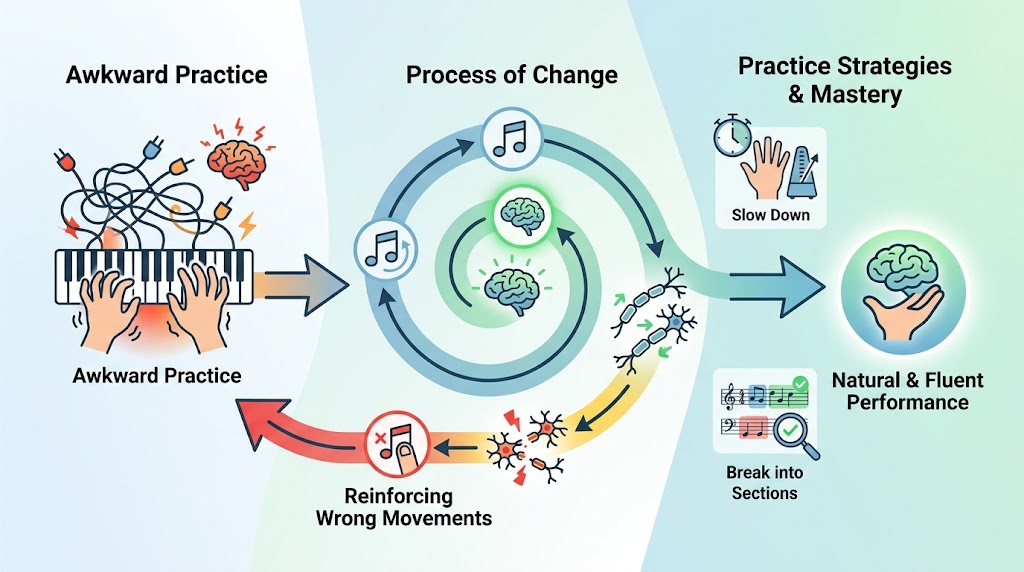
As each section becomes more secure, it can be connected to the next. This kind of focused practice helps musicians correct mistakes and build more accurate movements.
The Fruit of Patient Practice
“No discipline seems pleasant at the time, but painful. Later on, however, it produces a harvest of righteousness and peace for those who have been trained by it.” — Hebrews 12:11
Although this verse speaks of God’s discipline, it also offers a meaningful reflection for the practice room: growth takes patience, and its fruit may not appear right away.
A difficult passage may take weeks or even months to master. Progress can seem slow, but thoughtful practice and consistent effort help turn what once felt impossible into something natural.
In the next episode, we will explore how the brain anticipates what comes next in music—and why moments of expectation and surprise keep us listening.
Explore Paganini’s complete 24 Caprices for Solo Violin, Op. 1 here. (affiliate link)
Read previous: From Short-Term to Long-Term Memory: How Music Stays With Us — Fauré’s Dolly Suite, Op. 56