Calvin's Bare Room
I have a friend who sings like an angel.
Genuinely. The kind of voice that makes you stop mid-conversation. She grew up in a church that didn't allow instruments — no piano, no organ, no guitar. Just voices. When she first visited a service with a full band, she stood there looking slightly overwhelmed, like someone who'd walked into a room with too much furniture.
She could handle the singing. The rest of it felt like noise.
I've thought about her a lot while studying John Calvin.
Luther gave the congregation back its voice. That's where we ended last time. After centuries of trained choirs performing the Mass while ordinary people watched in silence, the Reformation handed the hymnal to the people in the pew and said: sing.
Calvin read all of this and said: good start. But let's go further.
Much further.
John Calvin arrived in Geneva in 1536 — just twelve years after that first Protestant hymnal rolled off the Wittenberg press. He was twenty-seven years old and had already written the Institutes of the Christian Religion. He hadn't planned to stay in Geneva at all — he was on his way to Strasbourg for a life of quiet scholarship. But a reformer named William Farel stopped him and, by Calvin's own account, pronounced something close to a curse on him if he left. Calvin stayed.
What he found wasn't quite what you might expect. The Reformation in Geneva had already been moving. Farel had led the city to officially abolish the Mass three months before Calvin arrived. Images had been pulled from the walls. Altars cleared.
But what replaced it was, to Calvin's eye, almost nothing. The demolition had happened. The reconstruction hadn't. He looked at the churches of Geneva the way a contractor looks at a house that's been gutted but never rebuilt — walls stripped, no one quite sure what to do next.
He had some ideas.
Calvin's guiding principle was what later scholars would call the regulative principle of worship: a church should only do in worship what Scripture explicitly commands. Luther's approach had been more permissive — if the Bible doesn't forbid something, it's probably fine. Calvin ran the logic in reverse. If the Bible doesn't authorize it, leave it out.
Applied to worship, this cleared out most of the accumulated tradition.
Organs: out. The instruments of the Psalms belonged to the ceremonial life of Israel, fulfilled in Christ. To bring them back was to reach backward into a shadow.
Choirs in vestments: out. Too much theater, too much spectacle, too much eye drawn toward human performance.
Images, statues, stained glass: out. The second commandment forbids making images for use in worship. Calvin took this with full seriousness.
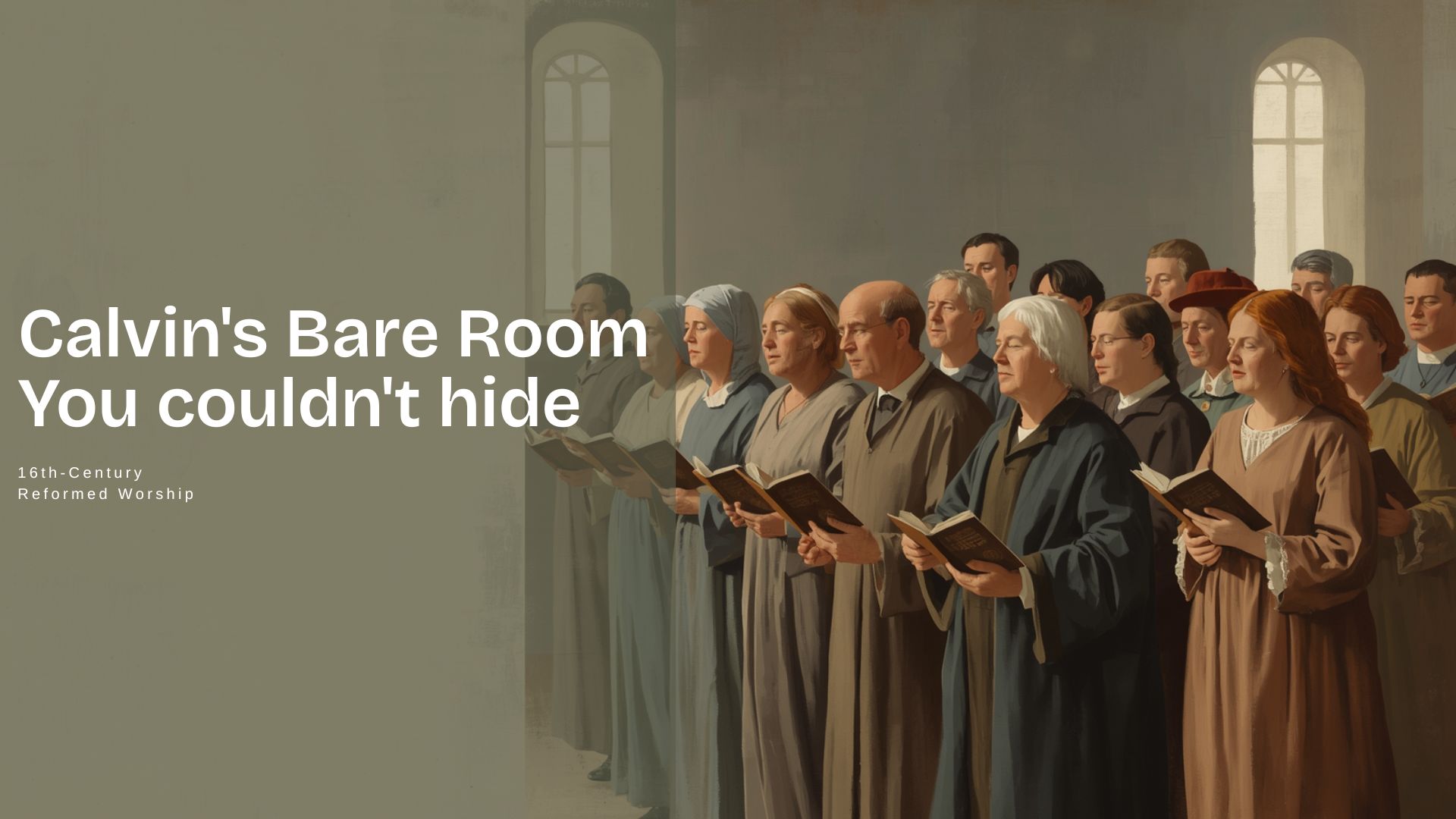
What was left? The Word, preached and read. Prayer. And the Psalms — sung by the entire congregation, in unison, without accompaniment.
Calvin didn't think singing was merely tolerable. He thought it was essential. In his preface to the Genevan Psalter — the collection of psalm settings he commissioned for congregational use — he wrote that singing "has great force and vigor to move and inflame the hearts of men to invoke and praise God with a more vehement and ardent zeal."
He wanted people to sing — that part is easy to miss. His point wasn't silence. But the singing had to be the Psalms: Scripture's own hymnbook, already God-given, already the prayer language of the church across thousands of years. And it had to be unison, without accompaniment — everyone on the same melody, no harmony pulling the ear in different directions, no organ filling the gaps. Just the congregation, the text, and the tune.
The Genevan Psalter set all 150 Psalms to singable melodies. Many were written or adapted by a composer named Louis Bourgeois, who apparently had a gift for tunes that stay in your head. Old Hundredth — the tune to "Praise God from whom all blessings flow," sung in churches around the world every week — is one of his. That's a long run for a melody written to serve Calvin's stripped-down vision.
I want to be honest about something.
There's a version of this story where Calvin is the villain — the man who sucked the beauty out of worship, who banned the organ and left the church in silence. That version has some truth. There were congregations in the Calvinist tradition where the logic of the regulative principle, pushed hard enough, became its own kind of emptiness.
But Calvin himself wasn't trying to empty the room. He was trying to clear out what he saw as human clutter so that God's voice could be heard — so that worship could be something received rather than produced. Strip away enough of the human invention, he believed, and what's left is the shape of a gift.
That distinction matters. The goal wasn't less. The goal was purer. Whether the tradeoff was worth it is one the Reformed tradition has been debating for four hundred years.
My friend eventually made peace with the band. She even learned to love it, some of it.
But she told me once that she still misses something from those unaccompanied services of her childhood. When everyone was singing the same melody, nothing added, nothing underneath — she could feel the congregation in a way she couldn't when the music was fuller. The voices were exposed. Yours included.
You couldn't hide.
Calvin might have called that the point.