Ethical AI and Transparency in Christian Music
Theological Integrity, Legal Responsibility, and Human-Centered Growth in the Generative Era
A Three-Part Industry White Paper Authority Publication
Prepared by the Devine Jamz Gospel Network Research Team | November 2026
Publication Note and Research Method
This series develops the themes and working analysis contained in the supplied extended white paper and video-integration notes. The source materials emphasize four ethical pillars: Transparency, Consent and Intellectual Property, Authenticity, and Economic Fairness. They also foreground the Christian understanding of worship, the importance of lived testimony, and the need to protect independent artists from deceptive promotion and artificial streaming activity.
External research was used to verify selected legal, platform, consumer, and market claims. Where a statistic comes from one platform or one survey, the scope is stated. Where a legal question depends on jurisdiction, contract language, facts, or evolving regulation, this publication offers general educational information rather than legal advice. Artists, labels, distributors, churches, and media organizations should obtain qualified legal guidance for specific decisions.
The series does not claim that every use of AI is unethical, nor does it treat all AI-assisted music as equivalent to fully synthetic music. It distinguishes routine technical assistance from generative contributions that materially shape lyrics, composition, vocals, artist identity, or the listener's understanding of who created and performed a work.
Executive Summary
AI and Transparency have become central questions for Christian and Gospel music as generative systems move from behind-the-scenes production tools into songwriting, vocal synthesis, artist branding, audience engagement, and distribution. The central issue is not whether technology belongs in music. Christian musicians have long used microphones, multitrack recording, synthesizers, digital workstations, pitch correction, and online distribution. The urgent question is whether creators and marketers use new tools in ways that preserve truthful attribution, consent, human dignity, spiritual integrity, and fair opportunity.
This three-part publication finds that responsible adoption requires more than a disclosure checkbox. It calls for a consistent framework that identifies material AI contributions, protects voice and likeness, documents human creative decisions, reviews theological content, and avoids artificial audience metrics. It also recommends a human-centered marketing model in which streaming and social platforms introduce music, while owned channels, live ministry, interviews, direct sales, and community relationships deepen the connection.
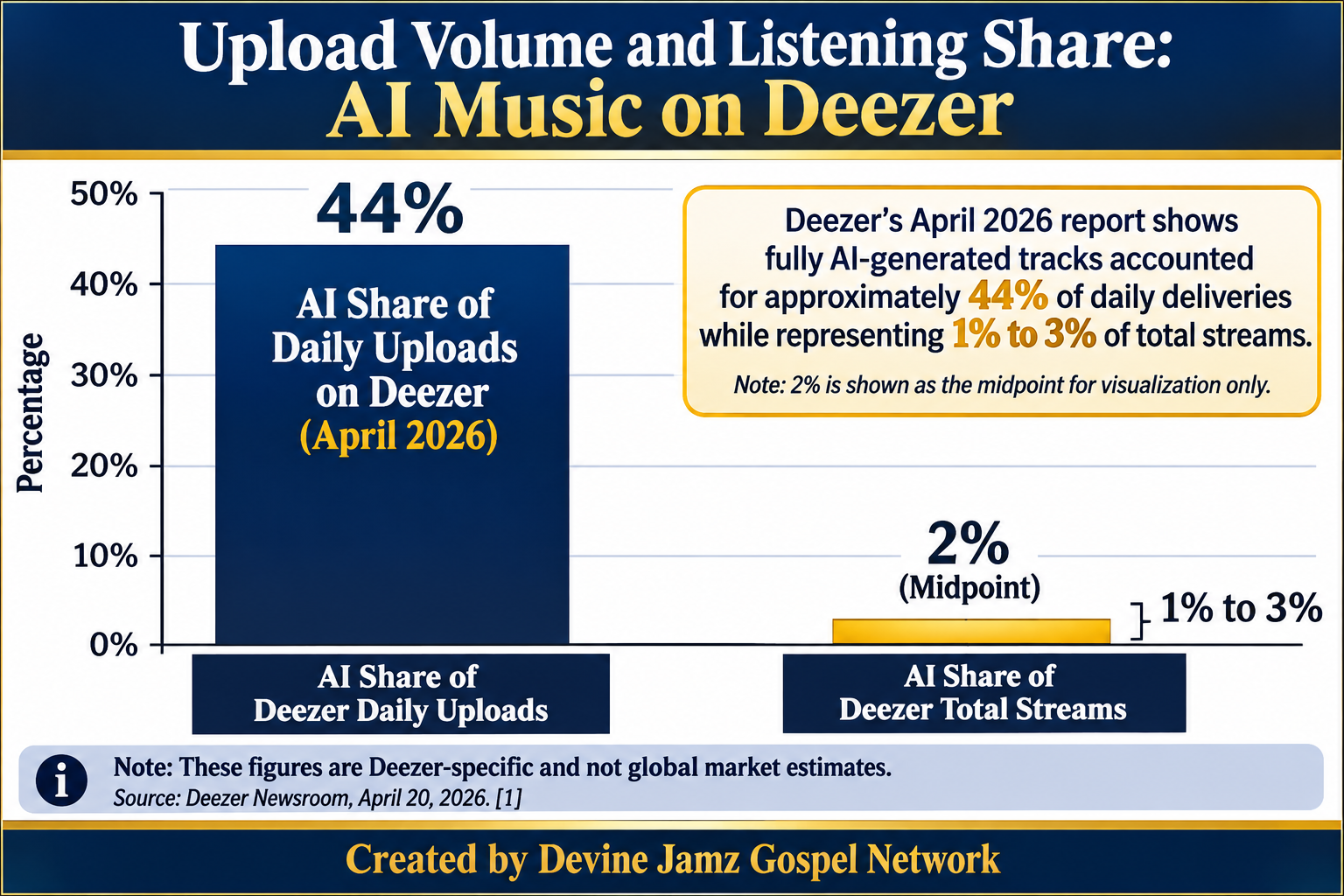
The market evidence is significant but must be interpreted carefully. Deezer reported in April 2026 that fully AI-generated tracks represented about 44% of its daily deliveries, while accounting for only 1% to 3% of total streams on that service. Deezer also reported that up to 85% of streams on fully AI-generated tracks in 2025 were detected as fraudulent and demonetized. These figures describe Deezer's platform and detection methods, not the entire global market. [1] IFPI's 2023 consumer study found that 79% of surveyed music fans believed human creativity remained essential, while 74% opposed unauthorized AI cloning or impersonation of artists. [2]
For Christian music, the stakes extend beyond revenue. Songs may carry testimony, grief, healing, prayer, identity, and pastoral encouragement. A synthetic voice can reproduce a sound, but it cannot truthfully claim a human biography or personal encounter with God. The industry should therefore distinguish the use of an assistive tool from the representation of a synthetic persona as a living witness.
The practical conclusion is clear: use technology where it strengthens human work, disclose material generative contributions, obtain permission before using identifiable voices or likenesses, preserve creative records, and build audiences through truthful relationships. These practices can help artists, labels, ministries, radio, marketers, and distributors innovate without sacrificing the trust on which Christian music depends.
PART 1 | THEOLOGICAL INTEGRITY AND HUMAN AUTHENTICITY
Industry Overview
Christian and Gospel music has always adapted to changing production and distribution methods. Hymnals gave way to recordings, radio broadened regional reach, compact discs and independent studios lowered some barriers to release, and streaming made global distribution accessible to artists without traditional label infrastructure. Generative AI represents a different kind of change because it can produce or imitate elements that audiences commonly associate with human creative identity: lyrics, arrangements, vocal performances, images, and personal narratives.
The theological question begins with the distinction between a tool and a witness. John 4:24 describes worship in spirit and truth. Within Christian belief, worship is a human response to God, grounded in faith, intention, embodied life, and relationship. An AI system can assemble words that quote Scripture, generate harmonies, or imitate a vocal style. It does not possess faith, repentance, spiritual experience, or a personal testimony. A creator may use an AI tool in a production process, but should not attribute spiritual experience to the system itself.
This distinction does not settle every theological debate about whether AI-generated music may be played in a church or listened to by believers. Christian traditions and congregations may reach different conclusions. It does establish a minimum ethical requirement: audiences should not be misled about the origin of a performance or the identity and lived experience of the person presented as its witness.
Industry Challenge Analysis
The difference between assistance and substitution
AI assistance can include noise reduction, stem separation, transcription, translation, mastering support, arrangement suggestions, chord-chart preparation, and administrative automation. These uses can help independent artists manage limited budgets and spend more time on performance, songwriting, rehearsal, and audience care. By contrast, generating a lead vocal, replacing a performer with a cloned voice, producing most of a composition from prompts, or inventing an artist persona changes what the audience is being asked to believe about the work.
The ethical boundary should be based on materiality and representation, not on the mere presence of software. A standard equalizer does not need a public disclosure. A synthetic lead vocal marketed as the voice of a real worship leader raises a different question. A fictional character can be part of an openly fictional creative project; the problem arises when the character is presented as a real person with invented struggles, church history, or testimony.
Testimony is not a marketing prop
In Gospel music, testimony can be inseparable from the meaning of a song. The story behind a lyric may include grief, deliverance, illness, recovery, family hardship, prayer, or a turning point in faith. The supplied video-integration notes include examples of artists whose music grew from lived circumstances: Milly Praise's live worship recording, Michelle Mundy's music shaped by bereavement and healing, Michael G's emphasis on musical legacy and mentorship, and Zanetta's song emerging from a period of severe personal adversity. These examples illustrate why a truthful account of creative origins matters. They are not proof that every meaningful song must have a dramatic backstory.
A fabricated testimony can exploit the emotional trust that listeners extend to Christian artists. It may also pressure real artists to exaggerate hardship or package private pain for engagement. Ethical storytelling should never require an artist to disclose trauma, medical details, family conflict, or intimate spiritual experiences. Consent, context, and the artist's own boundaries remain essential.
Artists Whose Music Grew From Lived Circumstances
AI and Transparency as a Trust Standard
Market Trends
Three developments are shaping the conversation. First, generative music tools are lowering the cost and time required to create demo material and finished-sounding tracks. Second, platforms are strengthening their response to spam, impersonation, and synthetic identity. Spotify announced in September 2025 that it had removed more than 75 million spammy tracks over the preceding 12 months and clarified its policy against unauthorized voice impersonation. [3] Third, listeners are becoming more aware that the sound of a recording does not necessarily reveal who performed it.
IFPI's 2023 study, based on more than 43,000 respondents across 26 markets, found broad support for human creativity, permission, and transparency. The results are not a Gospel-only survey and should not be treated as a direct measure of church audiences. They do, however, show that concerns about authorization and creative identity extend well beyond a narrow group of musicians. [2]

Key Findings
Case Study Spotlight | Devine Jamz Artist Storytelling Model
Situation
An independent Gospel artist may release a song rooted in a personal season of grief, recovery, prayer, mentorship, or spiritual renewal. The recording competes for attention in a digital environment where short-form clips and automated content can make every release appear interchangeable.
Challenge
A conventional promotional plan may focus almost entirely on the track, release date, and streaming link. That approach can leave the audience with little understanding of the person, message, or lived experience behind the music. It may also encourage exaggerated claims in an effort to gain clicks.
Strategy and implementation
The Devine Jamz approach highlighted in its Behind the Song resource begins with the artist's own account of the season that gave rise to the music. The artist chooses what to share, explains the song's central message, and connects the story to a meaningful musical moment. Content can then be adapted into an interview, a short testimony clip, a performance excerpt, and a longer article. Each format points audiences toward the complete story and the official release.
Results and lessons learned
The source material does not provide controlled campaign data that would justify a quantified claim of increased streams or conversions from this model. Its value is strategic: it creates a truthful chain between artist, song, message, and audience. It also gives the artist control over personal disclosure. The model supports the findings that human context is a differentiator and that storytelling should be documented rather than invented.
Strategic Recommendations
Build an AI contribution register
Why it matters: creators and partners need a shared record of how a track was made. Expected benefits: accurate credits, faster distributor responses, and fewer disputes. Implementation: log tool name, task, date, output, human edits, and final use. Challenge: teams may overlook small contributions. Next step: add a short production disclosure form to every release checklist.
Adopt a testimony integrity standard
Why it matters: invented biographies exploit audience trust. Expected benefits: credible storytelling and safer artist publicity. Implementation: confirm every biographical statement with the artist and secure approval for sensitive details. Challenge: promotional pressure can reward dramatic narratives. Next step: require written artist sign-off on bios, interviews, and campaign claims.
Separate assistive use from synthetic identity
Why it matters: a vocal cleanup plugin is not equivalent to a cloned lead singer. Expected benefits: clearer disclosure and more consistent decisions. Implementation: classify each use as technical assistance, generative contribution, or synthetic identity. Challenge: hybrid workflows can be complex. Next step: use a simple track-by-track classification sheet.
Train marketing and ministry teams
Why it matters: ethical problems often arise in captions, bios, ads, and interviews rather than in the audio file alone. Expected benefits: consistent public messaging. Implementation: train staff on consent, disclosure, copyright basics, and theological review. Challenge: policy changes across platforms. Next step: review the policy checklist quarterly.
Make human collaboration visible
Why it matters: audiences connect with people and accountable creative processes. Expected benefits: stronger relationships and reusable promotional content. Implementation: record optional behind-the-scenes footage, live takes, interviews, and songwriting notes. Challenge: privacy, budget, and time. Next step: capture a small set of approved assets during each recording project.
Related Devine Jamz Resource
Related Resource
Article Title:
Behind the Song: How Gospel Artists Can Share the Testimony Behind Their Music
Publication Related Impact:
Artists can apply these principles by exploring the Devine Jamz guide to sharing the testimony behind their music.
Why Relevant:
This article directly supports the paper's emphasis on truthful artist narratives, consent-based storytelling, and human context.
Related Resource
Article Title:
How a Strong Prayer Life Shapes Every Gospel Music Marketing Decision We Make
Publication Related Impact:
For a faith-centered approach to campaign decisions, see how prayer and discernment inform the Devine Jamz Gospel Network marketing process.
Why Relevant:
This resource connects ethical marketing decisions with the ministry values and spiritual discernment discussed in Part 1.
Related Resource
Article Title:
Gospel Music Marketing: 4 Things to Look for When Choosing the Right Promoter
Publication Related Impact:
Artists evaluating promotional partners can use the Devine Jamz guide to identify qualities associated with responsible Gospel music promotion.
Why Relevant:
This article reinforces vendor transparency, spiritual alignment, audience fit, and evidence-based promotion.
Sources and Research References
[1] Deezer Newsroom. Deezer: AI-generated tracks now represent 44% of all new uploaded music (April 20, 2026). https://newsroom-deezer.com/2026/04/ai-generated-tracks-represent-44-of-new-uploaded-music/
Research topic: AI upload volume, listening share, fraud detection, and recommendation treatment
How used: Provides platform-specific AI upload and stream figures; used with explicit limits on generalization.
Graph support: Primary support for the bar graph.
[2] IFPI. Engaging with Music 2023: Artificial Intelligence Enters the Stage. https://www.ifpi.org/wp-content/uploads/2023/11/AI-data_IFPI-Engaging-with-Music-2023.pdf
Research topic: Consumer attitudes toward human creativity, permission, voice cloning, and transparency
How used: Provides survey findings from more than 43,000 respondents across 26 markets.
Graph support: Context only; not the source of the bar graph.
Chart support: Primary support for the 79% human creativity pie chart.
[3] Spotify. Spotify Strengthens AI Protections for Artists, Songwriters, and Producers (September 25, 2025). https://newsroom.spotify.com/2025-09-25/spotify-strengthens-ai-protections/
Research topic: Voice impersonation, spam, artist protections, and platform policy
How used: Supports discussion of platform responses and unauthorized vocal impersonation.
[4] U.S. Copyright Office. Copyright and Artificial Intelligence, Part 2: Copyrightability. https://www.copyright.gov/ai/
Research topic: Human authorship and copyrightability of AI-assisted outputs
How used: Supports the distinction between mere prompting and sufficient human expressive contribution.
[5] Tennessee General Assembly. HB2091 / Public Chapter 588, ELVIS Act. https://wapp.capitol.tn.gov/apps/BillInfo/Default?BillNumber=HB2091&ga=113
Research topic: Voice as a protected personal right under Tennessee law
How used: Verifies enactment and effective date of the Tennessee statute; legal scope is described cautiously.
[6] European Commission, AI Act Service Desk. Transparency obligations under Article 50 of the AI Act. https://digital-strategy.ec.europa.eu/en/faqs/transparency-obligations-under-article-50-ai-act
Research topic: AI-generated and manipulated content transparency, application dates, and transition
How used: Supports the August 2, 2026 application date and December 2, 2026 transition for certain provider marking duties.
[7] DDEX. Release Delivery Standard. https://ddex.ddex.net/standards/release-delivery/
Research topic: Electronic Release Notification and music metadata exchange
How used: Explains DDEX as a structured release metadata delivery standard, not a standalone universal AI law.
[8] U.S. Department of Justice, Southern District of New York. North Carolina Man Sentenced To 18 Months In Prison For Super Intelligence-Assisted Music Streaming Fraud (October 6, 2026). https://www.justice.gov/usao-sdny/pr/north-carolina-man-sentenced-18-months-prison-super-intelligence-assisted-music
Research topic: Criminal streaming fraud using AI-generated songs and automated bot accounts
How used: Supports the case description, sentence, and forfeiture amount using the official DOJ announcement.
[9] Spotify for Artists. AI Persona badges on Spotify. https://support.spotify.com/us/artists/article/ai-personas/
Research topic: Disclosure of AI-generated artist identity
How used: Supports the distinction between an AI-generated public persona and a real artist who uses AI production tools.
[10] Devine Jamz Gospel Network. Behind the Song: How Gospel Artists Can Share the Testimony Behind Their Music. https://devinejamz.com/behind-the-song/
Research topic: Artist storytelling and authentic testimony
How used: Provides an internal example of consent-based, artist-led storytelling and promotional adaptation.
[11] Devine Jamz Gospel Network. How a Strong Prayer Life Shapes Every Gospel Music Marketing Decision We Make. https://devinejamz.com/how-a-strong-prayer-life-shapes-every-gospel-music-marketing-decision-we-make/
Research topic: Prayer, discernment, and faith-centered marketing
How used: Connects marketing decisions with the network's stated faith-based operating values.
[12] Devine Jamz Gospel Network. Gospel Music Marketing: 4 Things to Look for When Choosing the Right Promoter. https://devinejamz.com/gospel-music-marketing-4-things-to-look-for-the-right-promoter/
Research topic: Responsible music promotion and vendor evaluation
How used: Supports recommendations about transparent services, audience fit, and responsible promotional partners.
Additional source note: The uploaded extended white paper includes a broader bibliography and platform-policy comparisons. Those references were treated as leads for verification, not as automatic proof. Platform policies and distributor terms can change. Artists should confirm current requirements directly with their distributor and platform before release.
Disclaimer & Transparency Notice
This publication may contain affiliate links. Devine Jamz Gospel Network may earn a commission if you purchase products or services through links referenced in this publication at no additional cost to you. This publication was created with the assistance of Artificial Intelligence (AI) technology.
While reasonable efforts have been made to review and edit the content, AI-generated information may contain inaccuracies, omissions, outdated information, or interpretations that are not entirely accurate. Readers are encouraged to independently verify all facts, statistics, references, research findings, and claims before making decisions based upon this content.
The views and opinions expressed are solely those of Devine Jamz Gospel Network and are provided for educational, informational, and research purposes only.