Ezekiel 22 and the Anatomy of a Corrupted Society
An Introduction to the Series
Years ago, I served as a curriculum writer for the Sunday School Board of the Southern Baptist Convention, where I developed Spanish-language lessons to help adult Sunday School teachers prepare their classes. One series of lessons focused on the book of Ezekiel. I have since translated these lessons into English, updated the content, and reformatted them as essays. The lesson on Ezekiel 22 was published on July 27, 1986, in El Maestro de Adultos (Adult Bible Study). You can find the complete series of Ezekiel studies in my post “Studies on the Book of Ezekiel.”
The 1986 lesson carried the title “God’s Accusation Against a Corrupted Society.” Its central conviction still seems to me to be correct: Ezekiel 22 does not merely rebuke a few private sinners in Jerusalem. The chapter indicts an entire social order. Princes, priests, officials, prophets, and the propertied citizens whom Ezekiel calls “the people of the land” all stand under the prophet’s accusation. In Ezekiel’s portrait, bloodshed, idolatry, abuse of power, corrupt worship, false prophecy, and the exploitation of vulnerable people are not separate problems. They are symptoms of a comprehensive covenantal failure that brought Jerusalem to ruin.
A Sunday School lesson written for one hour of class could only touch the surface of such a chapter. In this series, I want to move more slowly, from a close reading of the text to theological reflection and, finally, to careful contemporary application. Because the chapter is rich and the questions it raises are difficult, I have divided the study into fourteen posts. This introduction explains the series plan, the approach I will follow, and the publication schedule.
The Plan of the Series
Ezekiel 22 contains three oracles, each introduced by the words “The word of the LORD came to me” (22:1, 17, 23). The series follows the structure of the chapter and is divided into three parts.
Part One examines the first two oracles. The first oracle (22:1–16) is an indictment of Jerusalem as “the bloody city,” a catalog of crimes in which violence, idolatry, sexual abuse, economic exploitation, and contempt for God are woven together. The second oracle (22:17–22) uses the image of a smelting furnace to describe the house of Israel as dross.
Part Two examines the third oracle (22:23–29), in which the prophet surveys the nation’s entire leadership: princes, priests, officials, prophets, and the people of the land. In this oracle, every institution of Jerusalem’s public life is found corrupt.
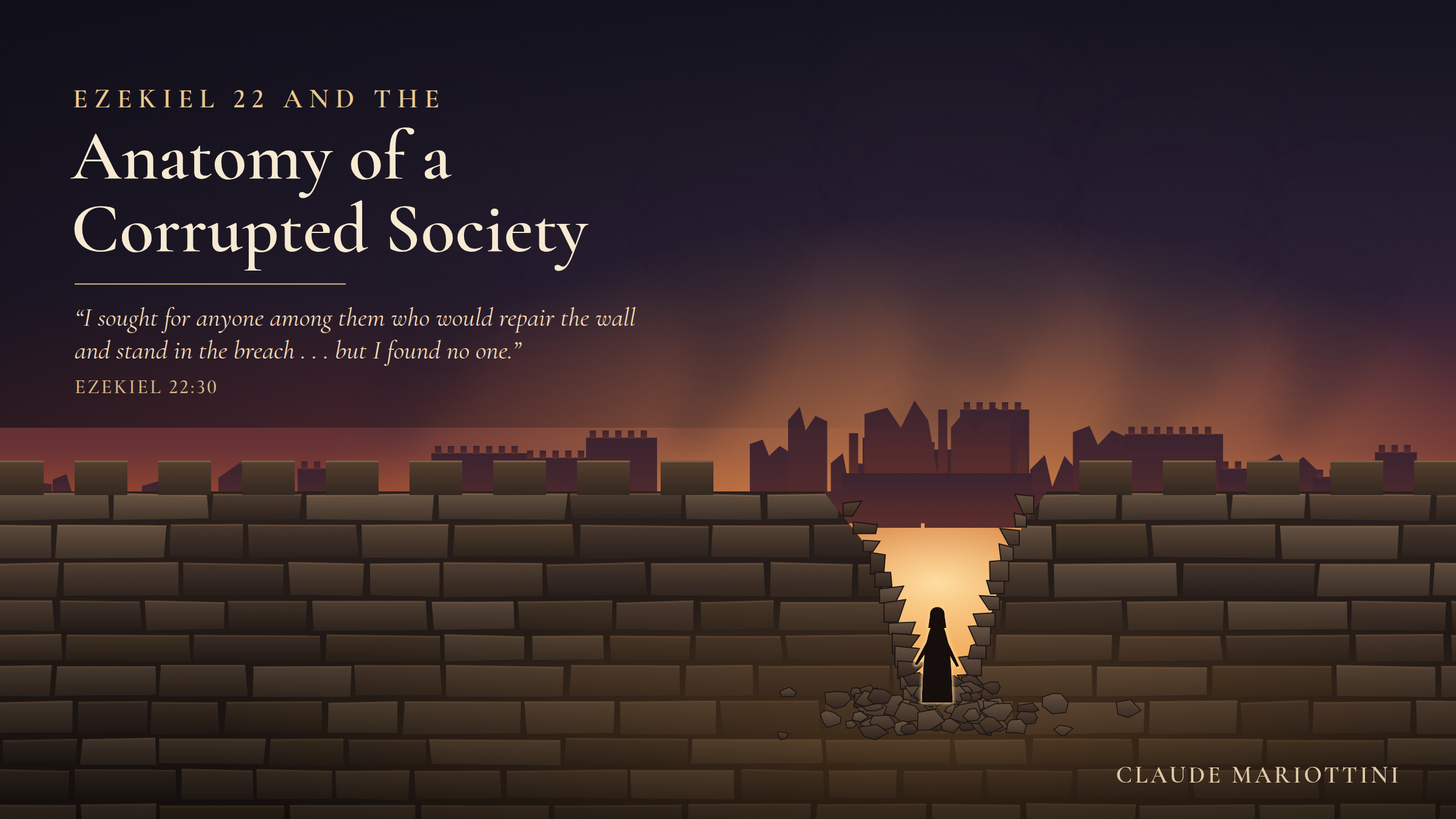
Part Three examines the two verses that close the chapter, where God searches for someone to “repair the wall and stand in the breach” and finds no one (22:30), and then pours out his wrath on the land (22:31). The final posts consider what it means for communities of faith today to repair the breach, and they conclude with the hope that lies beyond Ezekiel 22 in the promises of a new heart and a new spirit and in the vision of the valley of dry bones.
The posts in the series are the following:
Part One: The Bloody City (Ezekiel 22:1–22)
Post 1: “Will You Judge the Bloody City?” (Ezekiel 22:1–5)
Post 2: “And You Have Forgotten Me”: The Interlocking Charges of Ezekiel 22:3–12
Post 3: Guilty, Defiled, and Disgraced: The City as a Moral Body (Ezekiel 22:3–4, 13–16)
Post 4: “All of Them Have Become Dross”: Jerusalem in the Smelter (Ezekiel 22:17–22)
Part Two: When Every Institution Fails (Ezekiel 22:23–29)
Post 5: When Every Institution Fails: The Land, the Leaders, and a Textual Puzzle (Ezekiel 22:23–29)
Post 6: Lions and Wolves: Princes and Officials Who Devoured Their People (Ezekiel 22:25, 27)
Post 7: “They Have Done Violence to My Teaching”: The Failure of the Priests (Ezekiel 22:26)
Post 8: Whitewashing the Wall: Prophets Who Spoke When God Had Not Spoken (Ezekiel 22:28)
Post 9: “The People of the Land”: No One Is Innocent (Ezekiel 22:29)
Part Three: Standing in the Breach (Ezekiel 22:30–31)
Post 10: “I Sought . . . but I Found No One”: The Wall and the Breach (Ezekiel 22:30)
Post 11: Standing Before God: Intercession and Its Limits (Ezekiel 22:30; 14:12–20)
Post 12: “I Have Returned Their Conduct upon Their Heads”: Judgment and Responsibility (Ezekiel 22:31)
Post 13: Repairing the Breach: Four Responses to a Corrupted Society (Ezekiel 22:30)
Post 14: “Can These Bones Live?”: Hope beyond Ezekiel 22 (Ezekiel 11:16–21; 36:22–32; 37:1–14)
The Approach of the Series
The biblical text quoted throughout the series is the New Revised Standard Version (NRSV), unless otherwise indicated. Each post begins with the text under discussion, then examines it in conversation with the major commentaries on Ezekiel, including the works of Walther Zimmerli, Moshe Greenberg, Daniel Block, Margaret Odell, G. A. Cooke, and Patrick Fairbairn, as well as a number of specialized studies. When I quote a source, I give the exact page number in the notes so readers can consult the source themselves.
I will also quote my 1986 lesson from time to time. In rereading it, I have found that some of its sentences still express what I believe the chapter teaches, while others need to be stated more carefully. In a few places I discovered that my wording in 1986 had been shaped by the commentaries I was reading at the time, and I will acknowledge those debts where they occur.
One conviction will guide the whole series. Ezekiel 22 portrays Jerusalem’s collapse as a comprehensive covenantal failure. The chapter’s final image calls communities of faith to truthful witness, accountable leadership, and practices of justice. It does not authorize us to make simple pronouncements of divine judgment on contemporary nations. Ezekiel spoke his word first to the people of God, and the proper use of this chapter today begins with self-examination rather than accusation.
The Schedule of Publication
The posts in this series will be published three times a week, on Monday, Wednesday, and Friday. The fourteen posts will appear over the course of five weeks, and each post will build on the ones that came before it. I invite you to read the series in order, read Ezekiel 22 alongside each post, and share your comments and questions as the series unfolds.
The first post, “Will You Judge the Bloody City?,” examines Ezekiel 22:1–5 and the shocking name the prophet gave to the holy city.
Claude Mariottini
Emeritus Professor of Old Testament
Northern Baptist Seminary
If you enjoyed reading this post, you will enjoy reading my books.
VISIT MY AMAZON AUTHOR’S PAGE
BUY MY BOOKS ON AMAZON (Click here).
NOTE: Did you like this post? Do you think other people would like to read this post? Be sure to share this post on Facebook and share a link on X so that others may enjoy reading it too!
If you are looking for other series of studies on the Old Testament, visit the Archive section and you will find many studies that deal with a variety of Old Testament topics.