[Finance Series Part 4] 'The Borrower Is Slave to the Lender' — What Christians Often Miss About Biblical Debt Advice
Series: Faith & Finance — A Christian's Guide to the Real Economy | Part 4 of 7
My brother-in-law called me on a Tuesday.
"Hey, I know this is a big ask — but my buddy from church needs someone to co-sign his car loan. He's had some credit issues. I vouched for him. Would you be willing to?"
He's my brother-in-law. The buddy was a genuinely nice guy I'd met a few times. The amount wasn't huge. And here's the thing about being asked a financial favor by someone you love: the pressure to say yes has almost nothing to do with the money.
I said I'd think about it.
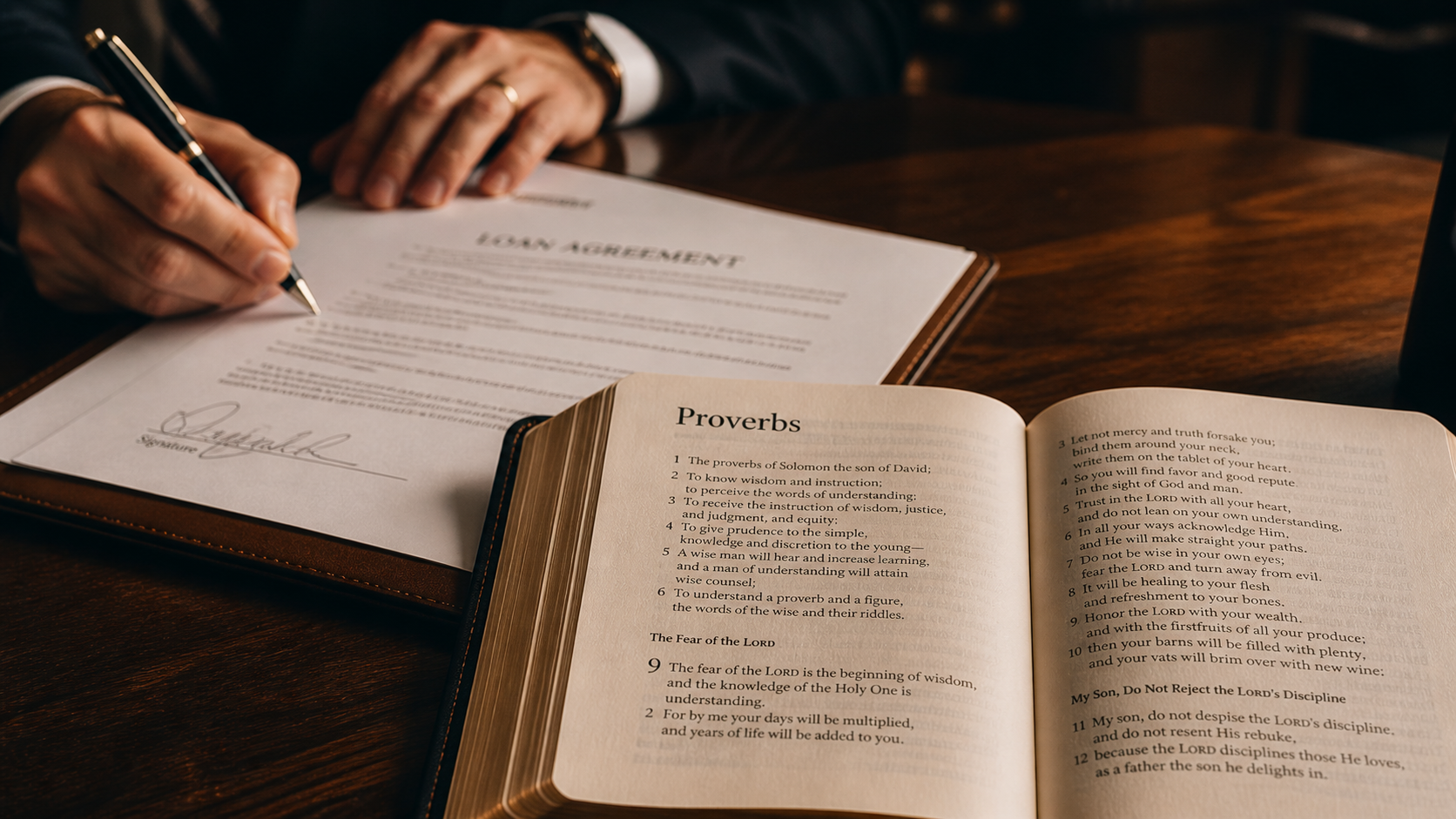
I opened Proverbs that night — not looking for that passage specifically, just reading where I'd left off. And then, almost comically, there it was:
"Do not be one who shakes hands in pledge or puts up security for debts; if you lack the means to pay, your very bed will be snatched from under you."
— Proverbs 22:26-27
I did not co-sign the loan. The friendship survived. So did my bed.

The Bible's Surprising Sophistication on Debt
The Scriptures aren't simplistically anti-debt. They're nuanced in ways that hold up surprisingly well under modern financial scrutiny.
A few key distinctions the Bible makes:
Debt that exploits the poor is condemned without ambiguity. Throughout the Old Testament, charging interest to a fellow Israelite in genuine need was forbidden (Exodus 22:25, Leviticus 25:36-37). The concern was that debt could become a mechanism of oppression — trapping vulnerable people in cycles they couldn't escape. The principle translates directly to today's predatory lending practices, payday loans, and high-interest consumer debt.
Debt as a tool of commerce is treated with pragmatic realism. The Bible never pretends that lending and borrowing don't happen or shouldn't happen in a functioning economy. Proverbs 22:7's warning — "the borrower is slave to the lender" — is a wisdom observation, not an absolute prohibition. It's saying: understand the power dynamic you're entering. Know what you're doing.
Personal guarantees and co-signing are treated with consistent wariness. This is the one area where Proverbs is most direct and most urgent. Multiple passages warn against putting up security for another person's debt (Proverbs 6:1-5, 11:15, 17:18, 22:26-27). The reason is simple: you are taking on unlimited liability for someone else's decisions. You cannot control those decisions. This is a structural risk, not a character judgment of the borrower.
A Framework for Christian Debt Decisions

Since the Bible doesn't give a simple yes/no on all debt, here's a framework that brings the biblical principles into practical decisions:
Ask: Is this productive or consumptive debt?
Productive debt is borrowed money that generates returns beyond its own cost — a business loan that funds equipment that increases revenue, a mortgage on a home that builds equity, a student loan for a degree that genuinely opens economic doors. These carry risk but have rational economic logic.
Consumptive debt is borrowed money spent on things that depreciate or disappear — financing a vacation, carrying a credit card balance for consumer goods, taking out a personal loan to cover lifestyle choices you can't afford. This is the form Proverbs most directly warns against, because it's pure slavery with no upside.
Ask: Can I service this if things go wrong?
This is the stress-test question. Not "can I make payments if everything goes as planned" — but "can I manage this if I lose a major client, face a health crisis, or the market turns?" Christian professionals tend to be optimistic, faith-filled people. That's a gift. It can also make us underestimate downside risk. Sober financial planning is not the opposite of faith — it's wisdom.
Ask: What does this obligation do to my freedom to give?
This one rarely appears in secular financial planning but matters enormously for the Christian. A debt load that eliminates your margin for generosity — that makes you unable to respond when someone genuinely needs help, that locks every dollar into payment obligations — quietly diminishes your ability to be the person God is asking you to be. Financial freedom and spiritual freedom are more connected than we often admit.
On Co-Signing Specifically
If someone asks you to co-sign a loan, here's what Proverbs is actually telling you:
You are not just endorsing someone's creditworthiness. You are agreeing to pay the debt in full if they don't. Legally, there is no difference between you and the primary borrower in the lender's eyes. If the borrower defaults, you don't get a warning — you get a bill and a credit hit.
This doesn't mean you can never help someone financially. You can give them money outright. You can help them find better financial options. You can connect them with a credit counselor. These are all expressions of genuine generosity.
But co-signing combines the maximum financial liability with the minimum financial control. You bear the risk of their decisions without the ability to make those decisions. Proverbs calls that foolish — not unkind, not ungenerous. Foolish. The distinction matters.
What About Business Debt?
Christian entrepreneurs often wrestle with this specifically. Is it biblical to take on business loans to grow a company?
The Bible doesn't prohibit it, and many faithful Christians have built significant, God-honoring businesses with borrowed capital. The relevant wisdom:
Borrow for productive purposes, not to paper over operational problems.
Understand exactly what you're signing. Personal guarantees on business loans mean your personal assets are on the line — treat them the same way Proverbs treats co-signing.
Keep debt serviceability conservative. Banks will lend you more than you should borrow. That's their job. Your job is to know your actual limit.
Don't let debt become the thing that makes you ethically compromised. When a business is underwater, the pressure to cut corners, delay payments to vendors, or mislead investors becomes intense. The best protection against that pressure is never getting so leveraged that desperation becomes an option.
The Real Point
Proverbs isn't anti-debt. It's pro-wisdom. It's asking you to enter every financial obligation with your eyes fully open — to understand the power relationships, the risks, the obligations, and the downstream effects on your freedom to live generously.
The goal isn't a debt-free certificate to frame on your wall. The goal is the kind of financial structure that lets you sleep, give, build, and serve without financial pressure systematically distorting your decisions.
That's the freedom Proverbs is protecting. It's worth protecting.
Next in the series: "Contracts, Honesty, and the Christian in the Marketplace" — what biblical integrity actually looks like when the deal gets complicated, the client pushes back, and the easy road is the one that bends the truth a little.
References:
- Crown Financial Ministries — Debt Free Living — https://www.crown.org/resources/debt/
- Ramsey Solutions — Christian Debt Advice — https://www.ramseysolutions.com/debt
- The Gospel Coalition — Financial Wisdom — https://www.thegospelcoalition.org/topics/money-possessions/