[Finance Series Part 5] Let Your Yes Be Yes — The Radical Business Ethic Christians Mostly Ignore
Series: Faith & Finance — A Christian's Guide to the Real Economy | Part 5 of 7
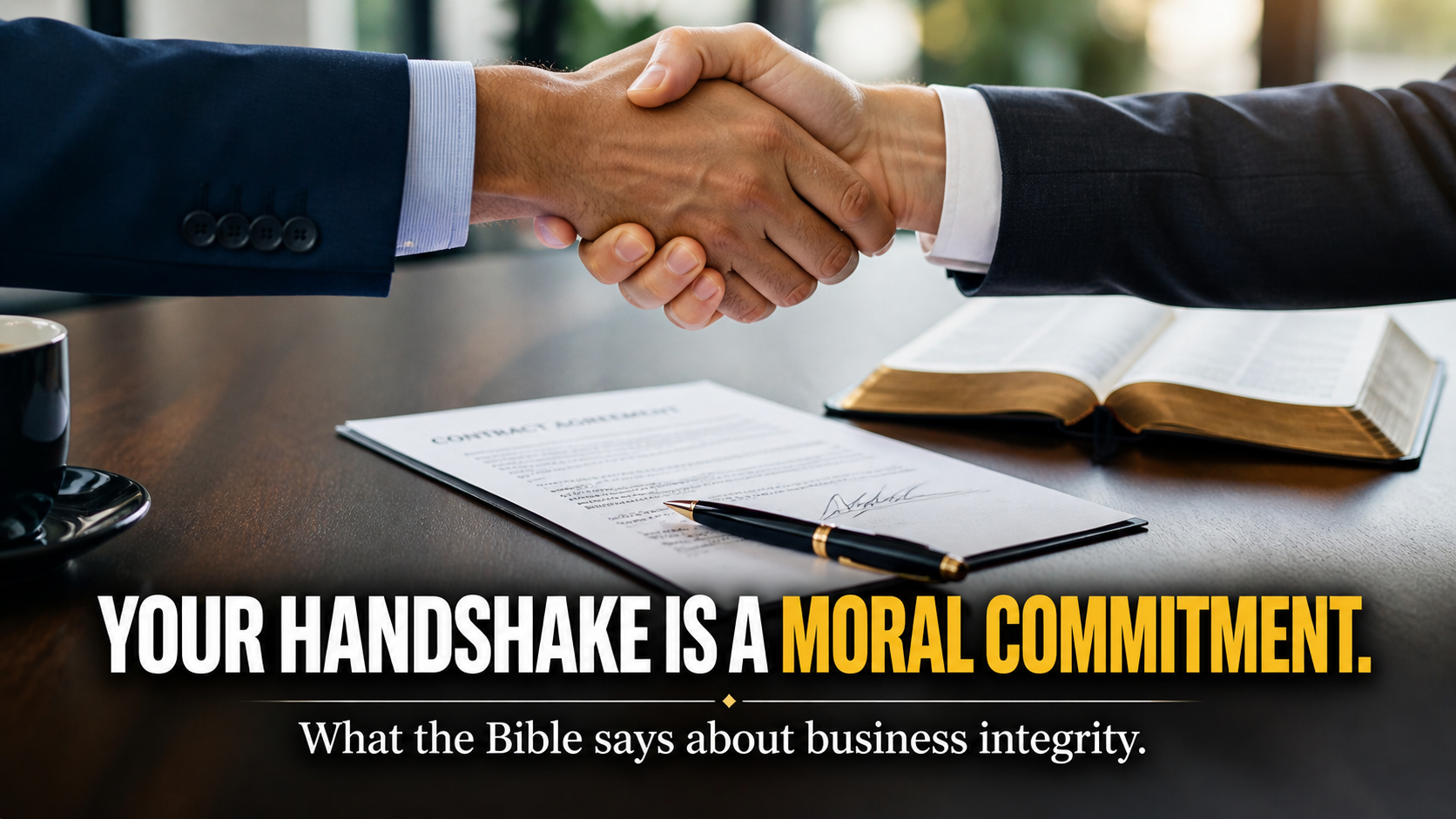
A business owner I know — I'll call him Ray — won a contract a few years ago that he probably shouldn't have bid on.
The scope was bigger than he'd handled before. He knew the timeline was tight. But the number was good and the client seemed reasonable, so he said yes. When delivery week came and things weren't ready, Ray did what many of us do: he sent an optimistic update. Then another. Then a version of the deliverable that technically met the contract terms but wasn't really what anyone had agreed to in the first meeting.
The client paid. Ray moved on. He told himself he'd delivered what the contract required.
He had. But he knew — and I think part of him still knows — that he hadn't delivered what he'd promised.
Ray calls himself a Christian. He tithes. He leads a small group. He's genuinely not a bad man. He just hadn't thought carefully about whether his faith had anything to say about the gap between a contract's fine print and a conversation's clear intent.
It does.
The Standard Jesus Actually Set

When Jesus addressed integrity in the Sermon on the Mount, He made it simple — almost uncomfortably so:
"All you need to say is simply 'Yes' or 'No'; anything beyond this comes from the evil one."
— Matthew 5:37
This comes in the context of oath-taking — the practice of swearing by various things to prove you were telling the truth. Jesus' point was that a person of integrity doesn't need elaborate oaths, disclaimers, or guarantees. Their word should simply be their word. Full stop.
For a business owner or professional, this principle lands with uncomfortable precision. It means:
The commitment you made in the sales call matters, not just the signed document.
The timeline you gave verbally is a moral obligation, not just a target.
The price you quoted in good faith shouldn't change because the client is desperate and doesn't know the market.
The handshake matters. The email matters. The clear expectation you set and then didn't meet — that matters.
This isn't naive. It's a higher standard than the marketplace normally operates by. And that's exactly the point.
The Proverbs Standard for Commercial Honesty
Long before Jesus, Proverbs established a strong theology of commercial integrity. The recurring image is the scale — the tool merchants used to weigh commodities.
"The LORD detests dishonest scales, but accurate weights find favor with him."
— Proverbs 11:1
In the ancient marketplace, crooked scales were the primary mechanism of commercial fraud. You'd make the weights heavy when buying grain from farmers and light when selling it to customers. The technique was standard practice in enough places that Proverbs mentions it multiple times (16:11, 20:23).
God, according to Proverbs, finds this personally offensive. The word used — detests — is strong language. It's the same word used for God's response to sexual immorality and injustice.
The modern equivalents aren't subtle: inflated invoices, hidden fees buried in contract language, scope creep that's never disclosed until the client is already dependent, misleading marketing that promises more than the product delivers, two-tier pricing that exploits customers who don't know enough to ask for a better deal.
Each of these is a crooked scale. Each is a form of taking something from someone through deception rather than through the genuine value you provide.
Taxes, Employees, and Vendors: The Three Tests

In practice, the Christian professional's integrity is most tested in three specific relationships.
With the government (taxes): Jesus' famous answer — "Give back to Caesar what is Caesar's" (Matthew 22:21) — is actually a business ethics statement. Paul reinforces it: "Give to everyone what you owe them: If you owe taxes, pay taxes" (Romans 13:7). Aggressive tax avoidance that involves misclassifying income, hiding revenue, or exploiting loopholes that weren't intended for your situation isn't a gray area for someone who takes Scripture seriously. There's a legitimate range of smart tax strategy that any competent accountant can help with. There's also a clear line, and the Christian should know where it is.
With employees: James 5:4 contains one of the most pointed economic statements in the New Testament: "Look! The wages you failed to pay the workers who mowed your fields are crying out against you. The cries of the harvesters have reached the ears of the Lord Almighty." Withholding or delaying wages — or paying the minimum you can get away with because workers need the job — is treated here not as a management decision but as an injustice that God hears. Fair pay, prompt payment, and honest dealing with the people who work for you are not optional extras for the Christian business owner.
With vendors and suppliers: The same principle of "let your yes be yes" applies downstream. Paying invoices when they're due, honoring the terms you agreed to, not leveraging your position to squeeze smaller vendors who can't afford to push back — these are integrity issues. The power you have in a business relationship doesn't excuse the obligation to use it fairly.
When Integrity Has a Price Tag
Here's where this gets genuinely hard.
Sometimes telling the truth costs you the deal. Sometimes honoring your word costs you money. Sometimes refusing to play the game by the marketplace's rules puts you at a competitive disadvantage against people who have no such scruples.
This is real. I don't want to minimize it.
But two things are also true.
First, a reputation for integrity — built slowly, over years, through consistent small choices — is one of the most durable competitive advantages in any industry. The clients who are worth having over the long term tend to be the ones who value it. The referrals that come from people who genuinely trust you are worth more than contracts won through impression management.
Second, and more fundamentally, the Christian operates with a different accounting system. The short-term cost of honesty is real. But it doesn't occur in a vacuum — it occurs before an audience that sees everything, including the private conversation, the ambiguous email, the quiet decision to tell the whole truth when a partial truth would have been convenient. That accounting system has a different bottom line.
A Practical Checkpoint
Before signing any significant contract or making any major business commitment, consider asking these three questions:
Am I confident I can deliver what I'm implying, not just what I'm technically promising?
Would I be comfortable if the other party knew everything I know right now?
Is the way I'm structuring this deal something I'd be willing to explain to someone I deeply respect?
If the answer to any of these is no — or if you're not sure — that uncertainty is worth taking seriously before you sign, not rationalizing after.
The Long Game
Ray's story doesn't end with that contract.
He actually told me about it over coffee, a year later, when he was wrestling with a bigger bid on a much larger project. He'd thought a lot about what had happened. He was still carrying the quiet discomfort of it.
This time, before submitting, he built in an honest timeline. He disclosed the constraints. He lost the bid to a competitor who promised a faster delivery.
He told me he slept better than he had in months.
Next in the series: "When the Market Crashes and Your Plans Don't Survive It" — what biblical wisdom says about navigating financial crisis, uncertainty, and the kind of fear that makes good people make terrible decisions.
References:
- Crossmap Blog - Kingdom Finances: https://blogs.crossmap.com/kingdomfinances
- Made to Flourish — Marketplace Integrity Resources — https://madetoflourish.org/resources/
- The High Calling (theology of work and ethics) — https://www.theologyofwork.org/