From Short-Term to Long-Term Memory: How Music Stays With Us — Fauré’s Dolly Suite, Op. 56
Have you ever struggled with a passage during practice, only to find that it feels more familiar the next day after a good night’s sleep? Even when the notes are not yet perfect, the music can begin to make more sense.

This experience is connected to a process called memory consolidation. It helps the brain stabilize newly learned information and retain it over time. Sleep plays an important role, allowing the brain to continue processing what we have learned even when we are no longer actively practicing.
French composer Gabriel Fauré’s (1845–1924) Dolly Suite, Op. 56, offers a gentle musical companion to this reflection. Written for piano four hands, the six-piece suite begins with Berceuse, a tender lullaby, and moves through a series of playful and affectionate musical scenes.
How Memories Become More Stable
When we first learn something, the memory is not yet secure. We may remember a melody shortly after hearing it or play a passage immediately after practicing, but that does not mean it has become part of our long-term memory.
When learning a new piece, we use working memory to keep track of notes, rhythms, and finger movements. With practice, these details form familiar patterns. Still, a passage that feels comfortable one day may seem uncertain when we return to it the next.
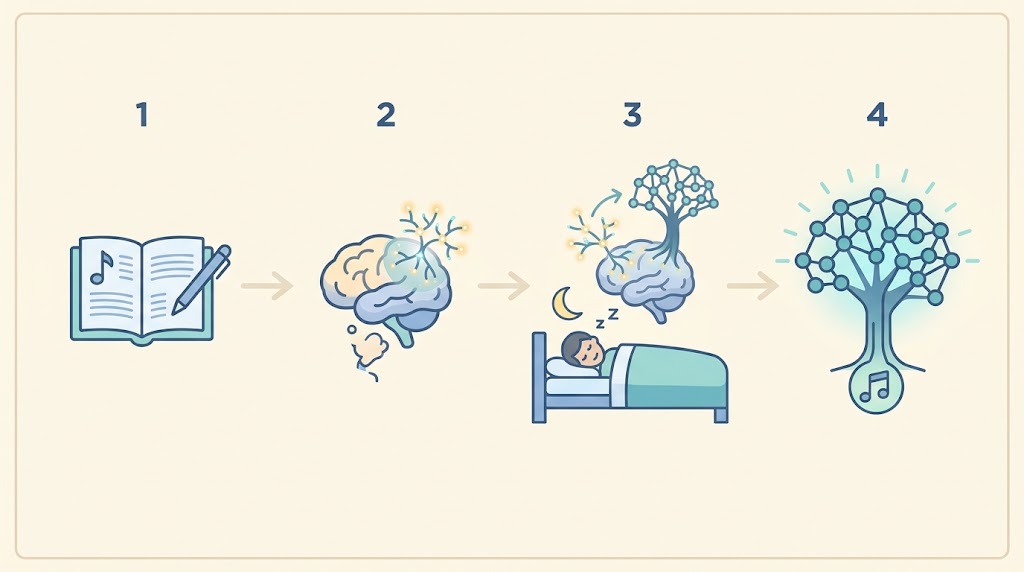
For musicians, this means that learning continues beyond practice. Time away from the instrument matters, too. During sleep, the brain processes and strengthens recently learned information. A good night’s sleep can help us retain what we have practiced and prepare us to return with fresh attention.
What We Choose to Keep
“I have hidden your word in my heart that I might not sin against you.” — Psalm 119:11
The psalmist speaks of keeping God’s Word in the heart—not simply hearing it, but holding it close so that it can shape daily life.
In a similar way, what we learn needs time to settle and become part of us. Growth does not come from effort alone; rest and patience also matter. Even when progress is not visible, learning can continue while we rest.
In the next episode, we will explore how repeated practice changes the brain over time and how small, consistent efforts support lasting musical growth.
Read previous: Working Memory in Mozart’s Clarinet Quintet in A Major, K. 581