The 8th Habit — What If the Thing You're Missing Isn't a Strategy?
You've done everything you were supposed to do. You worked hard, showed up, tried to do it with integrity. And still — most days — you go home feeling like something important was left on the table.
It's a quiet ache, and it's hard to name. It's not burnout exactly — you're still moving, still producing. It's more like the gap between the life you're living and the life you sense you were made for. You know the verse, the one about being created for good works prepared in advance. You believe it. You just can't seem to find them. Most of us spend our careers being effective at the wrong things — getting very good at a life that wasn't quite meant for us.
 Empty fluorescent-lit office corridor representing the hollow feeling of a successful but purposeless career
Stephen Covey spent the last decade of his life watching something happen that unsettled him. He had already written the book on effectiveness — the habits, the frameworks, the planners. Millions of people had read it. And yet something was missing in them. Something was missing in him too, if he was being honest.
He noticed it in the organizations he consulted with: talented, well-trained people working inside systems that never asked them to be fully themselves. People who came to work each morning having already left the most important parts of themselves in the parking lot. Disciplined, productive, miserable in a way they couldn't quite articulate.
He started asking a different question. Not "how do we become more effective?" but "why do so many effective people still feel hollow?" And the answer he landed on was both simple and quietly devastating: we had been treating people — including ourselves — as things. Resources to be managed. Problems to be optimized. We had forgotten that a human being is not a body with a brain attached. We carry a voice inside us. And most of us have never been asked to use it.
The turning point for Covey wasn't a methodology. It was a recognition. That the deepest human need isn't achievement or even security — it's meaning. To know that your particular presence in the world mattered. That the work you did, the way you led, the life you lived pointed toward something true and larger than yourself. He called this finding your voice. And then — harder still — helping others find theirs.
 Silhouette of a man standing before a whiteboard in a dim conference room, the moment of inner turning point
The central idea is deceptively quiet. Covey writes that inside every person there is a voice — not a metaphor, but a real capacity — that sits at the intersection of what you're good at, what you love, what the world needs, and what you feel called to. Most people live their whole lives adjacent to it. The tragedy isn't that they fail to find it. It's that they were never taught to look.
"The 8th Habit is not an extension of the 7 Habits. It's a whole new dimension."
Here's the question worth sitting with: When was the last time the work you did asked something of you that only you could give?
I came to this book expecting a productivity framework and found something that quietly asked me whether I'd been spending my energy on a life that looked good from the outside and cost me something real. I wasn't ready for that. I'm still not sure what to do with it.
About this book
The book is organized into two movements. The first half is about the individual — finding your own voice, understanding why so many capable people feel disconnected from their work, and learning to see yourself as more than a set of skills to be deployed. The second half expands outward: how do you create the conditions — in a team, a family, an organization — where other people can find and use their voices too. It's structured like a journey inward and then outward, and the second half doesn't quite make sense without having taken the first.
Covey keeps returning to a deceptively simple idea: that the human person is whole — body, mind, heart, and spirit — and that any system (any job, any church, any family) that addresses only part of us will produce people who are partially present at best. He wrestles with the difference between being managed and being led, between compliance and contribution, between doing your job and actually showing up. The thread underneath all of it is the conviction that greatness isn't reserved for a few remarkable people — it's a response available to anyone willing to stop letting their life be defined by someone else's expectations.
Covey draws on Viktor Frankl's writings about meaning and suffering, on Gandhi's discipline and self-mastery, and on a life spent inside boardrooms watching what actually produces lasting change versus what only looks like it does. He weaves in scripture without making it the centerpiece — it surfaces the way it does in a conversation with someone who has read widely and thought long and isn't trying to prove anything.
The people who tend to pick this up at exactly the right moment are the ones who have been successful by almost every measure and still feel, at the end of the day, that something important hasn't happened yet. If you've wondered whether the role you're playing is actually the one you were made for — and whether it's too late to find out — this tends to land quietly and stay.
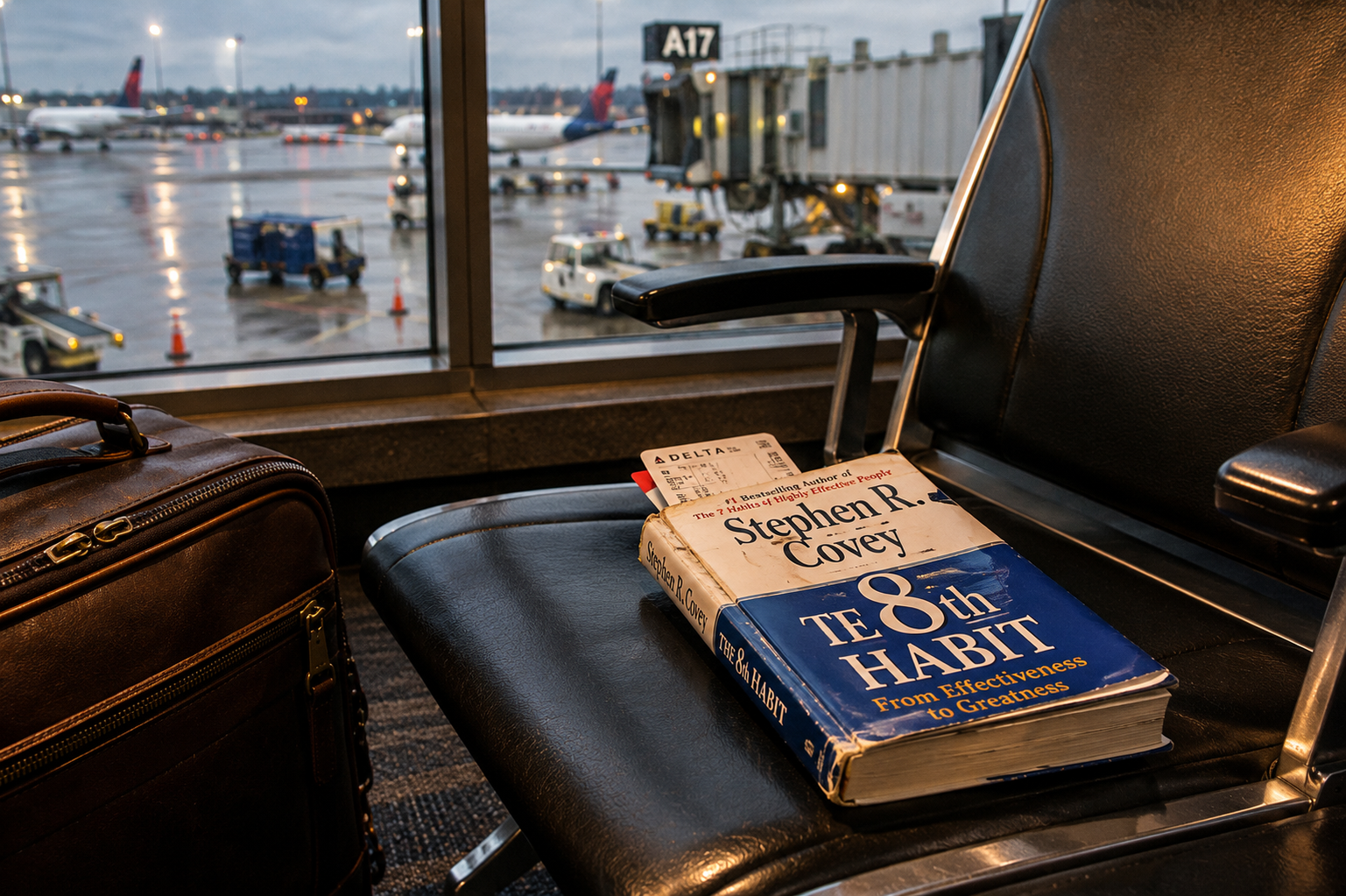 Copy of The 8th Habit by Stephen Covey resting on an airport gate seat with a boarding pass bookmark
If you'd like to read it: The 8th Habit by Stephen R. Covey.(Affiliate Link)
📚You Might Also Like
Are You Working Hard at the Wrong Things? — The 7 Habits of Highly Effective People
The Spear You Don’t Throw Back: A Masterclass in Radical Silence — A Tale of Three Kings