The Mathematics of Consonance: Palestrina’s Sicut cervus
When we hear two notes together, some combinations sound settled while others create tension. One interval may feel smooth and pleasant, while another seems to be waiting for something to happen. But why do some notes seem to belong together?
 Photo by cottonbro studio via Pexels
Part of the answer can be found in the way sound itself is produced.
When one note vibrates at twice the frequency of another, we hear the same note an octave higher. This corresponds to a frequency ratio of 1:2. Other simple relationships also produce familiar musical intervals: a perfect fifth corresponds to a ratio of 2:3, while a perfect fourth corresponds to 3:4.
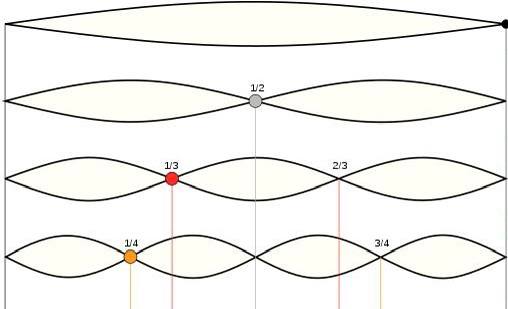 Frequency ratios for common musical intervals
These simple relationships help explain why certain combinations of notes can sound stable. But mathematics alone cannot explain everything we hear in music. Harmony is not simply a matter of finding the “right” notes.
When Consonance Meets Dissonance
Consonance and dissonance give harmony its sense of movement. Consonant sounds tend to feel stable, while dissonance creates tension and expectation.
A beautiful example is Sicut cervus by Giovanni Pierluigi da Palestrina (c. 1525–1594), a Renaissance motet based on Psalm 42. Instead of one main melody with accompaniment, several vocal lines move independently and come together as a whole.
The Latin text begins with the words Sicut cervus desiderat ad fontes aquarum, “As the deer longs for streams of water.” The flowing vocal lines seem to echo this longing, moving gently from one voice to another.
The first time you hear it, you may simply notice how peaceful and flowing the music sounds. But listen again, and you can begin to hear the individual voices moving toward and away from one another.
Some moments feel settled, while others create slight tension before moving onward. This subtle contrast keeps the music engaging.
If you watch the score, you can see this movement more clearly. The voices do not all move in the same direction or at the same time. One line may continue while another rises or falls, creating changing relationships between the notes.
Harmony is more than a collection of notes that sound good together. Tension and resolution give the music a sense of direction.
Order Does Not Mean Stillness
This is where the mathematics of music becomes especially interesting. Simple frequency relationships can help explain stability, but they do not by themselves create a beautiful piece of music. Context and timing matter too.
Music can have order without being static. In Sicut cervus, the voices are constantly moving while remaining connected within a larger structure. There is tension, but also direction, as independent lines come together as a whole.
That balance is part of what makes harmony so satisfying. We are not simply hearing notes that “fit,” but relationships changing over time.
Harmony in Our Lives
Our lives can be much the same. We often want everything to fall neatly into place, with problems resolved and difficult seasons brought to an end. But life does not always feel settled.
There may be tension, uncertainty, or seasons of waiting, yet an unsettled moment does not necessarily mean that the larger story has lost its direction.
“But everything should be done in a fitting and orderly way.” — 1 Corinthians 14:40
Paul was addressing order in the life of the church, but the principle of thoughtful order also gives us something to consider in music. Harmony does not require every voice to move in the same way. Different lines can move independently while contributing to a larger whole.
Perhaps harmony can teach us something about life as well. We may not understand how every part fits together while we are living through it. Some moments feel unresolved, and some things take time. But an unresolved moment is not necessarily the end of the story.
The beauty of harmony lies not only in the notes that come together, but in the way one sound leads toward another. In the next episode, we will explore another mathematical element of music: rhythm, repetition, and patterns.
Read previous: The Mathematics of Harmony: Bach’s Cello Suite No. 1