The Pastor Didn't Notice.AI Sermon Gave Hallucinated Theology.
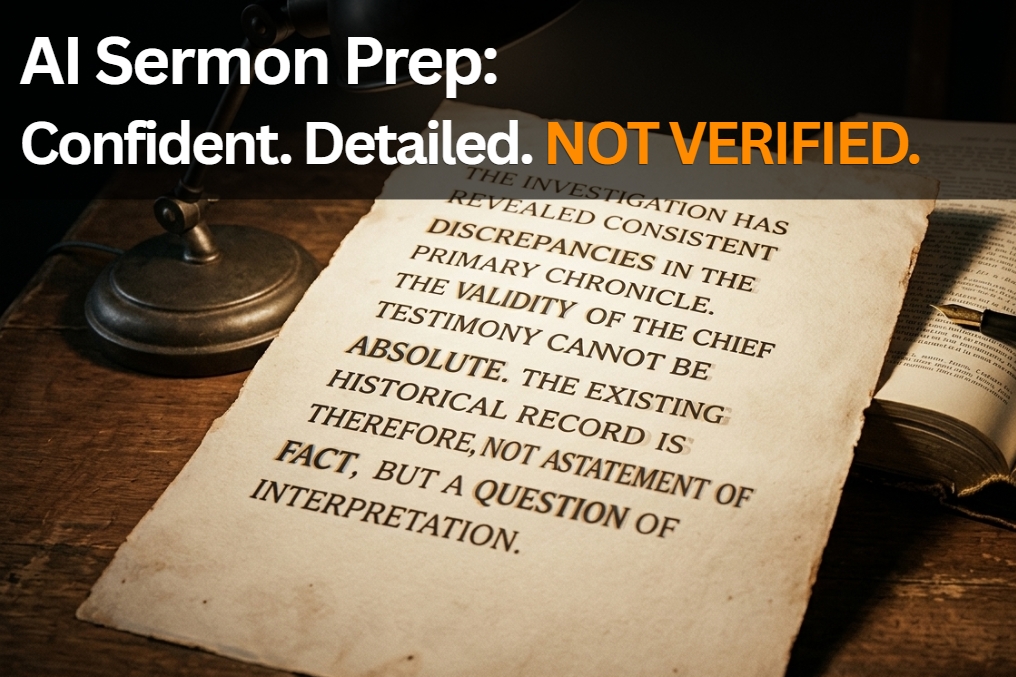
The pastor spent Thursday afternoon using AI to research a Hebrew word in the Old Testament.
The response was impressive. Three paragraphs, detailed and structured, tracing the word's usage across multiple passages and offering a nuanced theological interpretation. It read like something from a good commentary.
It was fundamentally wrong.
Not a matter of interpretive preference. Not a minor scholarly disagreement. The core explanation was incorrect — the kind of error a first-year Hebrew student or a basic lexicon would have caught immediately.
The pastor didn't catch it. The congregation heard it on Sunday.
The Real Risk of AI Sermon Preparation No One Talks About
Survey respondents repeatedly identified misinformation and doctrinal accuracy as major risks. AI-generated content, while fluent and persuasive, does not inherently distinguish between orthodox theology, contested interpretations, or outright error. Christian Post
This is the risk that gets the least attention in conversations about AI sermon preparation. Most discussions focus on authenticity — whether it's ethical to use AI, whether sermons will sound generic, whether congregations will feel deceived.
These are real questions. But they miss the more immediate danger: AI sermon preparation tools can generate detailed, confident, well-structured theology that is simply false. And they give no indication when this is happening.
What "Hallucination" Means — and Why It Matters for Preachers
 The technical term for this phenomenon is hallucination. It refers to AI generating plausible-sounding information that has no actual basis in fact.
Understanding why it happens is essential for any pastor using AI tools. AI doesn't retrieve information the way a search engine does. It predicts what text should come next based on patterns in its training data. When it encounters a gap — something it doesn't have reliable data on — it doesn't stop or signal uncertainty. It keeps generating. It produces the most statistically plausible continuation of the text, regardless of whether that continuation is true.
And it does this with complete, unvarying confidence.
There is no change in tone. No disclaimer. No flag. The hallucinated paragraph reads exactly like the accurate one. A pastor with limited background in the relevant area has no way to tell the difference.
Why Theological Errors Are the Hardest to Catch
In most domains, hallucination is an inconvenience. You verify the claim, find the error, correct it. The cost is time.
In theology, the stakes are different — and the errors are harder to catch.
"Buy truth, and do not sell it."
— Proverbs 23:23
Biblical languages, church history, patristic sources, and textual criticism are exactly the kinds of specialized domains where AI is most likely to hallucinate convincingly. These aren't areas with abundant, high-quality, well-organized training data. They're fields where expertise is narrow, sources are ancient, and confident-sounding errors require significant knowledge to detect.
Which creates a specific problem: the pastor who turns to AI precisely because they lack deep expertise in a given area is the most vulnerable to receiving — and repeating from the pulpit — something false. AI can "hallucinate" facts — always verify quotes, stats, and stories before using them. Josh Hunt
The congregation has no way to know. They hear it from a trusted voice, in a trusted setting, delivered with the full weight of pastoral authority. The error lands as truth.
A Practical Checklist for Pastors Using AI Sermon Tools
This isn't an argument against using AI in sermon preparation. AI tools can become a helpful assistant in this work — if used wisely. Tasks where AI can genuinely support workflow include research summarization, outline generation, and illustration brainstorming. ChurchTechToday
It is an argument for a clear-eyed protocol:
Verify anything specific. Word studies, historical claims, quotes attributed to theologians or church fathers, statistical claims — check them against primary sources. AI-generated citations in particular are frequently fabricated in full.
Be most suspicious of what sounds most certain. Hallucinated content doesn't announce itself. It sounds authoritative, detailed, and complete. The more confident the response, the more important the verification.
Use AI for structure, not substance. AI is reliably useful for organizing ideas and improving clarity. It is least reliable for the exegetical and historical content that gives a sermon its authority.
Keep the primary sources primary. No AI tool replaces direct engagement with the biblical text, reputable commentaries, and your own prayerful study. Those aren't inefficiencies to be optimized away. They're the work.
Truth has always had a cost. Verification, scholarship, and intellectual humility aren't obstacles to good preaching. They're part of what preaching is.
Faith + Tech explores what technology reveals about the state of our faith — not to condemn the tools, but to see ourselves more clearly through them.
→ Read next: AI Can Explain the Resurrection in Perfect Detail. Something Is Still Missing.
Reference:
https://www.joshhunt.com/2025/08/05/how-to-use-chatgpt-for-sermon-prep-tips-prompts-pitfalls-every-pastor-should-know/
https://www.npr.org/2025/07/17/nx-s1-5468637/clergy-grapple-with-the-ethics-of-using-ai-to-write-sermons