The Quiet Power of God
 Image courtesy Unsplash
"But you are a God ready to forgive, gracious and merciful, slow to anger and abounding in steadfast love." – Nehemiah 9:17
What comes to mind when you think of the power of God? I immediately envision the flood in Noah’s day (Genesis chapters 6-10), the plagues in Egypt (Exodus 7-12), and the tomb in Bethany where Jesus called "Lazarus, come out" (John 11). In a list of powerful acts of God, raising a dead man to life sits at the top.
These are what I call "loud" displays of the power of God. They glorify God in unarguable displays of his sovereign control over nature. We rightly respond with oohs and ahhs of wonder and praise.
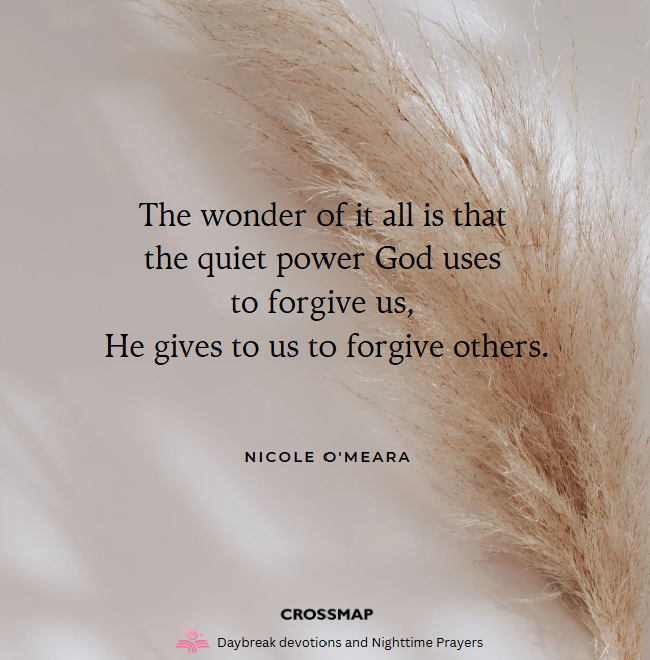
Lately, however, I’ve been drawn to God's "quiet" power, specifically the power to forgive. Nehemiah 9:17 declares, "But you are a God ready to forgive, gracious and merciful, slow to anger and abounding in steadfast love." God has forgiven us, mercifully, for our sins against him. We were dead in our sin, just as dead as Lazarus in his grave. By grace, God paid the penalty for our sins (death) restoring our relationship with him. The wonder of it all is that the quiet power he uses to forgive us, he gives to us to forgive others.
Corrie ten Boom, the Dutch woman who hid Jews above her father’s clock shop, described the physical effect of God’s power to forgive. After being captured by Nazis, Corrie and her sister were thrown into Ravensbruck concentration camp where they starved, fought illness and fleas, and where her sister died. Years later, Corrie met a German man she recognized as one of the Ravensbruck guards. He asked for her forgiveness. She couldn’t give it but prayed for God’s help [power] to forgive. She barely touched the man’s outstretched hand when she felt a current of energy surge from her shoulder to her hand and then to the man, while at the same time, love flooded her heart. With God’s power, she had done what she couldn’t do on her own—forgive.
This summer, I have been wounded deeply. Like Corrie, I cannot fathom forgiving my offender. And yet, I know I can forgive because I have been forgiven (Colossians 3:13). So, I have begun taking small steps toward forgiving: share my hurt with God, remember God’s forgiveness of the great debt I owed, and recall that God died for my offender too. I feel my heart bending ever so slightly toward mercy.
Forgiving others (and sometimes, ourselves) may feel impossible. In our own power, it is. But God’s power is limitless, unconstrained by natural law and human weakness. It may be less dazzling but it is no less powerful to enable a wounded heart to forgive than to make water pour from a rock. Forgiveness is a miracle that glorifies God in its unnaturalness. It is the quiet power of God pouring out from his child's heart.
Question for Reflection:
Who do you feel powerless to forgive? Ask God for His power to move one step closer to forgiveness today.