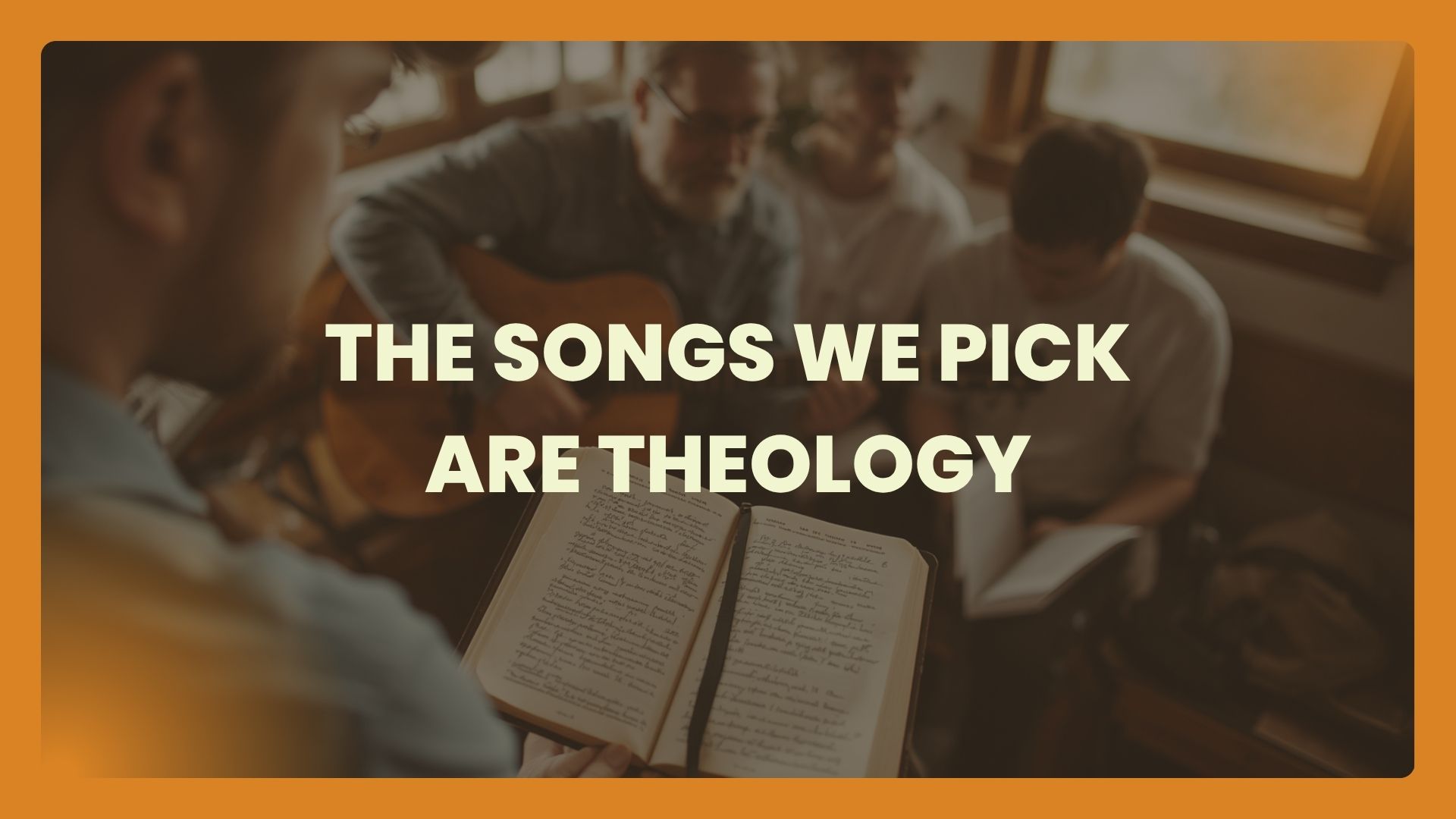
The Songs We Pick Are Theology
A few years ago, I was asked to make sure the closing song "matched" the sermon.
The sermon was on grace, or judgment, or restoration — I genuinely don't remember anymore, because I never actually heard what it was about until the preacher stood up to deliver it. No outline beforehand. No theme shared in the planning meeting. Just an assumption, never stated out loud, that I would somehow land the closing song on the same note he was about to land on.
So I did what worship leaders do in that situation. I waited until the sermon was underway, listened for a phrase I could hang a song on, and then scrambled. A different key than I'd rehearsed, a song the team hadn't run through — something that technically rhymed with the topic, thrown together in the last fifteen minutes before it had to happen.
Nobody ever showed me the theological reasoning for why the closing song has to mirror the sermon's content. I've looked for it. I don't think it exists — not as a real conviction, just as an unexamined habit. But the requirement gets enforced anyway, while the thing that would actually make it possible — knowing what's coming — almost never gets offered.
I want to tell you what I think is actually going on underneath that.
There's a principle worship scholars use that sounds technical but isn't, once you sit with it: lex orandi, lex credendi. What we pray shapes what we believe. And it runs both directions, all the time — what we believe shapes what we pray, and what we pray, week after week, quietly becomes what we believe, whether we meant it to or not.
It took me a long time to realize how literally that's played out in church history. The early church was baptizing in the name of the Father, Son, and Holy Spirit for centuries before anyone had worked out a formal doctrine of the Trinity. The practice came first. The doctrine had to catch up to what the church had already been confessing every time it baptized someone or prayed together. And Luther — a musician himself, which is part of why he understood this so fast — went looking for a way to get reformed theology into people who couldn't read a theology book, and landed on the congregational hymn. He called it a "theological weapon," and he meant it almost literally. People who would never sit through a doctrinal argument sang one every Sunday instead. Give it a few years, and they believed it, whether anyone had ever explained it to them or not.
So a song is never just illustrating a theme. It's doing the same kind of formative work a sermon does — arguably a deeper kind, because it gets repeated, memorized, and sung with the body in a way a sermon point rarely is. What a congregation sings becomes what a congregation believes about God, whether the words were chosen carefully or grabbed in a hurry fifteen minutes before the service.
This shows up differently depending on which worship culture you're standing in, and both versions cause real damage.
In music-centered worship, songs get chosen for how they land emotionally — for how well a bridge builds toward a moment, for whether the room visibly responds when the key changes. That's not nothing; a song that moves people is doing something real. But it creates its own unexamined assumption, the mirror image of the one I'll describe in a sermon-centered room: that if a song feels theologically right, it probably is theologically right. Nobody states that out loud either. It just governs the set. A song stays in rotation for years because the congregation loves it, while nobody asks closely what it actually claims about God, or whether the church would ever preach that claim from the pulpit. The set gets built like a mood with a beginning, a peak, and a resolution — and the theological content along the way gets evaluated, if it gets evaluated at all, by whether it carried the emotional arc rather than by whether it was true.
In sermon-centered worship, the danger is quieter and, I think, harder to see from inside it. The assumption isn't that songs don't matter — it's that the songs aren't where the theology happens. The sermon is where real content gets delivered. The songs around it are framing: something to warm the room up, something to let the room settle afterward. That sounds modest and harmless. It isn't. It's a theological claim — that the congregation's sung words don't carry doctrinal weight of their own, only the preached ones do — and it's a claim nobody actually argues for. It just gets assumed, and enforced through requirements like the one I described above, without anyone noticing that the requirement and the assumption underneath it don't actually have a theological leg to stand on.
Both cultures end up treating songs as something other than what they are: a congregation's most repeated, most embodied confession of what they believe about God.
So what changes, depending on where you serve?
If you preach: the songs around your sermon are not optional bookends. Sharing your text and your direction with whoever is planning the music — early enough for it to actually shape their choices, not just confirm a guess after the fact — isn't a courtesy. It's recognizing that the singing is doing theological work alongside your sermon, not underneath it.
If you lead or plan music: you are not curating a mood. Every song you place in the service is teaching the congregation something about God, whether you intended it to or not. That doesn't mean every choice needs a footnote — it means the question underneath your selection should be theological before it's musical.
If you intercede, serve on a worship committee, or hold no say over the music at all: this still touches you. The doxology you may sing without thinking, the psalm read responsively, the closing hymn — these are forming the congregation's theology as surely as anything said from the pulpit. You don't need a microphone to notice that, or to ask whether what's being sung lines up with what's being prayed and preached around it.
None of this is a checklist for sorting songs into good theology and bad theology. It's a question to keep asking: what is this congregation being taught to believe, every time they sing — and is anyone actually paying attention to that?
Think about the songs your church sang last Sunday. If someone only learned their theology from those songs — nothing else — what would they end up believing about God?