When the Piano Arrived
The first time someone told me that drums didn't belong in church, I was nineteen years old and standing behind a kit I'd set up myself.
We were a small congregation. College town. Nobody had told me there was a debate. I just thought we were trying to worship.
The objection came from a deacon whose family had attended that church for four generations. He wasn't unkind about it. He just looked at the drum kit the way you'd look at something that had wandered in from outside — something that didn't belong here, whatever here was.
I've thought about that moment a lot since then. Not with bitterness. More with curiosity. Because I found out later that the same objection had been cycling through churches for about four hundred years. The instruments change. The objection doesn't.
The organ fought for its place first.
It's hard to remember this now, because the pipe organ has become so completely identified with sacred music that arguing against it feels like arguing against stained glass. But for centuries, it was the instrument of the theater, the tavern, the public square. During the English Civil War in the 1640s, Puritans dismantled organs from English churches — not because they were against music, but because that particular instrument carried associations they didn't trust.
The organ won. It became the sound of Sunday — so thoroughly that by the nineteenth century, you almost couldn't imagine a proper church without one.
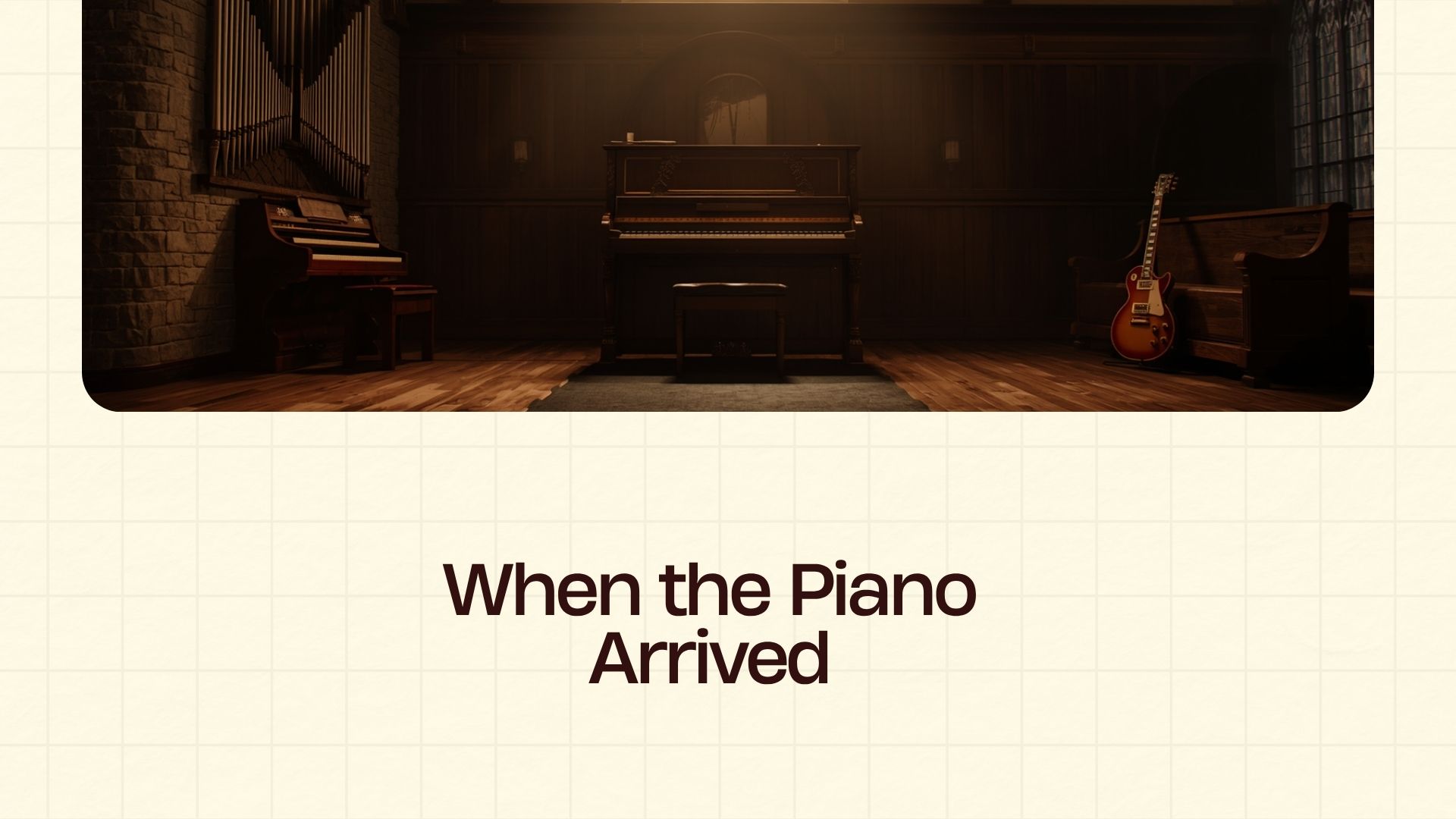
And then the piano arrived.
The piano's entry into Protestant worship in the 1800s set off a controversy that reads now as almost absurd. But the objections were serious, and they were made by serious people. The piano, critics argued, was a parlor instrument — drawing rooms and sentimental songs, not anything solemn or sacred. Several denominations formally opposed it. A minister and editor named Moses Lard put the theological case plainly in 1867: the issue was "the right of men to introduce innovations into the prescribed worship of God. This right we utterly deny."
What strikes me is not that the objection was wrong. It's that it was familiar. The organ had been through this. Every new instrument had to survive the same gauntlet: this thing doesn't belong here, because it belongs out there.
The piano survived. By the early twentieth century, you'd have been hard-pressed to find a Protestant church that didn't have one. The very thing that once seemed to threaten the sacred had become a marker of it. The cycle, apparently, was not done.
Guitars followed the same path.
It wasn't abstract to me. I watched it happen — watched the acoustic guitar get tolerated, then accepted, then celebrated, while the electric guitar remained in a kind of church purgatory for another decade. It was loud, and it carried the sound of rock music with it — which meant, for a lot of people, it carried the sound of everything the church was supposed to stand apart from.
The drum kit arrived with the electric guitar, which made it worse. Now you had a whole set of instruments assembled in the front of the sanctuary, every one of them broadcasting where it came from.
I spent a lot of years being frustrated by this. Now I find it genuinely interesting — partly because when I first read about the piano controversies of the 1800s, I felt something close to vertigo. The same argument. The same anxious question. The argument against drums in the late twentieth century was structurally identical to the argument against the piano in the nineteenth, which was structurally identical to the argument against the organ a century before that.
This instrument does not belong in the presence of God. It belongs to the world.
Is there such a thing as a secular instrument? The people making these arguments weren't idiots. They were trying to protect something real — a sense that the gathered worship of God deserved a sound that set it apart from everything else you heard during the week. That instinct isn't entirely wrong.
But the history suggests something uncomfortable: we've never been very good at telling the difference between an instrument genuinely incompatible with worship and one that is simply unfamiliar to us. What changed, in every case, was not the theology. It was the generation.
Maybe that's because holiness isn't a property of sound waves. Worship is something we're drawn into — something already happening before we play a note. The instruments are downstream of that.
When I was a teenager, "How Great Is Our God" on electric guitar felt like the most alive form of praise I had ever offered. To the deacon who asked me to take down the drum kit, the same sound felt like an intrusion. We were having the same argument every generation has had, dressed in different instruments.
I keep coming back to why the cycle keeps running.
The revival logic I wrote about last time is part of it. Once music became a tool for producing a response, questions about which tools work best were inevitable. But I think it goes deeper. Every new instrument carries the sound of somewhere else — the parlor, the arena, the street. And maybe the question behind every objection was actually a real question: is there anything set apart here?
I don't have a clean answer. What I know is that the piano eventually stopped sounding like a parlor instrument to the people who grew up with it in church. The organ stopped sounding like a theater. Someday the electric guitar will stop sounding like a rock concert to someone — and by then, whatever comes next will have arrived, and someone will be standing in front of it, wondering if it belongs.