Where Are We Now?
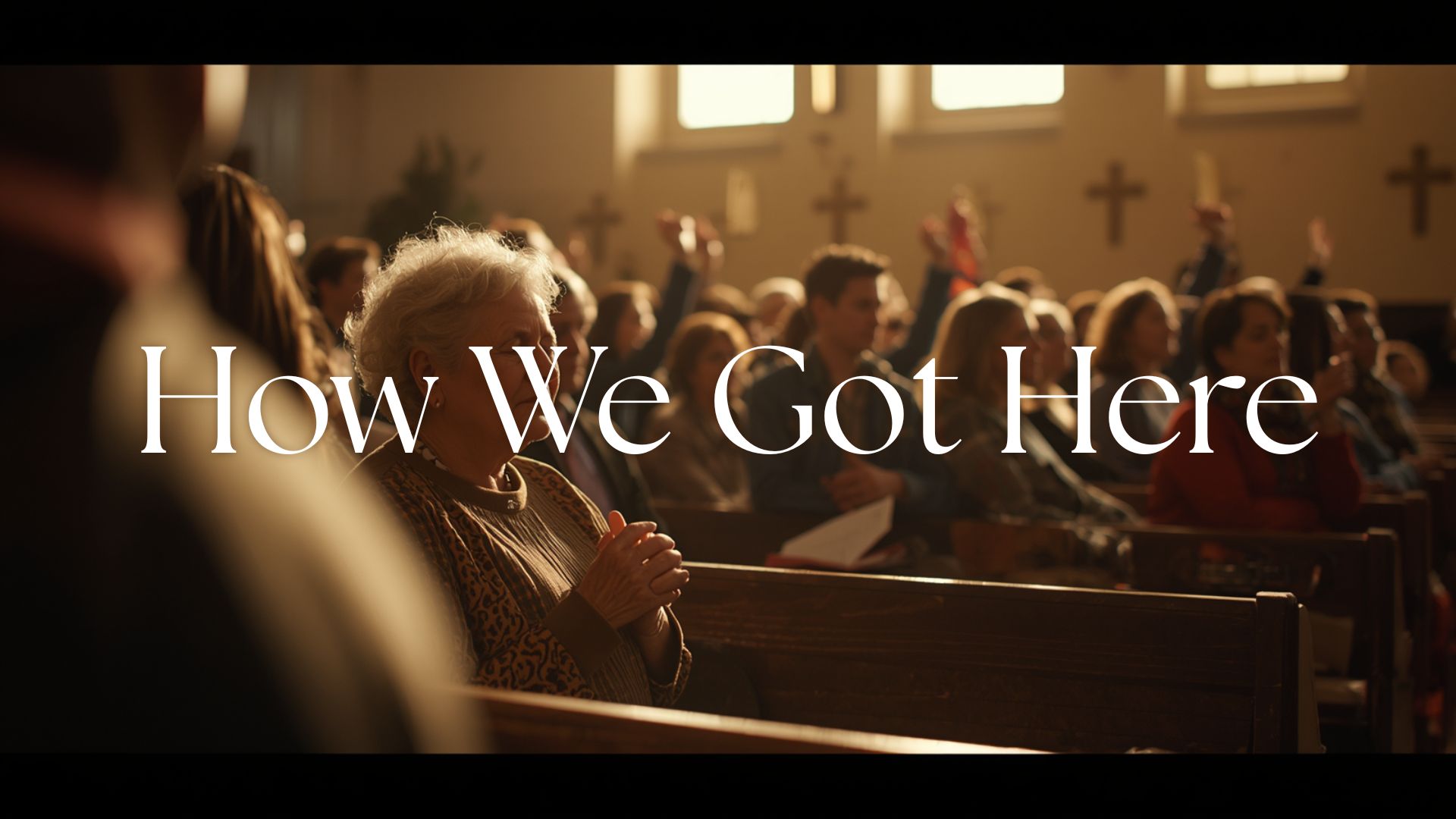
A few weeks ago, I was sitting in a Sunday service — not leading, just sitting — and I found myself doing something I almost never do. I was watching.
Not the screen. Not the worship leader. I was watching the congregation. The older woman in the third row who had her eyes closed and her hands folded in her lap, barely moving her lips. The college-age guy near the back who had both hands raised and was clearly somewhere else entirely. The family in the middle — kids squirming, dad staring forward, mom singing along with real effort and real tiredness at the same time.
I thought: this is what two thousand years of decisions looks like. Right here in this room.
We started this series in a house. Someone's courtyard in Rome or Corinth or Antioch. No stage, no sound system, no scheduled start time. People passing bread, reading a letter from Paul, praying out loud together — sometimes over each other, if Corinthians is any guide. The worship was participatory because there was no other option. Everyone's voice was the only instrument available.
Then Constantine walked in, and the houses became basilicas. The basilicas needed ceremony. The ceremony needed trained specialists. The people moved from the center of the room toward the edges. Latin closed around the liturgy like a vault, and by the medieval period, many worshipers were watching something happen rather than participating in it.
Luther kicked the door open. He put Scripture back in the language of the people, put songs back in the hands of the congregation, and — in the process — helped forge a tradition of congregational singing that spread across the Protestant world. Calvin stripped the room nearly bare and handed everyone a Psalter — a book of psalms to sing together. Cranmer threaded a needle few thought could be threaded and gave England something it's been arguing about ever since.
The revivalists of the eighteenth and nineteenth centuries moved worship off the calendar and into the moment. What mattered was not what season the church was in but what the Spirit was doing right now. Hymns became invitations. The altar call entered the order of service. Azusa Street broke open something that could not be contained — a freedom, a spontaneity, a physicality in worship that much of Western Protestant tradition had formally discouraged for generations.
Then the 1980s arrived, and the worship wars turned Sunday morning into contested ground. And out of that conflict came a new figure: the worship leader. A role that was invented, not inherited. A role I've been living in for twenty years.
So here we are.
Contemporary worship has largely won — at least in the spaces most of us occupy. Screens instead of hymnals. Bands instead of organs. A single platform voice instead of a dispersed congregational one. The services are generally shorter, the songs are generally newer, and the person at the front is generally younger than anyone who held that function in most of the previous eighteen centuries.
This is not a lament. I've seen genuine worship happen in these rooms. I've stood at the front in exactly these services and felt, on the good days, like a servant who got to be present for something real.
But I find myself carrying a set of questions that won't quite leave me alone.
I keep noticing the same thread running through all of it. In the early church, the worship depended on the whole body — many voices, not one. The medieval story is, in part, about how that got lost: the slow drift toward a production so polished that the ordinary person in the back wonders if their voice is needed. The worship wars were the same argument again, louder: who is this for? Which generation's formation counts? Whose experience of God gets to set the terms?
That argument isn't over. It's just resting.
The history we've traced in this series is not a straight line. It's not a story of progress, with each era getting closer to some ideal version of Christian worship. It's more like a series of overcorrections. Too much ceremony, so someone strips it back. Too little beauty, so someone ornaments it. Too much clergy, so someone gives the power back to the congregation — and when that swings too far, someone builds a structure again.
Every generation inherits what the previous one built, and then reacts against the part that hurt.
We're doing the same thing. We just don't know yet which part of what we've built will be what the next generation pushes back against. I have some guesses, but I could be wrong.
What I'm more confident of is this: the questions that have pressed on Christian worship from the beginning haven't gone away. They've just taken new shapes. Who speaks and who sings? Does the form we've chosen serve the gospel, or has it quietly started to serve something else?
I don't have clean answers. That's probably obvious by now.
What I have is this: twenty years at the front of a room, and an increasing sense that the most important thing I can do there is point. Not generate something, not perform something. Just point — toward what is already happening before any of us walked in.
If the history of Christian worship teaches anything, it's that the form is never the thing itself. The houses gave way to basilicas. The Latin gave way to the vernacular. The organ gave way to the guitar. And in all of those transitions — in the losses and the gains, the fractures and the recoveries — the thing that persisted wasn't a style or a structure. It was people gathered in the name of Jesus, trying to orient their whole lives toward God. Sometimes beautifully, sometimes badly — and sometimes in ways that excluded the very people it was supposed to gather.
The question for our moment isn't different: is what we're doing gathering people toward God, or gathering them toward something else? It's worth sitting with — honestly, with the whole history in view.
We got here somehow. And wherever we go next will be another chapter in a story that started in someone's house two thousand years ago — and hasn't finished yet.
Looking back over everything we've traced in this series — from the early church to today — what's one thing that surprises you most about how Christian worship has changed? And what's one thing that hasn't changed at all?