Working Memory in Mozart’s Clarinet Quintet in A Major, K. 581
A musical phrase disappears almost as soon as it arrives. Yet we do not experience music as a series of unrelated sounds. We hear a melody taking shape, a familiar idea returning, or a phrase moving toward a resting place.

How do we hold on to something that is already passing? Part of the answer lies in a mental process called working memory, which allows us to hold information in mind briefly while using it.
Musicians rely on working memory as they keep melodies, rhythms, and musical details in mind while reading music, listening, and performing.
Listening to Mozart’s Clarinet Quintet in A Major, K. 581, gives us a chance to follow this process as musical ideas pass between the clarinet and strings.
How We Hold Musical Ideas in Mind
When we hear a melody, our brains briefly hold the notes we have just heard. This allows us to compare them with the sounds that follow and recognize the melody as a connected whole.
Working memory also depends on attention. We cannot focus equally on every sound around us, so our brains select the information that matters most. For musicians, this means keeping track of a melody, following the rhythm, and noticing changes in the music—all while preparing for what comes next.
One way the brain manages information is through chunking. Instead of remembering each item separately, we group related information into meaningful units.
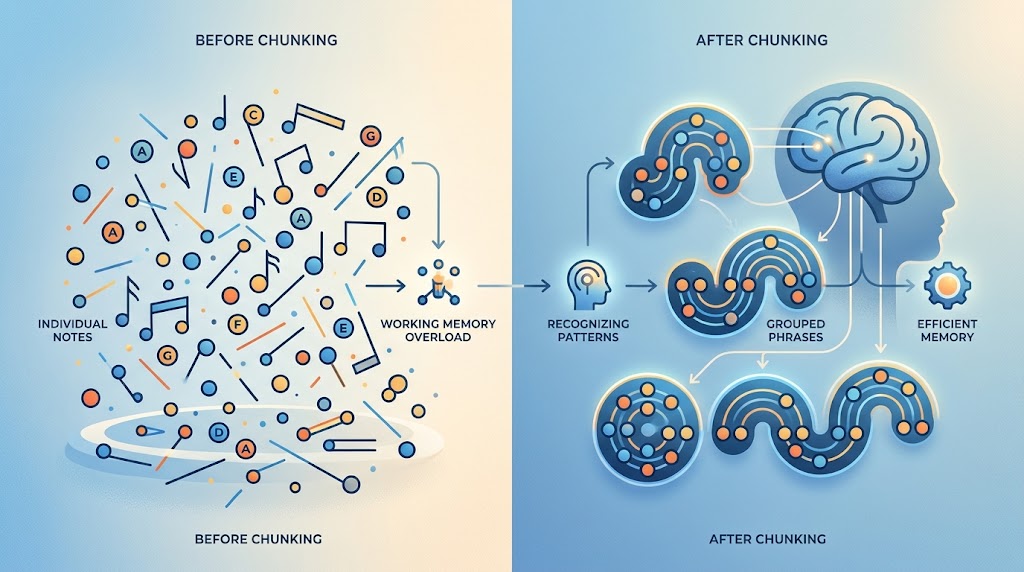
When notes form a familiar phrase, we remember them as a meaningful whole rather than as separate sounds. Musicians use this process naturally, recognizing patterns and grouping notes into phrases. This makes music easier to follow and remember.
As you listen to Mozart’s Clarinet Quintet, notice how a familiar musical phrase returns in a slightly different form. Try to recognize the pattern rather than focusing on every individual note.
Listening and Responding Together
Working memory is also important when musicians perform together. Each player must keep their own part in mind while listening to the other instruments.
In Mozart’s quintet, the clarinet and strings share musical ideas, sometimes taking the lead and sometimes responding to one another. The players must stay attentive to changes in timing and expression and adjust their playing as the music unfolds.
We do something similar in conversation. We listen while remembering what someone has said and thinking about how to respond. In both music and everyday life, attention helps us stay connected to the moment.
Keeping Our Attention on What Matters
“Let your eyes look straight ahead; fix your gaze directly before you.” — Proverbs 4:25
This verse encourages us to stay on the path of wisdom. It also invites us to reflect on where we direct our attention. In music, focused attention helps us recognize patterns, follow melodies, and respond to what we hear.
Life also brings many competing demands. Work, family responsibilities, and daily decisions can easily divide our attention. We may not be able to focus on everything at once, but we can learn to recognize what matters most in each moment.
Just as musicians connect individual notes into meaningful phrases, we can bring greater purpose to our daily lives by giving careful attention to what is before us.
In the next episode, we will explore how memories become more stable over time—and how sleep helps us retain what we have learned.
Read previous: How the Brain Recognizes Musical Patterns: Beethoven’s Symphony No. 5