After the Whammy — How Do We Live With It?
When Life Hits Hard — From Avoidance to Redemption(2)
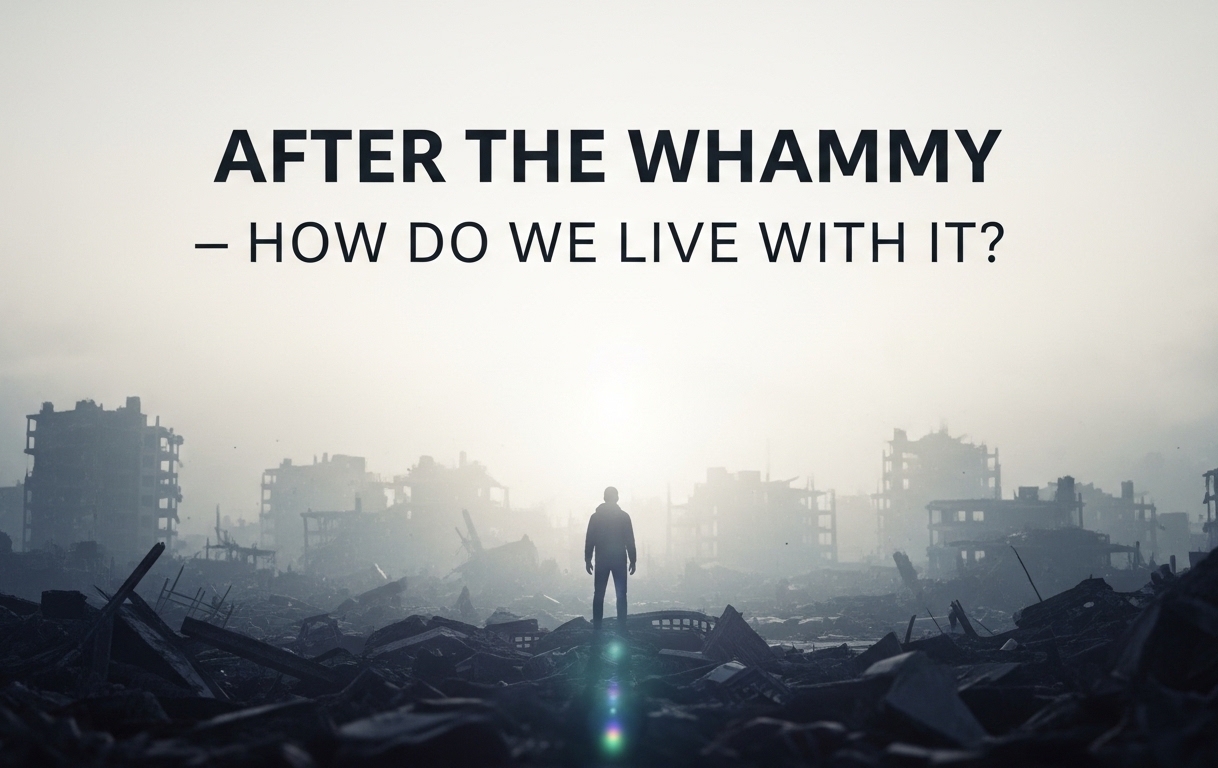
Questions about how to avoid the "whammy" eventually hit a dead end. There comes a point where we stop asking, "Can I escape this?" The damage is done, the clock can't be turned back, and certain choices leave marks that never fade. At that stage, the question shifts. It's no longer about "How do I get rid of this?" but rather, "How do I live while carrying this?"
This is precisely where Christianity introduces the Cross. If we look at its original meaning, it remains an uncomfortable story. It doesn’t offer a way to erase failure or bypass pain; instead, it insists that we must go through it. In the biblical narrative, the Cross was never treated as a light or easy passage. The process reveals the sheer density of suffering with an almost disturbing clarity.
The Cross stands as the ultimate convergence of extreme failure, shame, and irreversible consequences. In first-century Jewish society, it wasn't just a punishment. It was a public humiliation, a total exclusion from the community, and above all, a symbol of being "cursed." The claim that the Messiah would hang there was more of a contradiction than a solution by the standards of the time. The scene beginning in Gethsemane makes this reality undeniable.
"And being in agony he prayed more earnestly; and his sweat became like great drops of blood falling down to the ground." (Luke 22:44)
The state described here isn't just simple tension. It is a simultaneous existence of extreme pressure, a desperate desire to avoid the path, and yet, the choice not to run away. The prayer that follows is even more blunt:
"My Father, if it be possible, let this cup pass from me…" (Matthew 26:39)
The Cross was never a path that was embraced easily from the start. If there was any other way, it was a path to be avoided. This point is crucial because it presents Jesus’ obedience not as a mindless, robotic submission, but as a choice forged through deep internal conflict. He didn't endure because he was immune to pain; he changed his direction while being fully aware of the agony ahead. The pivot of that transformation lies in the second half of his prayer:
"…nevertheless, not as I will, but as you will." (Matthew 26:39)
What we see here isn't just a strengthening of the will. It is a profound trust in a relationship. Because there was someone he trusted more than his own feelings or judgment, he was able to make a different choice. The power to move past the Cross came less from sheer determination and more from faith in God.
The scene upon the Cross is even more extreme, encompassing not just physical pain but the experience of total abandonment. This moment is a vital turning point in Christian faith because it compresses the deepest forms of the human "whammy"—loss, failure, isolation, and shame—into a single event. The interpretation Christianity offers is unique: it doesn't say the pain vanished, but that its recipient changed. It suggests that the weight humans were meant to carry was taken on by another. Thus, the Cross is understood through a structure of substitution. The change Christianity speaks of isn't about "getting a little better," but about moving onto an entirely different orbit.
"But God shows his love for us in that while we were still sinners, Christ died for us." (Romans 5:8)
Love is accompanied by faith. Jesus trusted God and walked this path through the love God had for sinners. Love, in this context, isn't an emotional whim; it’s a choice that comes with a price. It’s a method of entering into the pain rather than removing it. Therefore, the Cross becomes a demonstration of the actual form love takes. The momentum to move toward the final outcome is explained in the same light:
"…who for the joy that was set before him endured the cross…" (Hebrews 12:2)
The "joy" mentioned here isn't about the immediate situation, but a certainty about what follows. It is the belief that a greater meaning exists beyond the current suffering. Without this, the Cross would have just been an end to the pain. Instead, the Bible presents it as an event endured with full knowledge of its significance.
Ultimately, the Cross can be summarized this way: Jesus did not cross it easily. It was a path he wanted to avoid if possible, and he experienced extreme agony and conflict throughout the process. Yet, the reason he could walk that path to the very end wasn't mere willpower, but love and trust in God.
In this sense, the Cross transcends being a simple theological symbol. It is an event that acknowledges the limits of human endurance while showing us a way to move beyond those limits. It isn't a message of avoidance, but of passage—a passage made possible through love and faith.