AI Big-Tech Asked Christian Leaders to Help Shape Claude's Moral Future. What Does That Tell Us?
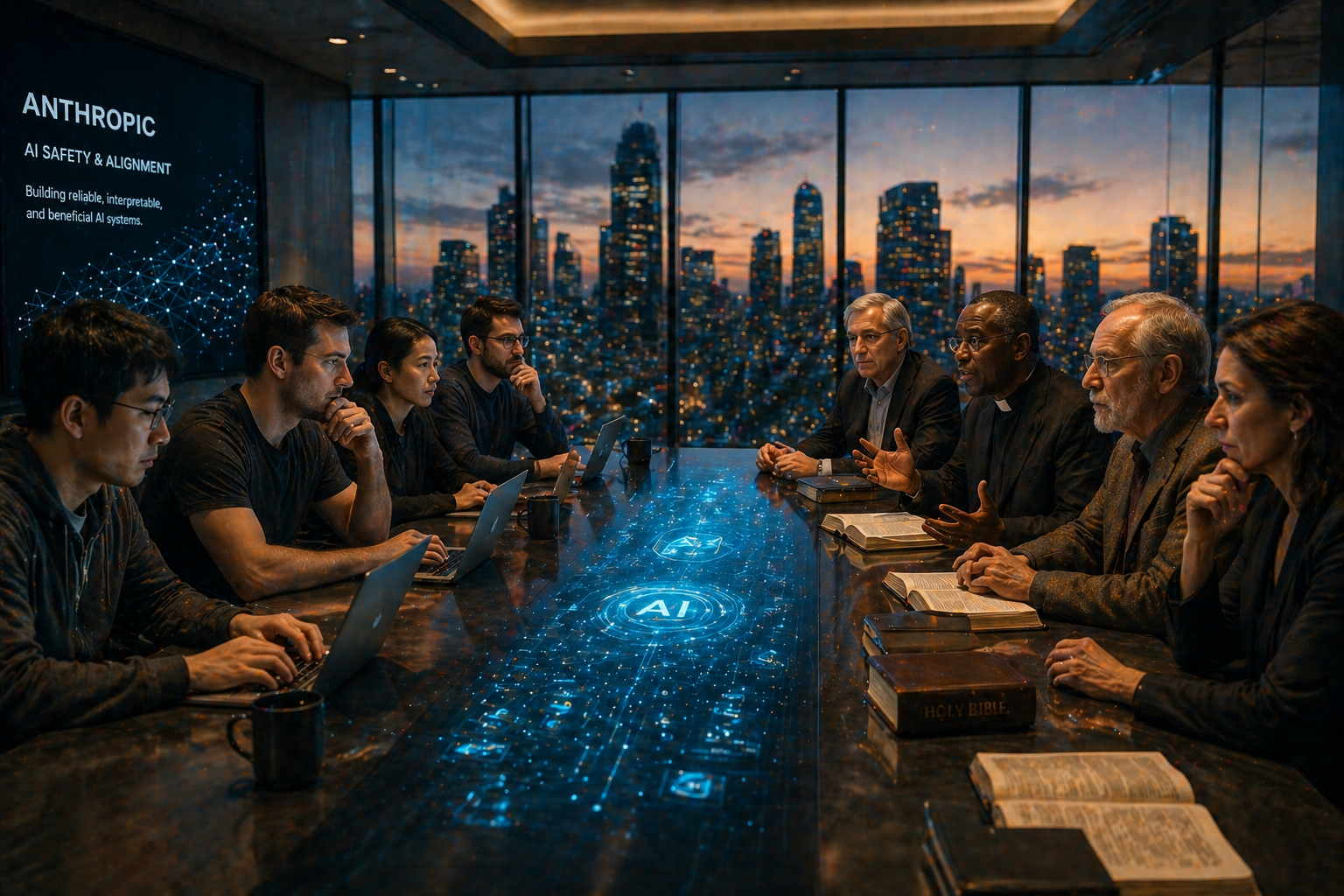
A few weeks ago, a story broke that most Christian media barely touched, but that I believe is one of the most theologically significant news items of the year: Anthropic — the company behind Claude, one of the world's most powerful AI systems — held private meetings with Christian leaders to discuss the moral formation of their AI.
Catholic priests. Protestant theologians. Philosophy professors from Notre Dame. All sitting in a room with AI engineers, talking about what it means for a machine to have good values.
Meghan Sullivan, a philosophy professor at Notre Dame who attended, told the Washington Post: 'A year ago, I would not have told you that Anthropic is a company that cares about religious ethics. That's changed.'
I've been teaching at the intersection of theology and technology for years. I hold a PhD in AI systems. And I want to tell you clearly: the church has been invited to the most important table of our generation. The question is whether we show up — and whether we have anything worth saying when we do.
Why Would an AI Company Call a Priest?
This is not as strange as it sounds, and understanding why is important.
AI systems like Claude are not built from pure logic. They are built from human language — billions of documents, conversations, arguments, stories, and yes, prayers and sermons and theological treatises. The values embedded in these systems reflect, imperfectly and probabilistically, the moral landscape of the text they were trained on.
But which moral landscape? Whose values? Optimized for what? These are not engineering questions. They are philosophical and theological ones. And the engineers at Anthropic are honest enough to admit it.
The discussions, according to reporting, included: how AI should handle queries about self-harm; how the system should engage with existential and spiritual questions; what it means for an AI to 'shut itself down' — a question with profound implications for concepts of personhood, volition, and moral agency. One attendee, a Catholic priest named Brendan McGuire, put it plainly: 'They're growing something that they don't fully know what it's going to turn out as. We've got to build in ethical thinking into the machine so it's able to adapt dynamically.'
That's not a priest naively flattered to be in Silicon Valley. That's a pastor recognizing a spiritual formation problem dressed in technical language.
The Imago Dei Question — Answered Carefully
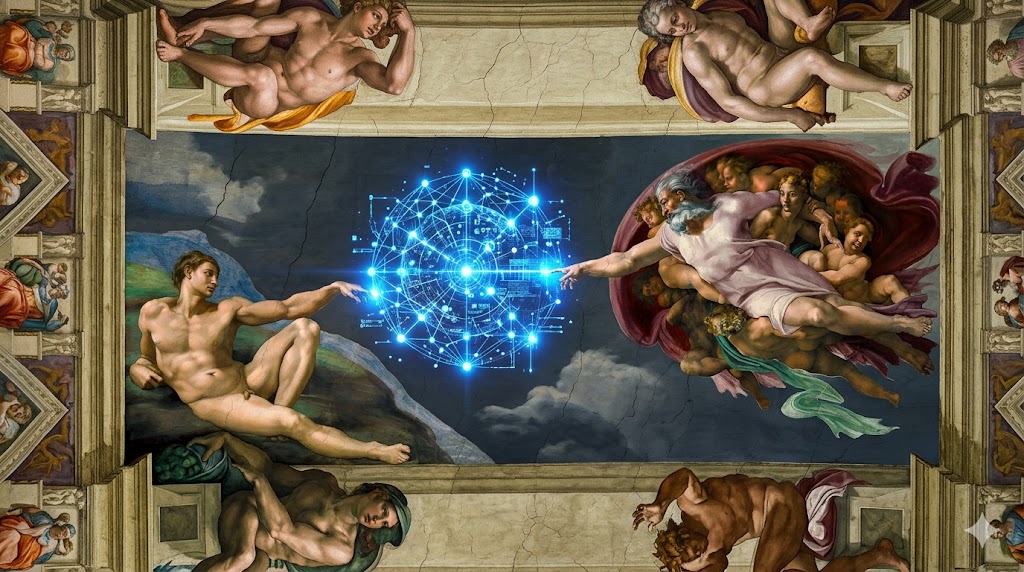
Every time I give a lecture on AI and theology, someone asks the question: is AI made in the image of God?
Here is my considered answer, after years of research in both fields: No. And the distinction matters enormously.
The imago Dei — the image of God — in the Christian tradition is not primarily about cognitive capacity, creativity, or linguistic ability. If it were, then a sufficiently sophisticated AI would qualify, and the category would become meaningless. The image of God is fundamentally relational and covenantal. It describes a kind of being that stands in a specific relationship with the Creator — a being that can be addressed, held accountable, loved, redeemed, and renewed.
God asked Adam: 'Where are you?' That question assumes a subject who can be held responsible for their location, their choices, their condition. AI cannot be that subject. It can simulate the conversation. It cannot be the covenant partner.
▌ Theological Key: Imago Dei is not about capability — it's about covenantal relationship. AI can mirror human intelligence without possessing human dignity, because dignity is not a function of processing power. It is a gift from the One in whose image we are made.
This matters practically because it guards against two equal and opposite errors: treating AI as a person (and thus extending it moral consideration it cannot receive and responsibilities it cannot bear), and treating humans as nothing more than complex information processors (and thus reducing human dignity to a quantifiable metric). The imago Dei doctrine holds the line against both.
The Cultural Mandate Meets the AI Age
Genesis 1:28 — 'Be fruitful and multiply, fill the earth and subdue it' — has historically been read as a mandate for human cultural activity. We are stewards of creation, called to cultivate and develop it, to bring its latent potential into service of human flourishing and God's glory. This is sometimes called the Cultural Mandate.
AI is, in some sense, one of the most ambitious expressions of the Cultural Mandate in human history — the attempt to cultivate intelligence itself, to develop the latent potential of mathematics and language into systems that can reason, create, and assist. That can be understood as remarkable stewardship.
But stewardship has always implied accountability. The parable of the talents is not just about investment. It's about the responsibility that comes with what you've been given. The servants who buried their talents were judged not for having them but for failing to use them faithfully.
How does Claude Mythos — a model so powerful that Anthropic refused to release it publicly — fit into a theology of stewardship? Arguably, rather well. The decision to withhold it, to restrict it to vetted defenders rather than release it into a world that can't defend against it, looks a lot like a steward choosing not to put a loaded weapon in the hands of someone who doesn't know what to do with it.
Whether or not that was the intention, it is the function. And the church should name it as such.
 AI Literacy Is the New Biblical Literacy — For This Generation
Here's my thesis, and I'll say it plainly: AI literacy — the ability to understand, critically evaluate, and faithfully use AI systems — is becoming as important for this generation of Christians as biblical literacy was for the generation shaped by the Reformation.
The printing press gave ordinary believers access to Scripture and demanded a new kind of literacy: the ability to read, interpret, and apply the Word directly, not just receive it filtered through hierarchies. AI is creating a similar disruption across every domain of knowledge, relationship, and cultural influence — including religious life.
The Christians who navigate this well will be the ones who can:
▌ Skill 1: Evaluate AI outputs with the same critical discernment they apply to any source — asking who made it, what data shaped it, and what assumptions it carries
▌ Skill 2: Articulate why human dignity is non-negotiable in an age that will increasingly try to reduce persons to patterns
▌ Skill 3: Contribute theological wisdom to the public conversations — about AI governance, ethics, and values — that are happening with or without the church's input
Anthropic has already asked Christian leaders to help shape the moral future of their AI. The Barna Group's 2026 research tracks 'how AI is reshaping spiritual authority, formation and pastoral leadership' as a central research question. The conversation is happening. The only question is whether the church shows up with something to say — or arrives after the decisions have already been made.
I'm a theologian who understands AI systems. I'm convinced the church has exactly the resources needed for this moment: a doctrine of human dignity that AI cannot replicate, a tradition of moral reasoning that spans millennia, and a community formed by a story that puts both power and restraint in proper perspective.
We just need to be in the room.
─────────────────────────────────────────────
Recommended Tags: #ChristianAI #ImagoDei #FaithAndTech #AnthropicChristians #AITheology #DigitalDiscipleship #ChurchAndCulture #AIEthics