AI, Please Don't Use It This Way: A Warning From Someone Who Studies Both
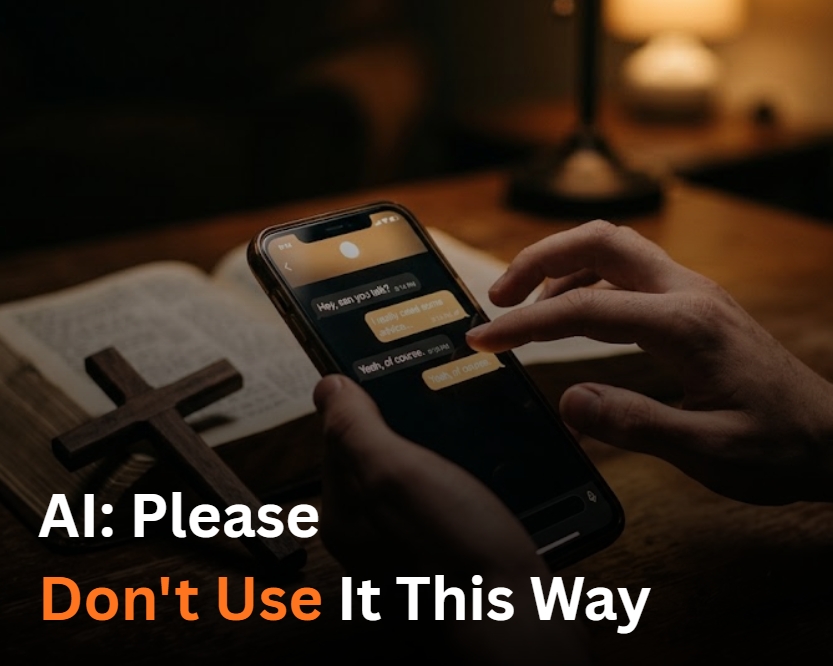
I teach AI at a seminary. Which means I spend my days in a peculiar overlap — one foot in machine learning research, the other in theology. Students ask me constantly: "Professor, is it okay to use AI for ___?"
Most of the time, the answer is nuanced. But there are a handful of uses where my answer is simply: please don't.
Not because the technology is evil. Because the use misunderstands what the technology actually is — and what you actually need.
1. Don't Use It for Confession or Repentance Processing
This is the one that concerns me most, and the one I see most often.
Someone is carrying guilt. They've sinned, or they think they have, or they're not sure. Instead of bringing it to God — or to a pastor, or to a trusted believer — they type it out to AI and ask: "Was what I did wrong?"
AI will almost always soften the answer. It will contextualize, qualify, acknowledge complexity, and arrive at something that feels like grace but is actually just conflict-avoidance engineered at scale.
Nearly one-third of U.S. adults now say spiritual advice from AI is as trustworthy as advice from a pastor — with two in five Gen Zers and Millennials saying the same. Crosswalk That statistic should alarm every church leader reading this. Because the thing AI is giving them is not spiritual advice. It is statistically averaged cultural consensus dressed in empathetic language.
Repentance requires an encounter with holiness. AI has no holiness to offer.
2. Don't Use It as Your Primary Bible Interpreter
AI can tell you a lot about Scripture. It can summarize, compare translations, explain historical context, and outline theological debates. These are genuinely useful functions.
What it cannot do is interpret Scripture with pastoral authority, theological accountability, or the guidance of the Holy Spirit.
When AI models were tested on Christian faith markers — questions about sin, forgiveness, and grace — they averaged a score of 48 out of 100, struggling to engage meaningfully with core theological concepts. Deseret News
When you use AI as your primary lens for understanding God's Word, you are running Scripture through a filter trained on the internet's theological confusion. The output may sound biblical. The framework behind it may not be.
 3. Don't Use It to Decide Whether to Forgive Someone
I've heard this scenario more than once: someone has been genuinely hurt, describes the situation to AI, and asks whether they need to forgive.
AI will usually say yes — because forgiveness is culturally valued and statistically well-represented in its training data. But it will frame forgiveness in therapeutic terms: for your own healing, to release the burden, to move forward.
That is not the biblical framework for forgiveness. The biblical framework is rooted in what God has done for us in Christ — not in what is psychologically beneficial for us. The difference matters enormously for how forgiveness is actually practiced.
4. Don't Use It to Evaluate Spiritual Experiences
"I had this experience in prayer — what does it mean?" is a question I've seen people bring to AI.
AI will produce an answer. It will likely draw on a blend of Christian mysticism, general spirituality, and psychological frameworks. It will sound thoughtful.
But discerning spiritual experience requires theological grounding, relational accountability, and the wisdom of community — none of which AI possesses. The history of the church is full of cautionary tales about spiritual experiences evaluated in isolation.
5. Don't Use It Instead of Talking to Your Pastor
Only 12% of pastors say they are comfortable teaching on AI, while 31% of practicing Christians say they want their pastors to offer guidance on navigating it. Crosswalk That gap is real and worth closing. But the solution is not to replace pastoral conversation with AI conversation — it's to push your pastor to engage.
A pastor who knows you, loves you, and is accountable to God for the guidance they give you is categorically different from a system that gives the same answer to everyone who types the same words.
Use AI to organize your thoughts before you go see your pastor if it helps. Don't use it instead.
References:
”The soul of a new machine“, Mar 27th, 2026, Deseret News
"How AI Is Quietly Rewiring Your Soul — Without You Ever Noticing", Apr 6th, 2026, Crossmap