Can AI Actually Help You Study the Bible? An IT Professor's Honest Review
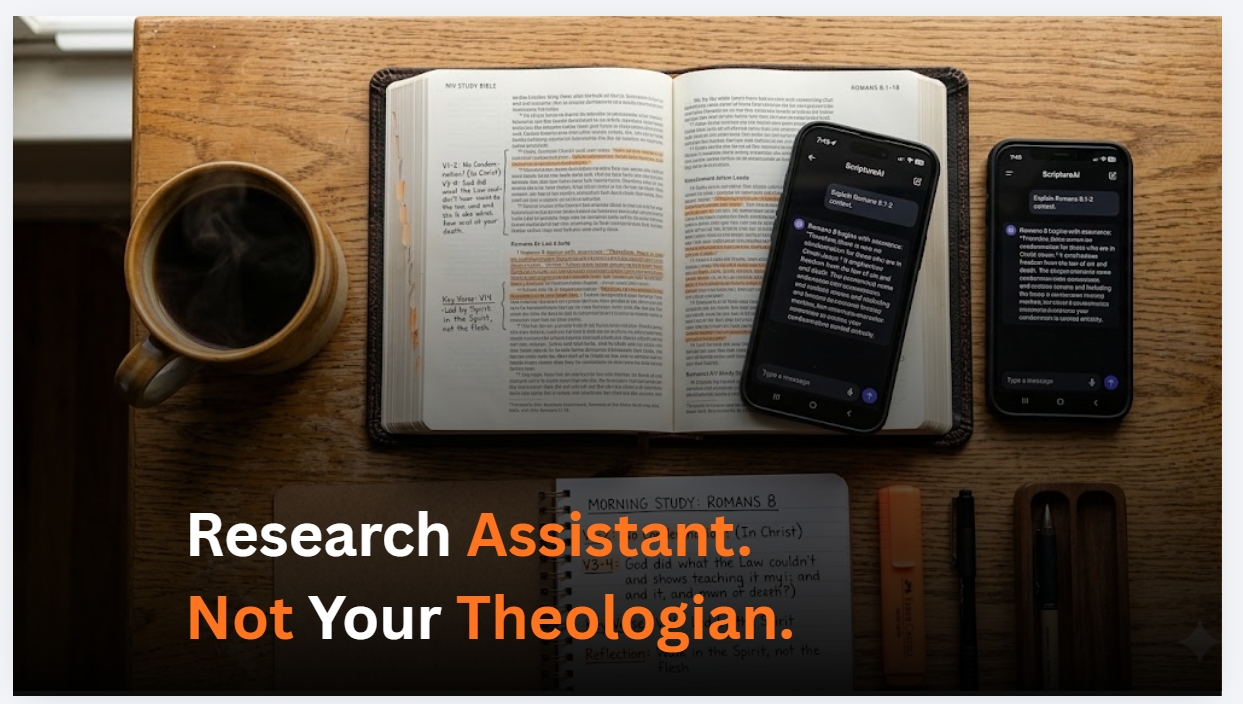
Students in my AI courses ask me tech questions. Students in my theology courses ask me faith questions. Almost nobody asks me both at once — which is exactly why I think this particular question doesn't get answered well anywhere.
So here it is: an honest review of AI for Bible study, from someone who understands the technology and takes the Scripture seriously.
Short version: better than you probably think, in ways you probably don't expect, and dangerous in one specific way almost nobody is talking about.
Where AI Is Genuinely Useful for Bible Study
Original language context — instantly.
This used to require a Greek lexicon, a Hebrew dictionary, and enough seminary training to know what you were looking at. Now you can ask: "What is the Greek word behind 'love' in John 3:16, what are its semantic range and distinctions from other Greek words for love, and how does this affect the meaning of the verse?"
The answer you get will be accurate enough to significantly deepen your reading — and will take thirty seconds instead of thirty minutes. For the vast majority of Christians who don't have seminary training, this is a genuine and meaningful upgrade.
Cross-referencing at scale.
"What other passages in Paul's letters address the relationship between grace and obedience, and how do they relate to each other?" — this kind of synthesis used to require either a concordance, a commentary, or a lot of time. AI handles it well, and the output is a useful starting point for your own study.
Historical and cultural background.
What was a Roman centurion? What did it mean to "recline at table" in first-century Jewish culture? What was the social significance of a Samaritan in Jesus' context? AI is excellent at this kind of background retrieval. The information is accurate enough to enrich your reading substantially.
Comparing translations meaningfully.
"Compare how the ESV, NIV, NASB, and NLT translate Romans 8:28, and explain the significant differences in word choice and what they reflect about translation philosophy." This is a genuinely useful Bible study exercise, and AI executes it well.
The One Danger Almost Nobody Is Talking About
Here it is: AI will give you confident answers to questions that theologians have debated for centuries.
Ask it about predestination and free will and it will give you a clear, measured answer — one that feels like it resolves the debate. Ask it about the nature of hell and it will give you something similarly tidy. Ask it about the millennium and you'll get an answer that sounds definitive.
The tidiness is the problem.
Scripture maintains tensions. The history of the church maintains debates. Faithful Christians across traditions have held different views on these questions for good reasons. AI, optimized for coherent and satisfying outputs, will smooth those debates into something that feels resolved.
When you study the Bible with AI as your primary interpreter, you are at risk of inheriting its theological confidence — and that confidence is often not warranted.
Use AI as a research assistant. Keep a theologian, a commentary, and a community of believers in the loop for interpretation.
 A Practical Study Framework
Here's how I recommend integrating AI into Bible study without letting it replace what it shouldn't:
Step 1 — Read the passage first. Always. Don't let AI shape your first impression.
Step 2 — Note your own questions. What confuses you? What surprises you? What do you want to understand better?
Step 3 — Use AI for background and language. Original word meanings, historical context, translation comparisons. This is where it excels.
Step 4 — Use a commentary or theologian for interpretation. Calvin, Wright, Fee, Carson — pick a tradition and engage a real theological voice for the meaning questions.
Step 5 — Bring it to community. Whatever you've learned, bring it into conversation with other believers. The interpretation of Scripture has never been a solo exercise.
About 40% of practicing Christians say AI has helped them with Bible study, prayer, or spiritual growth. Crosswalk That number will grow. The question is whether the help is actually helpful — or whether it's creating a generation of Christians who feel more informed and are actually less rooted.
Reference:
Christian AI Apps
How Is AI Shaping You?, Feb 20th, 2026, DesiringGod