Dvořák’s “American” String Quartet: Four Voices, One Beautiful Whole
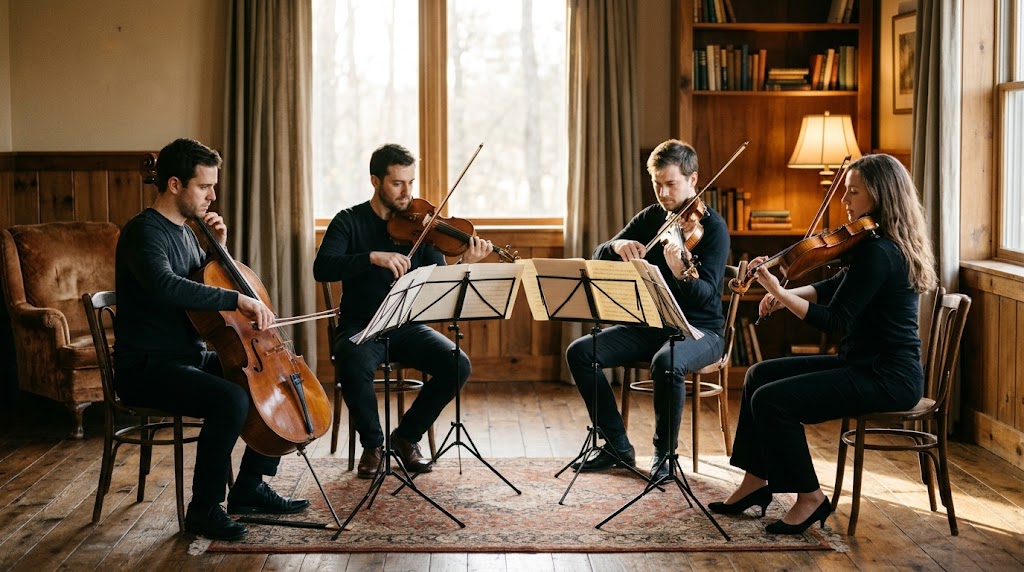
In a string quartet, each instrument has its own voice. One may carry the melody while the others provide support, then another may step forward with an idea of its own. The music comes alive as the four instruments respond to one another.
Antonín Dvořák (1841–1904) brings this interplay to life in his String Quartet No. 12 in F Major, Op. 96, known as the “American” String Quartet. Composed in 1893 during his stay in the United States, it is filled with memorable melodies and lively rhythms.
Four Instruments, Different Roles
A string quartet consists of two violins, a viola, and a cello. The first violin often carries the melody, while the second violin and viola add harmony and texture. The cello provides a deeper foundation, though it can also take the lead.
These roles are not fixed throughout the music. At times, an instrument that usually provides support takes on the melody, while the others adjust around it.
Listen for the Changing Voices
Notice when the first violin carries the melody and how the other instruments support it. Then pay attention to moments when the second violin, viola, or cello comes forward with a musical idea of its own.
The supporting parts matter, too. A repeated rhythm gives the music momentum, while changes in harmony add depth and shift the mood. Across the quartet’s four movements, the instruments take turns leading, responding, and supporting one another, keeping the music lively and full of conversation.
Different Gifts, One Community
The “American” String Quartet shows that working together does not mean everyone has to do the same thing. One person may lead, another may offer steady support, and someone else may contribute an idea that changes the direction of the whole. Each role matters.

The same is true in a family, a classroom, a workplace, or a church community. We all have different strengths, and sometimes our most meaningful contribution is helping others do their part well.
“We have many members in one body, and these members do not all have the same function.” — Romans 12:4
Paul’s words remind us that unity does not require sameness. Like the instruments in Dvořák’s quartet, we can bring our different gifts together and make room for one another.
Explore more of Dvořák’s string quartets here. (affiliate link)
Read previous: Schubert’s Trout Quintet: When Instruments Share a Melody