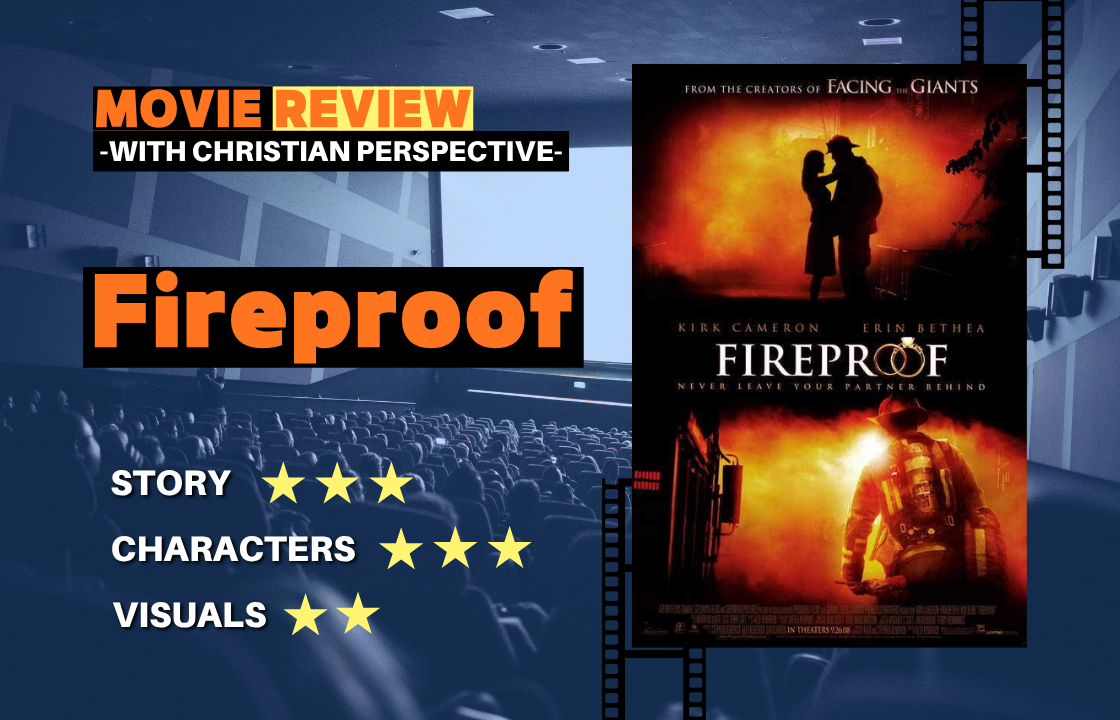
'Fireproof' Movie Review: A Christian Marriage Movie That Still Hits Hard Years Later
 Can a marriage survive when love feels completely gone?
Fireproof remains one of the most talked-about Christian marriage movies because it focuses less on feelings — and more on sacrifice, repentance, and covenant love.
When Fireproof first released, a lot of people assumed it would be “just another church movie.” Low budget. Unknown actors. Predictable ending.
Then something unexpected happened.
Couples started talking after the credits instead of during the movie.
Small groups used it for marriage discussions. Pastors referenced it in sermons. Husbands quietly bought “The Love Dare” without telling anyone. And somehow, this modest Christian film became one of the most influential faith-based marriage movies ever made.
But years later, does Fireproof still hold up?
Honestly, yes — though maybe not for the reasons people think.
What Is Fireproof About?
The movie follows Caleb Holt, a firefighter who looks brave in public but is failing badly at home. His marriage with Catherine is collapsing under resentment, selfishness, emotional distance, and constant conflict.
After divorce papers enter the picture, Caleb’s father challenges him to complete a 40-day experiment called “The Love Dare.”
At first, Caleb treats it like a task list.
Then the movie slowly reveals the deeper issue: the real fire isn’t inside burning buildings — it’s inside Caleb himself.
That shift is where Fireproof becomes more than a relationship movie.
It becomes a confrontation with pride.
Why Christians Connected So Deeply With This Movie
Most Christian marriage films before Fireproof felt overly polished or unrealistic.
Fireproof did something different:
It showed ugly arguments.
It showed emotional withdrawal.
It showed selfishness without immediately softening it.
It showed how bitterness grows slowly.
A lot of viewers saw themselves in Caleb long before they wanted to admit it.
The movie’s core message is deeply biblical:
Love is not sustained merely by emotion.
Love is sustained by sacrifice, covenant, repentance, and grace.
That idea reflects passages like:
- Ephesians 5:25 — “Husbands, love your wives, just as Christ loved the church and gave himself up for her.”
- 1 Corinthians 13:4-7 — “Love is patient, love is kind... It always protects, always trusts, always hopes, always perseveres.”
- James 2:17 — “Faith by itself, if it is not accompanied by action, is dead.”
The film does not present marriage as “follow your feelings.” It presents marriage as daily discipleship.
That distinction is one reason the movie stayed relevant.

The Strongest Part of the Movie Isn’t the Romance
Many people remember the emotional scenes or the famous “Love Dare” moments.
But the strongest part of Fireproof is actually Caleb’s spiritual transformation.
At the beginning:
he wants control,
validation,
comfort,
and personal happiness.
Later, he begins confronting sin, selfishness, anger, addiction to selfish habits, and spiritual emptiness.
The movie quietly argues something many Christian couples eventually discover:
A marriage problem is often partially a worship problem.
Not always. Not simplistically. But frequently.
The film avoids turning marriage into mere “communication techniques.” Instead, it roots change in repentance and Christ-centered love.
That is a major reason many pastors and Christian counselors still recommend it.
Is Fireproof Realistic?
Yes and no.
Some scenes are undeniably dramatic. Certain dialogue moments feel a little staged compared to mainstream Hollywood films.
But emotionally?
The movie is surprisingly accurate.
Many marriages do not collapse because of one catastrophic betrayal. They collapse through:
accumulated neglect,
unresolved resentment,
emotional laziness,
digital distraction,
pride,
and silence.
Fireproof captures that erosion well.
The movie also understands something modern culture often ignores:
Love can return after emotional numbness.
Not always. Not instantly. But sometimes the feelings follow faithful action rather than preceding it.
That concept is extremely countercultural today.
The Christian Message Is Clear — But Not Artificial
One criticism often aimed at Christian films is that they feel like sermons disguised as movies.
Fireproof occasionally gets close to that line, but it mostly succeeds because the spiritual themes emerge through character change rather than lectures alone.
The gospel presentation in the film is direct, but it is integrated into Caleb’s personal collapse and rebuilding.
For many viewers, that honesty made the message land harder.
Weaknesses Worth Mentioning
To be fair, the movie is not perfect.
Some limitations include:
supporting characters occasionally feel one-dimensional,
certain dialogue exchanges feel overly scripted,
pacing slows in the middle sections,
some emotional resolutions happen faster than real life usually allows.
Also, if someone expects a purely secular relationship drama, the explicit Christian worldview may feel too direct.
But removing the Christian framework would also remove the movie’s core foundation.
The entire story depends on redemption, humility, forgiveness, and covenant love.
Without those ideas, Fireproof would lose what made it memorable.
Why Fireproof Still Matters in 2026
Ironically, the movie may be more relevant now than when it first released.
Modern relationships face:
endless digital distraction,
social media comparison,
emotional burnout,
pornography normalization,
hyper-individualism,
and disposable relationship culture.
Fireproof pushes against all of that.
It asks uncomfortable questions:
What happens when commitment survives after emotions weaken?
What if love is a discipline, not just chemistry?
What if humility matters more than winning arguments?
Those questions remain painfully relevant.
Final Verdict
Fireproof is not merely a movie about fixing marriage.
It is a movie about dying to self.
That is why it resonated with so many Christian viewers — and why it still does.
If you want:
a biblically grounded marriage film,
meaningful discussion material for couples or small groups,
or a Christian movie that actually challenges the viewer rather than merely entertaining them,
Fireproof is still worth watching.
Not because it is flawless.
Because it understands something many modern stories forgot:
Real love is tested in the fire before it becomes strong.