He Is Risen
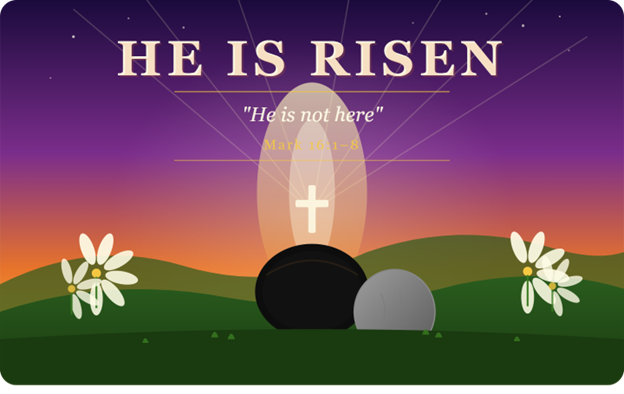
He Is Risen
“He is not here” (Mark 16:6).
[Note: This sermon was preached on Easter Sunday, Sunday, March 31, 2002, at Trinity Baptist Church, Chicago, Illinois].
I. The Darkness of Calvary
When Jesus died upon the cross at Calvary, darkness covered the earth. The evangelist Mark records that from the sixth hour until the ninth hour, darkness came over the whole land (Mark 15:33). That physical darkness was a fitting emblem of what was happening in the spiritual realm, for at that very moment, darkness also filled the hearts of his beloved disciples. The light of their very lives had gone out. Their teacher, their Lord, their hope—everything they had believed and trusted was now lying cold and lifeless in a sealed tomb.
As Jesus himself had foretold on the night of his arrest, they were as sheep without a shepherd (Mark 14:27). The disciples were scattered. Peter had denied him three times. Judas had betrayed him and then, overwhelmed by remorse, had taken his own life. The others had fled into the shadows of the city. Probably they were hiding somewhere in Jerusalem, afraid for their lives, the doors of their hiding place locked for fear of the Jewish authorities (John 20:19). What should they do now? Where could they go? The one who had said, “I am the way, the truth, and the life” (John 14:6), was dead. The way seemed closed forever.
The experience of the disciples following the crucifixion is not so remote from our own experience as we might first suppose. Every man and woman who has ever stood at the graveside of someone deeply loved knows something of that darkness. Every person who has watched their dearest hopes collapse, who has seen what seemed good and beautiful and true swept away by the cruelty of the world, has stood in some measure where the disciples stood on that first Good Friday. The cross, seen without the resurrection, speaks only the language of defeat. And so, on Calvary, the only message that the hearts of the disciples could read was this: “Christ was defeated.”
II. The Announcement of the Angel
But God was not finished. Early on the first day of the week, while it was still dark, several women made their way to the tomb. They had come with spices, intending to complete the burial preparations that the urgency of the Sabbath had interrupted. They were, as it were, going to perform the last act of love that could be performed for a dead man. Their hearts were heavy with grief. Their question as they walked was practical and revealing: “Who will roll the stone away from the entrance of the tomb?” (Mark 16:3). They had no expectation of resurrection. They expected a sealed tomb, a silent grave, and a body that needed anointing.
What they found instead shattered every expectation. The stone—described by Mark as “very large”—had already been rolled away. And when they entered the tomb, they encountered not the body of Jesus, but a young man dressed in a white robe, sitting on the right side. Their reaction was immediate and entirely human: they were alarmed (Mark 16:5). And then came the announcement that changed the entire history of the world:
“Do not be alarmed. You seek Jesus of Nazareth, who was crucified. He has risen; he is not here. See the place where they laid him” (Mark 16:6).
Five words in the original Greek, (“he has risen; he is not here”), constitute the hinge upon which all of human history turns. The verb ἐγείρω is in the passive voice: Jesus was raised. He did not merely revive from a swoon, nor did he rise by his own unaided power. He was raised by the power of God the Father, in fulfillment of the Scriptures, according to the eternal purpose of redemption. The empty tomb is not a problem to be explained away; it is a proclamation to be received with trembling and joy.
Good news is often as difficult to accept and comprehend as bad news. This was certainly the experience of the women at the tomb. Mark records that they received the announcement of the angel with mixed emotions: they fled, trembling and bewildered, and said nothing to anyone, for they were afraid (Mark 16:8). Their fear was not the fear of unbelief, but the holy awe of those who have suddenly found themselves standing at the intersection of heaven and earth. They had come expecting a corpse; they departed confronted by a world in which death itself had been overturned.
III. The Cornerstone of Our Faith
The resurrection of Jesus Christ from the dead is not a peripheral teaching of the Christian faith. It is not one doctrine among many, to be affirmed or denied according to personal preference. It is the cornerstone upon which the entire structure of the gospel rests. The story of Jesus began with a miracle—the miracle of the virgin birth, by which the eternal Son of God entered human history in the womb of a young woman in Nazareth. And the story of Jesus in its earthly chapter ends with a miracle—the miracle of his bodily resurrection, by which the crucified Savior was vindicated by God and exalted to the right hand of the Father. This is what the New Testament clearly and consistently teaches.
The apostle Paul understood this with crystalline clarity. Writing to the church at Corinth, where some were beginning to doubt the resurrection, he stated the matter with unsparing directness:
“And if Christ has not been raised, your faith is futile and you are still in your sins” (1 Corinthians 15:17).
Remove the resurrection, and you do not have a diminished Christianity; you have no Christianity at all. You have only a noble martyr, a wise teacher, a failed revolutionary—but not a Savior. The resurrection is the Father’s verdict on the cross. It declares that the atoning sacrifice of Jesus was accepted, that the debt of sin was fully paid, that death, the wages of sin, has been conquered. Without the resurrection, the cross is merely a tragedy. With the resurrection, the cross becomes the greatest act of redemption in the history of the universe.
Paul also understood that the resurrection of Jesus is inseparable from the believer’s own salvation. He wrote to the church in Rome:
“if you confess with your mouth that Jesus is Lord and believe in your heart that God raised him from the dead, you will be saved.” (Romans 10:9)
Notice that Paul does not simply say, “Believe that Jesus died for your sins.” He says, “Believe in your heart that God raised him from the dead.” The resurrection is not an appendix to the gospel; it is part of the gospel itself. Not to believe in the bodily resurrection of Jesus is not to believe in Christ as Savior. And not to believe in the resurrection of Jesus is to have no assurance of your own resurrection from the grave.
IV. The Meaning of the Resurrection
What does the resurrection mean? It means, first of all, that death has a conqueror. Every human being who has ever drawn breath has lived under the shadow of mortality. Death comes to the learned and the unlearned, to the powerful and the powerless, to the old and, with heartbreaking frequency, to the young. The Psalmist wrote, “What man can live and never see death? Who can deliver his soul from the power of Sheol?” (Psalm 89:48). The answer of all pagan philosophy was silence. The answer of the empty tomb is Jesus.
The resurrection means, second, that the central message of the gospel is true. If the gospel could be summarized in two brief sentences, they would be these: “Christ died for our sins” (1 Corinthians 15:3), and “Christ has been raised from the dead” (1 Corinthians 15:20). These two sentences, taken together, constitute the gospel in miniature. The cross without the resurrection is a story of defeat; the resurrection without the cross is a story without meaning. But cross and resurrection together tell the story of a God who so loved the world that he gave his only Son, and who vindicated that Son by raising him from the dead.
The resurrection means, third, that the believer has a living Lord, not merely a dead example. This is the point that the risen Jesus himself made when he appeared to Mary Magdalene in the garden on the morning of the resurrection (John 20:11–18). He was not a vision. He was not a ghost. He was the same Jesus who had been crucified, now alive with a resurrection body, able to be touched, able to eat, able to speak, able to be known. When Mary recognized his voice and cried out “Rabboni!”, she was not recognizing a memory. She was recognizing a living person.
And the resurrection means, fourth, that our own resurrection is guaranteed. Paul calls the risen Christ “the firstfruits of those who have fallen asleep” (1 Corinthians 15:20). In the agricultural world his readers knew, the firstfruits were the pledge and foretaste of the full harvest to come. The resurrection of Jesus is not an isolated miracle, unique to him and disconnected from the rest of humanity. It is the beginning of a resurrection harvest that will include all who belong to him. Because he lives, we too shall live (John 14:19).
V. He Is Not Here — He Is Risen
The message of Easter is not a past-tense message. It is not merely the report of something that happened in a garden outside Jerusalem two thousand years ago, however significant that event may be. The angel’s words have a present-tense force that the grammar itself enforces: “He has risen.” The Greek verb, used in the parallel accounts in Matthew and Luke, denotes an action completed in the past with effects that continue into the present. He was raised, and he remains raised. He lives now. He reigns now. He intercedes now at the right hand of the Father (Romans 8:34; Hebrews 7:25).
The cross has long been recognized as the symbol of the Christian faith, and rightly so. But the empty tomb carries a message that the cross alone cannot carry. The cross speaks of sacrifice, of suffering, of the cost of our redemption. The empty tomb speaks of victory, of life, of the completion of that redemption. The cross says, “It is finished” (John 19:30); the empty tomb says, “He is not here” (Mark 16:6). Both declarations are necessary. Both are glorious. Together they tell the whole story of our salvation.
Jesus is alive today. He is not in his tomb, for he has chosen to dwell—not in a garden outside Jerusalem, not in a church building however beautiful, not in the pages of a book however sacred—but in the heart of each person who by faith receives the message of Easter: Jesus is Lord and Savior. “Christ in you,” wrote Paul to the Colossians, “the hope of glory” (Colossians 1:27). This is the wonder of the resurrection applied to the individual believer: the risen, living Christ takes up residence in the human heart through the Holy Spirit. He is not distant. He is not dormant. He is present, and he is alive.
Conclusion: The Gospel in Two Sentences
In their bereavement, the women came to the tomb where Jesus was buried. They came expecting death, and they found life. They came expecting a sealed stone and a silent darkness, and they found an open tomb and a radiant messenger. They came to mourn, and they were commissioned to witness. The same transformation that came over those women at the empty tomb can come over every person who receives the message they were sent to carry.
The resurrection of Jesus Christ is not a doctrine for the classroom alone. It is the living center of a living faith. It means that the one who said “I am the resurrection and the life” (John 11:25) has proved his claim by rising from the dead. It means that sin is forgiven, death is conquered, and eternal life is freely offered to all who will believe. It means that the darkness that fell over the disciples on Good Friday was not the final word. Easter morning was. And because Easter morning happened, every morning is now an Easter morning for the believer, a day lived in the light of the risen Christ, in anticipation of a resurrection that is as certain as his own.
The message has not changed. The angel’s words still ring across the centuries with undiminished power: “You seek Jesus of Nazareth, who was crucified. He has risen; he is not here.” He is risen indeed. And because he is risen, we need not remain in our tombs of sin, despair, and death. We may walk out into the light of Easter morning, alive in him who is the resurrection and the life.
Claude Mariottini
Emeritus Professor of Old Testament
Northern Baptist Seminary
If you enjoyed reading this post, you will enjoy reading my books.
VISIT MY AMAZON AUTHOR’S PAGE
BUY MY BOOKS ON AMAZON (Click here).
NOTE: Did you like this post? Do you think other people would like to read this post? Be sure to share this post on Facebook and share a link on X so that others may enjoy reading it too!
If you are looking for other series of studies on the Old Testament, visit the Archive section and you will find many studies that deal with a variety of Old Testament topics.