How Dante Inspired Liszt: Franz Liszt’s Dante Sonata
Have you ever walked through a season of life that felt like a dark and endless valley, surrounded by fear, struggle, or doubt?
Centuries ago, Italian poet Dante Alighieri (1265–1321) imagined a journey through Hell and toward Paradise in his masterpiece, The Divine Comedy.
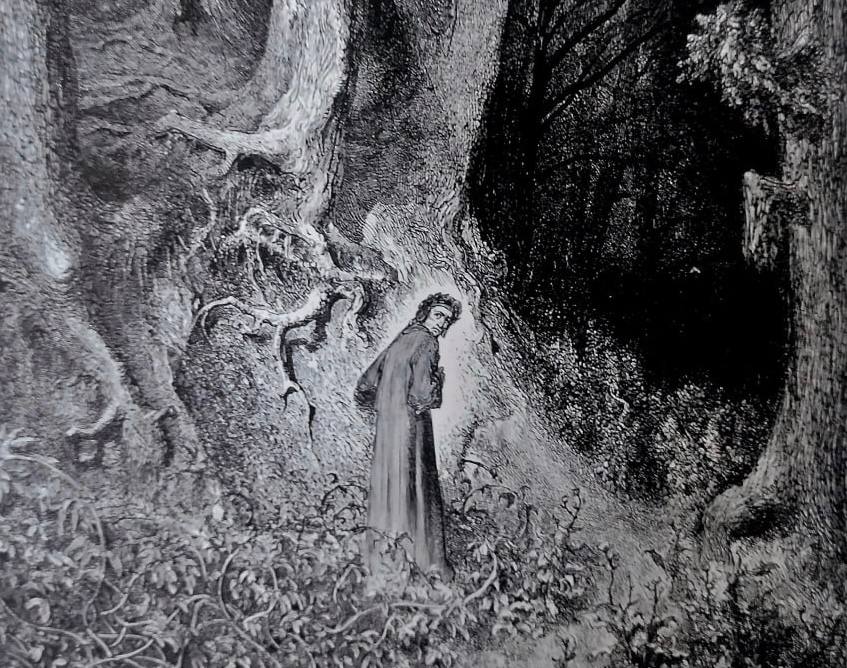 Dante Lost in the Dark Forest — Gustave Doré, 1866
Nearly five centuries later, Franz Liszt (1811–1886) drew inspiration from Dante's vision of darkness, struggle, and hope. The result was Après une lecture du Dante: Fantasia quasi Sonata (After a Reading of Dante), commonly known as the Dante Sonata.
Liszt’s music takes us through terror, conflict, longing, and hope, reminding us that even the darkest journey may not be the end of the story.
The Story Behind Liszt’s Dante Sonata
Dante’s Divine Comedy tells the story of a journey through the afterlife. In the poem, Dante himself becomes the traveler. Lost in a dark wood, he is guided first by the Roman poet Virgil and later by Beatrice.
Filled with frightening encounters, the journey is also about confronting sin, recognizing its consequences, and moving toward transformation and hope. This contrast between darkness and light gave Liszt a powerful source of inspiration.
Liszt did not simply retell Dante’s Divine Comedy scene by scene. Instead, he transformed its terror, struggle, and hope into a powerful musical response.
The title Après une lecture du Dante was inspired by the title of a poem by Victor Hugo, while the work itself was deeply influenced by Dante’s Divine Comedy. Liszt transformed Dante’s emotional and spiritual world into sound.
What to Listen For in the Dante Sonata
The Dante Sonata begins with powerful descending chords that immediately create a dark and ominous atmosphere. As the music continues, restless movement and dramatic contrasts heighten the sense of struggle.
Yet the piece is not dark from beginning to end. Lyrical passages bring moments of tenderness and reflection, while the later music begins to feel like a movement beyond the darkness.
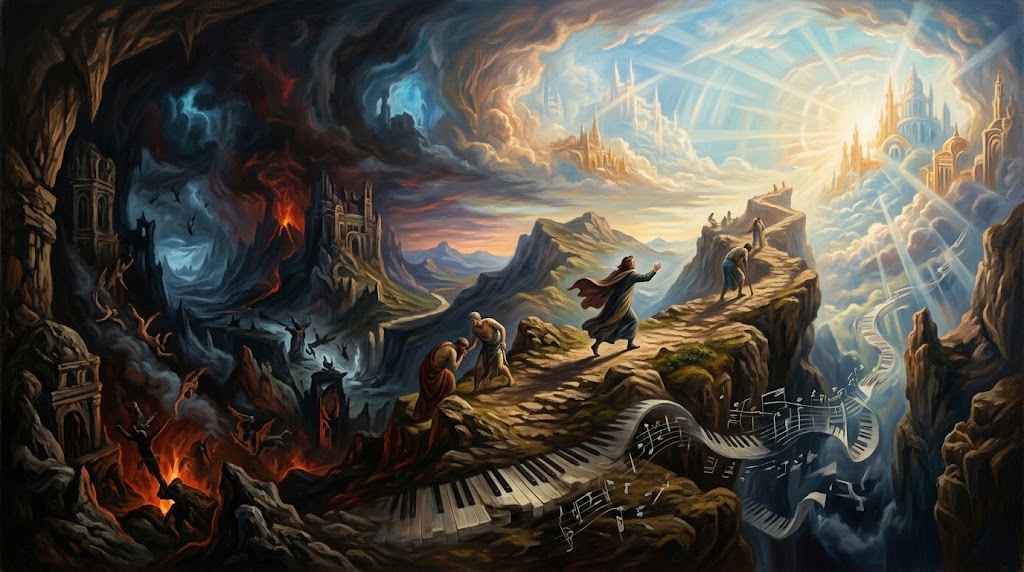
When Life Feels Like a Dark Valley
Dante’s journey may belong to another world and another century, but its emotions are surprisingly familiar. There are seasons when life can feel like a dark valley. We may face disappointment, uncertainty, loss, or circumstances we cannot control.
Liszt’s Dante Sonata does not offer an easy answer to suffering. Instead, it gives musical expression to the struggle itself. This is one of the gifts of music: it gives voice to experiences that are difficult to put into words. Dante’s journey reminds us that a dark place does not have to be the final destination.
Hope Beyond the Present
“I consider that our present sufferings are not worth comparing with the glory that will be revealed in us.” — Romans 8:18
This verse places suffering within a larger hope. For Christians, hope is not simply optimism that things will improve. It rests on God and the promise that what we see now is not the whole story.
We may not know what the next part of our journey will look like, but we can trust that God sees the whole path, even when we see only the next step. Perhaps that is why Dante’s journey continues to speak to us centuries later: we long to believe that darkness is not the end.
The piece is intense, but that intensity is part of its power. Liszt takes Dante’s journey and gives it another language—the language of the piano. Sometimes music cannot tell us exactly what lies ahead, but it can remind us that the journey is still unfolding.
Read previous: Who Taught the Teacher? Leonard Bernstein – Candide Overture