How Prayer Fits into the Whole
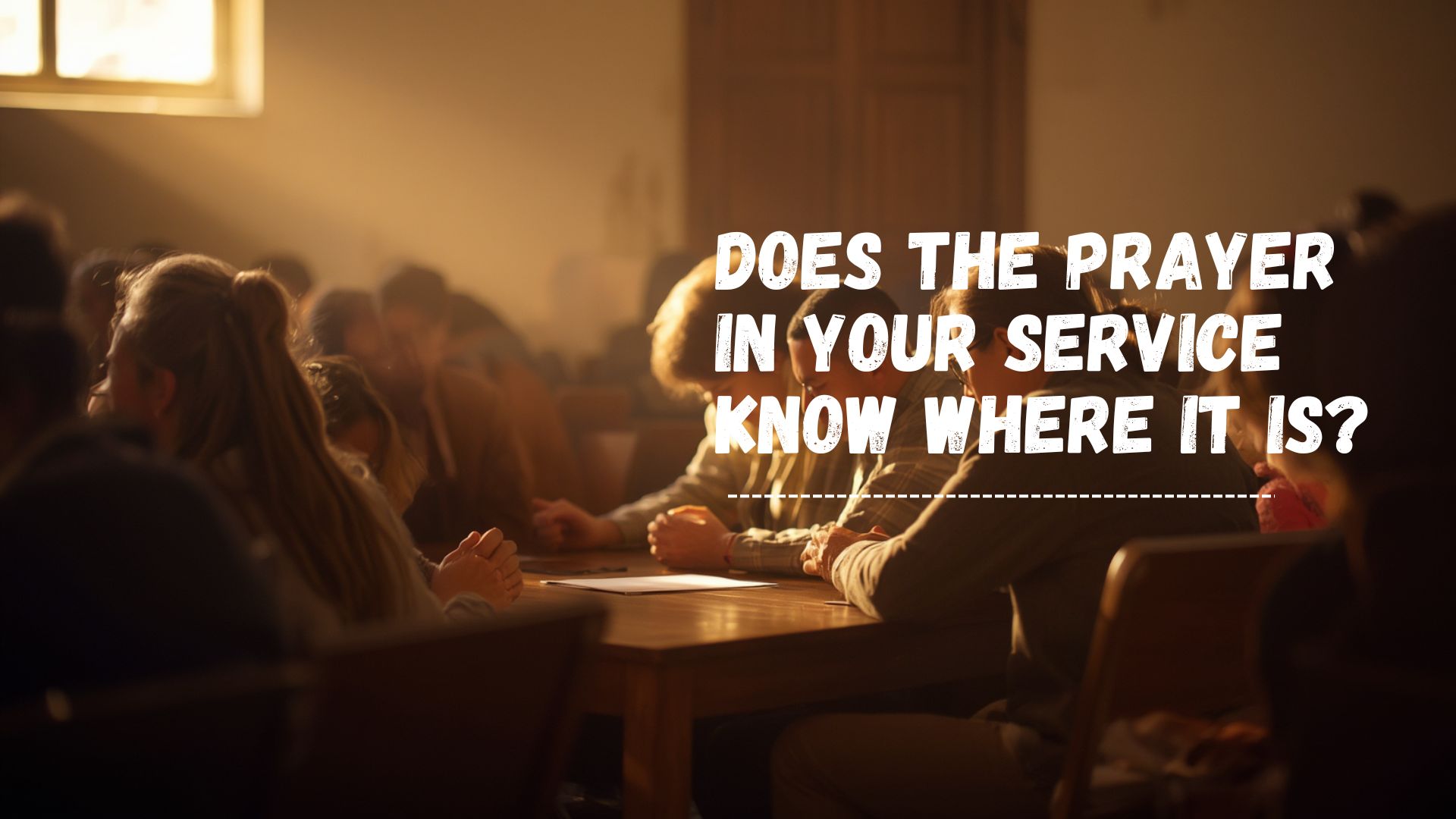
I was sitting in on a service once, watching the intercessory prayer.
The person leading it had been asked to bring the congregation's needs before God — the community's life, the work of the church, the people in the room who were carrying things the rest of us didn't know about. That's what intercessory prayer does. It's the moment in the service when the body turns outward and prays on behalf of others, bringing the world's weight into the presence of God together.
What I heard instead sounded like an opening prayer. General. Personal. A good prayer, honestly — sincere, well-meant. But it was asking God to be present, to open our hearts, to help us receive. That's the work of an invocation. It belongs at the beginning, before any of the other movements have happened. By the time we'd reached the intercessory prayer slot, we'd already gathered, already heard Scripture, already been preached to. We were well past the threshold. But the prayer was still standing at the door.
And then the sermon ran long. So the time that had been allotted for the congregation to pray together — to actually bring names and needs and the church's present life before God — compressed. Went fast. Then ended.
What stayed with me wasn't frustration with the person praying. It was something quieter than that. More like the recognition that the prayer had no anchor in what had just happened. It wasn't praying out of what the congregation had just heard. It wasn't praying toward what the community was actually carrying. It was prayer that could have happened anywhere, at any point, in any service — or in any private room.
There's a difference between prayer as a spiritual discipline and prayer as a structural element in corporate worship.
Both are real. Both matter. But they're not the same thing.
Private prayer is between you and God. It has no necessary relationship to a congregation's shared life, a particular moment in a service, or a theological movement that just happened. You pray from where you are, with what you have. That is exactly right.
Corporate prayer in worship does something different. It's the body acting together. It has a position inside a larger sequence — a sequence that has its own logic, its own theology, its own direction. Different kinds of prayer occupy different positions for a reason. Confession belongs to the Gathering, before the Word is proclaimed — because confession is the act of honest arrival, not the warm-up to the sermon. Intercessory prayer, in most traditions, comes after the Word has been proclaimed — because the congregation that has heard God speak is now ready to speak to God on behalf of others. The congregation has received. Now it gives.
When those prayers get misplaced — or when a prayer in the intercessory slot sounds indistinguishable from an invocation — what's lost isn't just liturgical tidiness. What's lost is the theological work the prayer was supposed to do at that particular moment in the service.
The prayer exists inside a conversation that has a shape. When the prayer doesn't know what that shape is, it ends up talking past the service rather than with it.
Here's where the two familiar distortions come in, because this problem shows up in different forms depending on the culture you're in.
In music-centered worship, prayer tends to get squeezed between songs — a brief spoken moment to slow things down or bridge from one emotional register to another. It becomes a transitional device. The logic operating underneath is: the real worship is the music; the prayer is what happens in the space between. It absorbs the leftover time. Its function is to maintain the flow, not to do its own theological work.
In sermon-centered worship, the distortion is different but structurally identical. Prayer is either the warm-up to the sermon — getting people quiet and ready to receive — or it's what comes after and therefore doesn't matter as much, because the real thing has already happened. The sermon is the weight-bearing element. Everything else, including prayer, finds its value relative to that. When the sermon runs long — not out of carelessness, but because the preacher has important things to say — prayer is what gives up its time first, because prayer was never holding equal weight to begin with.
Both of these reduce prayer to connective tissue. A bridge, a transition, a pause. Neither treats it as structural.
There's a line in Romans 8 that I keep coming back to in this context: "In the same way, the Spirit helps us in our weakness. We do not know what we ought to pray for, but the Spirit himself intercedes for us through wordless groans."
Paul isn't describing an exceptional condition — crisis, grief, spiritual emergency. He's describing the ordinary situation of anyone who prays. We do not know what we ought to pray for. Not sometimes. Not beginners. We.
That sentence is important for corporate prayer in worship because it tells us something about what prayer actually is. It's not a performance of spiritual confidence. It's not a demonstration of theological fluency. It's the body, in its weakness and not-knowing, turning toward God in the Spirit who is already interceding. The Spirit takes what the congregation brings — including the inadequate, the unfocused, the half-formed — and carries it before the Father.
Which means the person leading intercessory prayer is not doing something the congregation watches. They're standing in front of something the congregation is doing together, in the Spirit, as part of the body's Christlike act of intercession. That's a different weight than "the transitional moment before the sermon." It's one of the most distinctly priestly things a congregation does — bringing the world's needs, the community's life, the names of the people in those chairs before God.
That work needs its proper place, its proper time, and someone leading it who understands what moment they're standing in.
So what does this change for those of us who plan, lead, or participate in worship?
For those who plan services: prayer placement isn't a scheduling decision. It's a theological one. Where does this prayer sit in the Gather-Word-Table-Send sequence? What has happened just before it? What is it responding to? What is it preparing the congregation for? If you can't answer those questions about the prayer in your service, it may be functioning as filler — not because of bad intentions, but because no one has asked.
For those who lead prayer in a service: it helps, enormously, to know what kind of prayer you've been asked to lead and where it sits in the service. Intercessory prayer is not the same thing as an opening invocation. It's praying out of what God has said — on behalf of others, in the Spirit, as the body's priestly act. Knowing the difference requires knowing where you are in the service and what the congregation has just been through. That's not something you can improvise your way into.
For those who preach: this one lands closer to home. When the sermon consistently runs beyond its time, it's not just the closing song that gets cut. It's often the prayer that had been set aside for the congregation to actually do something together — to intercede, to respond, to bring the weight of the week before God. The sermon matters. But it matters inside a service that has other acts of equal structural weight. One of those acts is the congregation praying together.
The prayer I witnessed that day wasn't a failure of spirituality. The person leading it was sincere, and probably prayerful. What was missing was simpler than that: a sense of what the prayer was for in that particular moment, in that particular sequence, in that particular community.
Corporate prayer in worship has an address. It knows where it is in the service, what just happened, and what the congregation needs to do together in this moment. When it has that knowledge, it carries its full weight.
When it doesn't, it floats — untethered and unrecognized, doing private work in a corporate room.
When you think about the prayers in your worship service — the ones that aren't the sermon and aren't the songs — do they feel like they belong where they are? Does the person leading them seem to know what moment they're standing in?