Revival Comes to Town
I've been to a lot of services that were designed to produce something.
Not just inspire something, or lead someone somewhere — produce something. A response. A decision. A visible moment of transformation. I've led some of those services myself. You can feel the difference in the room. There's a kind of pressure built into the architecture of the whole thing — the music building toward something, the message aimed at a specific landing point, the invitation at the end structured so that walking away unchanged feels like you made a choice.
I used to assume that's just how it worked. That this was worship.
It took me a long time to realize that it was actually a fairly recent invention. That somewhere in the eighteenth century, something shifted in the Western church — something about what worship was for — and we've been living with that shift ever since.
For most of Christian history, Sunday morning was shaped by the logic of offering. You came to give something to God. Prayer, praise, confession, the Lord's Supper — these were acts of return, acts of offering. The congregation was not an audience waiting to be moved. They were participants in something that was already, always, about God.
Then the revivals came.
It didn't happen all at once. It began stirring in the 1730s. One of the first to take it seriously was a young theologian in New England named Jonathan Edwards. Edwards wasn't a showman — he was one of the most precise theological minds in American history, and he was also watching something happen in his congregation that he didn't entirely know what to do with. People were weeping. Crying out. Collapsing under what he could only describe as a weight of spiritual awareness. He documented it carefully, skeptically, and ultimately concluded it was real: something was happening in the emotional interior of people's faith that the church had been underestimating.
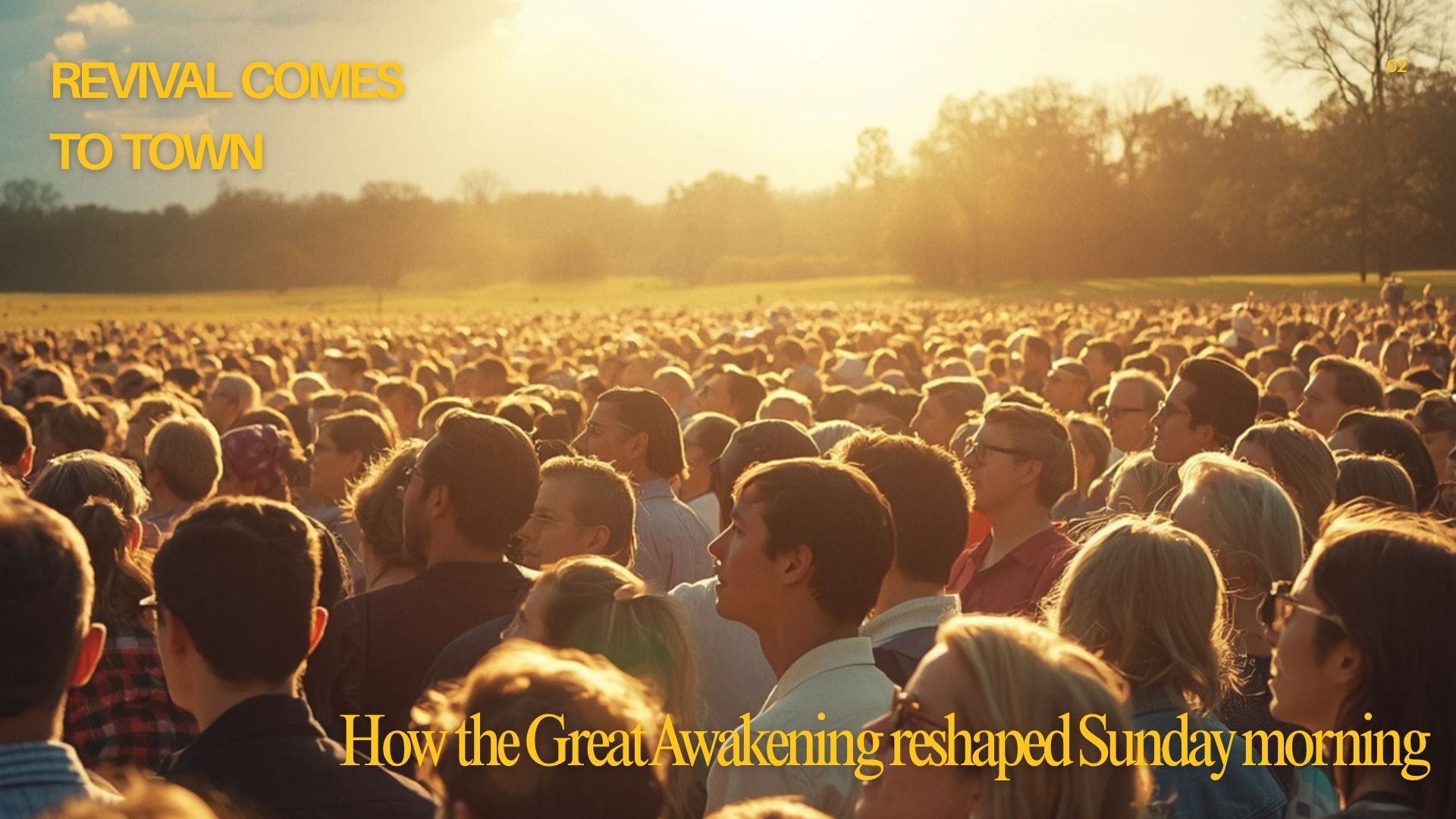
A few years later, a preacher named George Whitefield crossed the Atlantic and began preaching outdoors — not in churches, but in open fields, to crowds of thousands who had no church home. He was theatrical, loud, charismatic. Benjamin Franklin, who didn't believe a word of it, watched Whitefield preach and walked away having given him all the money in his pockets. When you could do that, you started to think about preaching differently.
But it was Charles Finney, in the early nineteenth century, who turned revival into a method.
Finney was a lawyer before he was a preacher, and it showed. He approached revival with the systematic logic of someone who believed that if you arranged the conditions correctly, you could reliably produce a conversion. Prayer meetings beforehand. A specific seating arrangement designed to isolate people who were "almost persuaded." The anxious bench — a front pew where people under conviction could sit visibly, publicly, surrounded by the weight of community expectation. And music: not to worship, but to soften resistance, to prepare the heart for what the preacher was about to do.
He called them "new measures." Critics called them manipulative. Finney called the critics cold.
What he was doing — whatever you think of the theology behind it — was reorganizing the entire logic of a worship service around a single question: Will this person make a decision before they leave?
Everything else became instrumental to that end.
I don't want to be uncharitable here. The revivals changed lives. Real lives. The kind of lives that were grinding toward destruction and came out the other side of one of those meetings with something new in them. And the theological instinct behind it was serious — that faith is not merely inherited or institutional, that it must be personally received and personally owned.
That instinct isn't wrong.
But something happened to the shape of worship in the process. The gathered congregation, which had for centuries been the subject of the service — the body that prayed and offered and received together — gradually became the audience. And the audience had one job: to respond.
The preacher became the center, with the music shaped around what he was about to do — and the invitation at the end was the hinge on which the whole service turned. If nobody came forward, the service felt like it had failed.
That structure — preacher, music, response — is so deeply embedded in Protestant evangelical worship today that most people have never thought to question it. It feels like the shape of Sunday.
But it's only about two hundred years old.
Standing in front of a congregation now, I feel the weight of both worlds.
I believe in response. I believe that encounter with God should do something — that you don't leave the same. I've seen what genuine revival does, and I'm not dismissing it.
But I also believe that worship was always, first and last, about God — not about what happens to me while I'm there, not about whether the altar call produced the numbers we hoped for.
The Cranmer I wrote about last time was working in a different logic entirely — the logic of formation, of slowly, patiently being shaped by words and rhythms handed down across centuries. The revivalists were working in the logic of crisis — urgent decision, now-or-never, this might be your last chance.
Both of those things are in the Bible. The question is which one gets to organize Sunday morning.
We decided, mostly, that it was the second one.
And we're still living in that decision.