Shadows and light: The Christian soul of the horror story
A reflection by Pastor Duncan Williams for CFP
Each year as October draws to a close, pumpkins glow on doorsteps and tales of the supernatural return to our screens. For many Christians, Halloween and its associated horror stories can feel uncomfortable – something to avoid, or at best a cultural curiosity that sits uneasily beside our faith. Yet if we look closely, some of our most enduring classic and modern horror stories are not enemies of Christian truth. They are, in their own way, mirrors that reflect the great spiritual battle at the heart of our faith: the struggle between good and evil, the consequences of pride, and the hope that light will always overcome darkness.
The Anti-Christ: Dracula and the Great Reversal
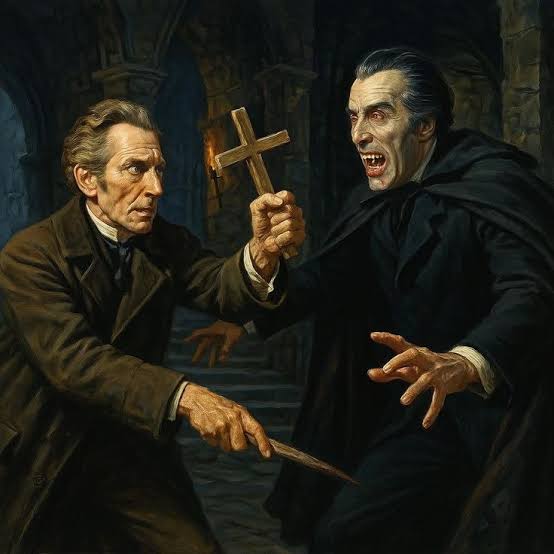
Few figures cast a longer shadow than Count Dracula. Bram Stoker’s 1897 creation is far more than a monster; he is a powerful spiritual inversion. In the Eucharist, we drink of Christ’s blood in remembrance of His sacrifice – a gift that brings eternal life, grace, and unity. Dracula, by contrast, takes blood to sustain an unnatural, deathless existence, stealing life from others to prolong his own. He is the great counterfeit: what Christ gives freely, Dracula takes by force. Where Christ lays down His life for the world, Dracula consumes the lives of the world for himself.
It is deeply significant that the crucifix – the very symbol of Christ’s suffering and victory – repels him. Dracula recoils not because the cross is magic, but because it represents everything he rejects: humility, sacrifice, and selfless love. In the end, he is defeated. Good does not
merely hold its ground; it conquers. The story affirms that evil, however ancient or powerful it may seem, cannot ultimately stand against the truth.
Shadows and Light: The Christian Soul of the Horror Story
Mary Shelley’s Frankenstein explores another profound biblical theme: what happens when humanity seeks to take the place of God. The subtitle – The Modern Prometheus – hints at this: Victor Frankenstein reaches beyond the boundaries set for human beings, daring to create life where only God has that right. He believes knowledge and science alone can give him the power of the Creator.
The tragedy is not in the creation itself, but in the creator’s pride and failure to love. Victor builds a living being, but he cannot nurture or care for what he has made. He abandons his creation, and that rejection turns innocence into bitterness. The story is a solemn warning: we were never meant to be God. We are called to be stewards, not masters, of life. The creature is not inherently evil; he becomes what the world makes of him. It is a sombre reflection on our responsibility to one another – and the cost of turning away from what God has entrusted to us.
The Wolf Man: The Beast Within
If Dracula represents evil outside us and Frankenstein represents human pride, The Wolf Man speaks to something deep inside every human heart: the struggle with our own fallen nature. The story of Larry Talbot, a good man cursed to become a creature of the night, reflects the apostle Paul’s own honest confession in Romans 7: “I do not do the good I want, but the evil I do not want is what I keep on doing.” Talbot does not choose to be a wolf, yet once transformed, his rational self is swallowed up by instinct and violence. He is not destroyed by his curse alone; he is destroyed by the fear and misunderstanding of those around him. Yet even here, the tale reminds us that our greatest battle is often not against what is outside us, but against the darkness within.
Modern Horrors: The Exorcist and the Reality of Hope
These themes endure in modern storytelling. William Peter Blatty’s The Exorcist is one of the most chilling films ever made, yet at its core, it is deeply rooted in Christian belief. It acknowledges the uncomfortable truth that evil is real and can invade human lives in ways we cannot explain or control. But more importantly, it affirms that evil does not have the final word. Two priests do not defeat a demon through their own power; they rely on the authority of God. One priest gives his life in sacrificial love – a powerful echo of the gospel message. It is a terrifying story, but it is also hopeful: even in the darkest place, God is present.
A Christian Perspective on Darkness
Horror stories work because they tap into universal human fears: the fear of death, the fear of losing control, the fear that evil might triumph. But they also offer reassurance that these things are not the end of the story. The darkness in these tales serves to make the light shine all the brighter. Evil is always shown to be self-destructive, pride always leads to a fall, and goodness – often through suffering and sacrifice – prevails.
C.S. Lewis once wrote that we do not need to be kept in the dark about the dark. We can look these things in the face, not because we are strong, but because we know where true strength lies. When we watch these stories, we are not celebrating evil. We are acknowledging its existence, recognising its tactics, and remembering the truth that our faith has always declared: the light shines in the darkness, and the darkness has not overcome it.
( Image: Hammer Films Promo Artwork 📸 )