The Meal That Became a Service
There's a document called the Didache. Most Christians have never heard of it, which is part of what makes it interesting.
It's a short manual — some kind of handbook for new Christian communities — written somewhere around the end of the first century. Maybe earlier. Scholars argue. Early enough to feel like a dispatch from a different world. When I first read the section on the Lord's Supper, I had to stop.
Not because it was wrong. Because it was so different.
The Didache's instructions for the eucharist are not about a ceremony. They're about a thanksgiving prayer to be said over the cup and the bread, in that order — the cup first, then the bread — before a communal meal. Afterward, the community is allowed to eat "as much as they want." Then there's a closing prayer of thanksgiving for the meal. And that's it. No altar. No priest. No elaborate choreography.
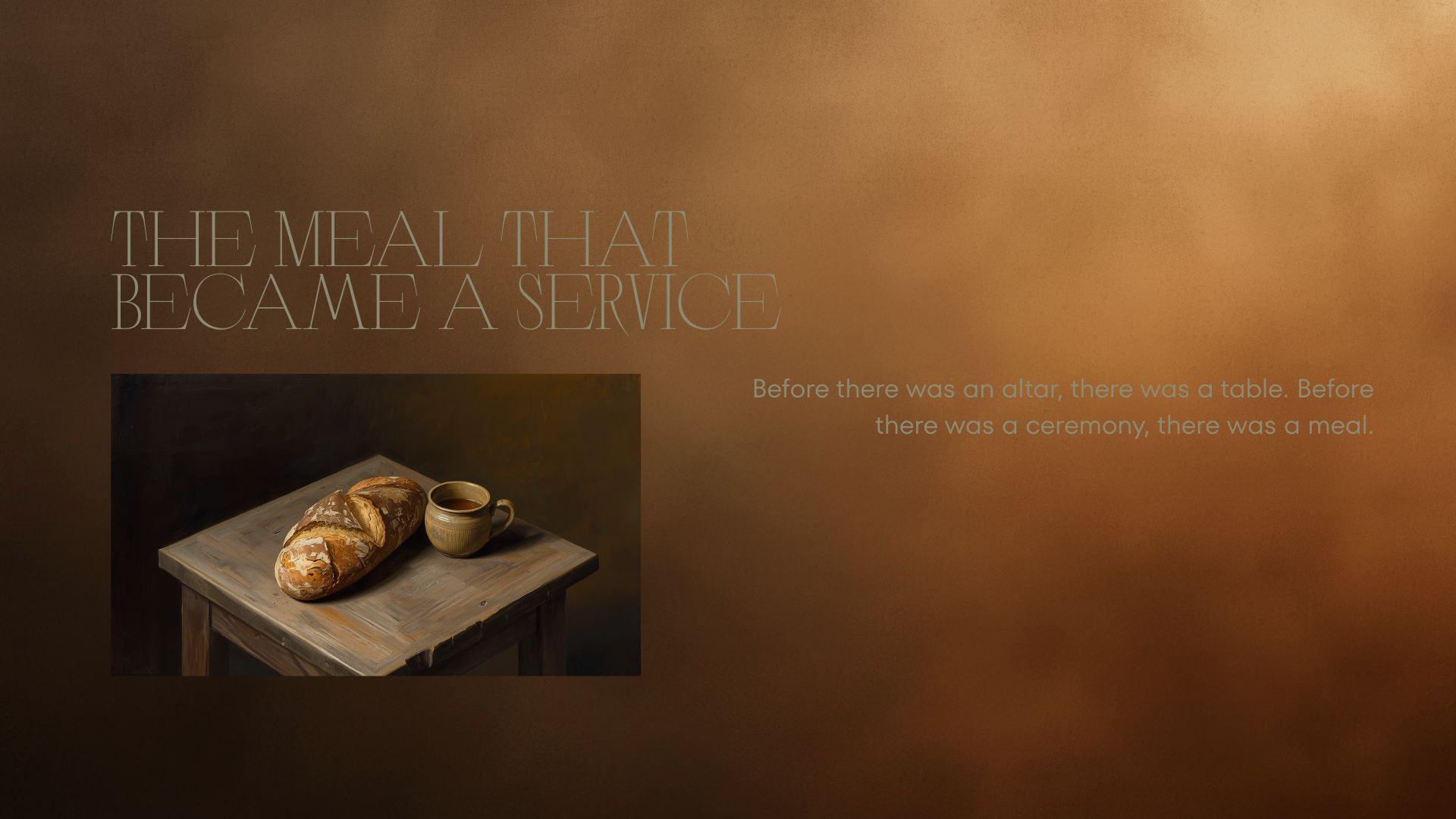
Just food, prayers, and a community gathered around a table.
The earlier we go in church history, the more the Lord's Supper looks like an actual supper. Paul's letter to the Corinthians makes this unmistakably clear — and not in a flattering way. He's furious because some members of the church are arriving early and eating everything before others get there. Some are going home drunk. Others are going home hungry.
You don't write a letter like that about a ritual. You write it about a meal.
So when did it change? When did the table become an altar and the dinner become a ceremony?
The short answer is: gradually, and for more than one reason.
By the second century, a few things were shifting. Christian communities were growing. The house churches that had once fit thirty to fifty people in someone's dining room were spreading across cities, which meant larger gatherings, which meant more structure. The Passover framework that had shaped the earliest celebrations of the Lord's Supper — rooted in the exodus story, the unleavened bread, the cup of blessing — was being slowly separated from its Jewish context as Gentile Christians became the majority. And the Roman world outside the church was suspicious. Communal meals behind closed doors looked dangerous. Some communities began separating the meal from the ritual to make the ritual more legible, less threatening.
Ignatius of Antioch, writing around 110 CE, is already using the word eucharist — thanksgiving — as a distinct term, and already insisting that it only be celebrated under the authority of the bishop. The meal and the rite are beginning to pull apart.
By the time Justin Martyr is writing his First Apology around 150 CE — a defense of Christianity addressed to the Roman emperor — the shape he describes is almost recognizable. Readings from the apostles and the prophets. A sermon. Communal prayer. Then bread and wine, consecrated and distributed. The full meal has disappeared. What remains is the bread and the cup, and the prayer over them.
The supper had become a service.
I find I have mixed feelings about this.
Part of me wants to mourn it. There is something about a community eating together that cannot be replaced by a ritual, however beautiful. The early agape meal — the "love feast" that appears in Jude and probably in 2 Peter — was not just a vehicle for the eucharist. In its earliest form, the meal and the eucharist seem to have been the same event. The shared table was the enacted proclamation that in Christ there is no slave or free, no Jew or Gentile, those who arrived early and those who couldn't leave work until late.
When the meal disappeared, something of that embodied proclamation went with it.
But I also understand why it happened. Not every change is a loss, even if something is genuinely lost. The meal had real problems — Paul's Corinthian letter is evidence enough of that. Structure developed not only because of outside pressure but because of internal chaos. And what remained, even without the full dinner, was the essential thing: a meal Christ had given before the church had organized it — bread broken, cup shared, his death proclaimed, his resurrection anticipated. Until he comes. The form changed. The core didn't.
There's a detail in Justin Martyr's description I keep coming back to. He says that after the bread and wine are consecrated, deacons carry portions to those who are absent — those who couldn't gather. And in the same passage, he describes a collection taken up for the sick, the imprisoned, the widows, the orphans. Both flowed from the same gathering.
The meal was gone, but someone was still making sure the table reached people who couldn't get to it.
Something about that feels like faithfulness. Not the faithfulness of preserving the original form perfectly, but a different kind — the faithfulness of asking what the meal was for, and making sure that purpose survived even when the form changed.
I don't know that I've always thought about worship that way. I've spent a lot of years thinking about getting the form right. How the service is structured, what comes first. There's nothing wrong with that. Form matters. But Justin's deacons carrying bread to those who couldn't be there is a reminder that the form was always in service of something else — a presence that needed to reach people.
The meal became a service. And somehow, in becoming a service, it became a way of extending the table further than a dining room ever could.