The People Stop Singing
There's a moment in rehearsal that I've learned to dread.
You're working through a new song with the worship team — one that's genuinely beautiful, technically demanding, harmonically interesting. The musicians are locked in. The vocalists are tight. And then you step back and realize: no one in a congregation is ever going to sing this.
Not because the song is bad. Because it belongs to the people on stage now. It has become, without anyone intending it, a performance.
I've caught myself building that wall without realizing it.
Here's what's strange: that tension isn't new. It's actually one of the oldest problems in Christian worship history.
By the early medieval period — somewhere around the 6th to 9th centuries — the shift was already well underway. The congregation had largely stopped singing.
Not all at once. Not because anyone issued a decree. It crept in slowly, the way most big changes do. And when it was done, the shape of Christian worship had shifted in ways that would take nearly a thousand years to reverse.
The story starts, honestly, with beauty.
The early church sang together — hymns, psalms, antiphonal responses where one group answered another. But as Christianity became institutionalized after Constantine, the worship space changed. The basilica was large. The liturgy became elaborate. And the music, naturally, began to develop in complexity.
Chant — what we'd later call Gregorian chant — was not originally designed to exclude anyone. It began as a way to sing the psalms and liturgy in an ordered, reverent way. But chant is difficult to learn. It requires training, a trained ear, dedicated practice. Schola cantorum — singing schools attached to cathedrals and monasteries — began to produce professional singers whose whole vocation was liturgical music.
These were not bad people doing a bad thing. They were doing something genuinely beautiful.
But trained singers filling a high-vaulted stone space have a way of making everyone else fall silent.
This is the part that I keep coming back to.
There's a specific dynamic that happens when music becomes too good for ordinary people to participate in. I've felt it as a worship leader. The moment the skill gap widens enough, something shifts in the room. The congregation doesn't decide to stop singing. They just... stop feeling like it's theirs.
By the high medieval period — say, the 12th and 13th centuries — the Mass had taken a shape most ordinary Christians would barely recognize from the early church. The clergy faced away from the congregation, toward the altar. The prayers were spoken in Latin, often inaudibly. The music was performed by a choir or by trained cantors. The central act of the Eucharist — the consecration of bread and wine, the prayer of blessing when bread and wine are set apart — had become something the congregation watched rather than participated in.
The people were present. But they were, increasingly, an audience.
There's a detail from the late medieval period — the 14th and 15th centuries — that genuinely stopped me when I first encountered it.
By then, many churches had erected a wooden or stone screen — called a rood screen — between the nave (where the congregation sat) and the chancel (where the clergy conducted the liturgy). The congregation could hear the service. They could catch glimpses through carved openings. But they couldn't see it clearly. They couldn't follow it. The liturgy happened, quite literally, behind a wall.
The rood screen was not designed with cynical intent. It had symbolic meaning — marking the boundary between the holy and the ordinary, the sacred space of the altar and the gathered space of the people. But the effect, for ordinary Christians, was that worship became something conducted by specialists in a room they weren't quite allowed into.
What did congregations do during the Mass?
Something the official liturgy didn't account for. They prayed their own private prayers. They said the rosary. They told their beads. They watched for the moment of elevation — when the priest raised the consecrated host — and tried to catch a glimpse of that. Some theologians of the period apparently felt that seeing the host was itself spiritually significant, since receiving the Eucharist fully was something that happened rarely for ordinary laypeople. Receiving communion annually was considered sufficient.
The gathered community had become a room full of individuals doing private devotions in the presence of a liturgy they could not access.
I'm not drawing a straight line between the medieval Mass and the contemporary church. History is rarely that clean.
But I do wonder what it does to people — over generations — when the worship of the gathered community becomes something you watch. When the music belongs to the trained few. When the ritual is conducted in a language, or at a level of complexity, that signals: this is not quite for you.
We think of worship participation as something people choose. But people stop singing for a reason. The shift from participant to spectator never happens by accident.
The church of the late medieval period didn't intend to build that distance. It accumulated. Detail by detail, century by century, until the wall was thick enough that most people couldn't remember a time when it hadn't been there.
The Reformation, when it came, would try to tear it down. That's the next chapter.
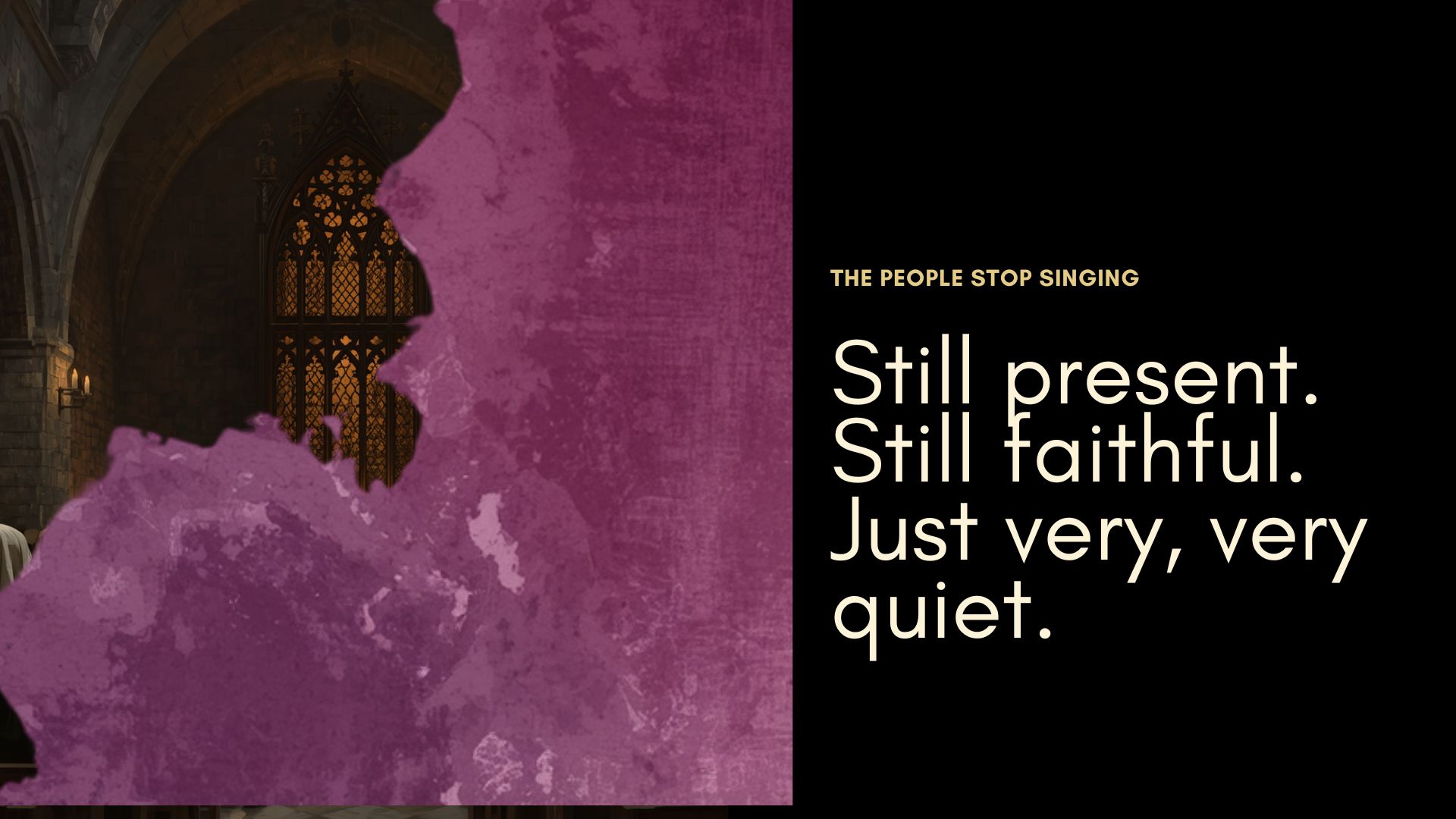
But for now, I'm sitting with the image of a congregation in a stone nave in the year 1200, listening to trained voices sing the Mass in Latin, watching through a carved screen, whispering their own prayers in a language the liturgy had stopped using.
Still present. Still faithful. Just very, very quiet.
And still, I have to believe, still being addressed — by a God whose initiative doesn't wait for the congregation to find its voice again.