'The Senior' Movie an Inspiration to Anyone Living with Regret
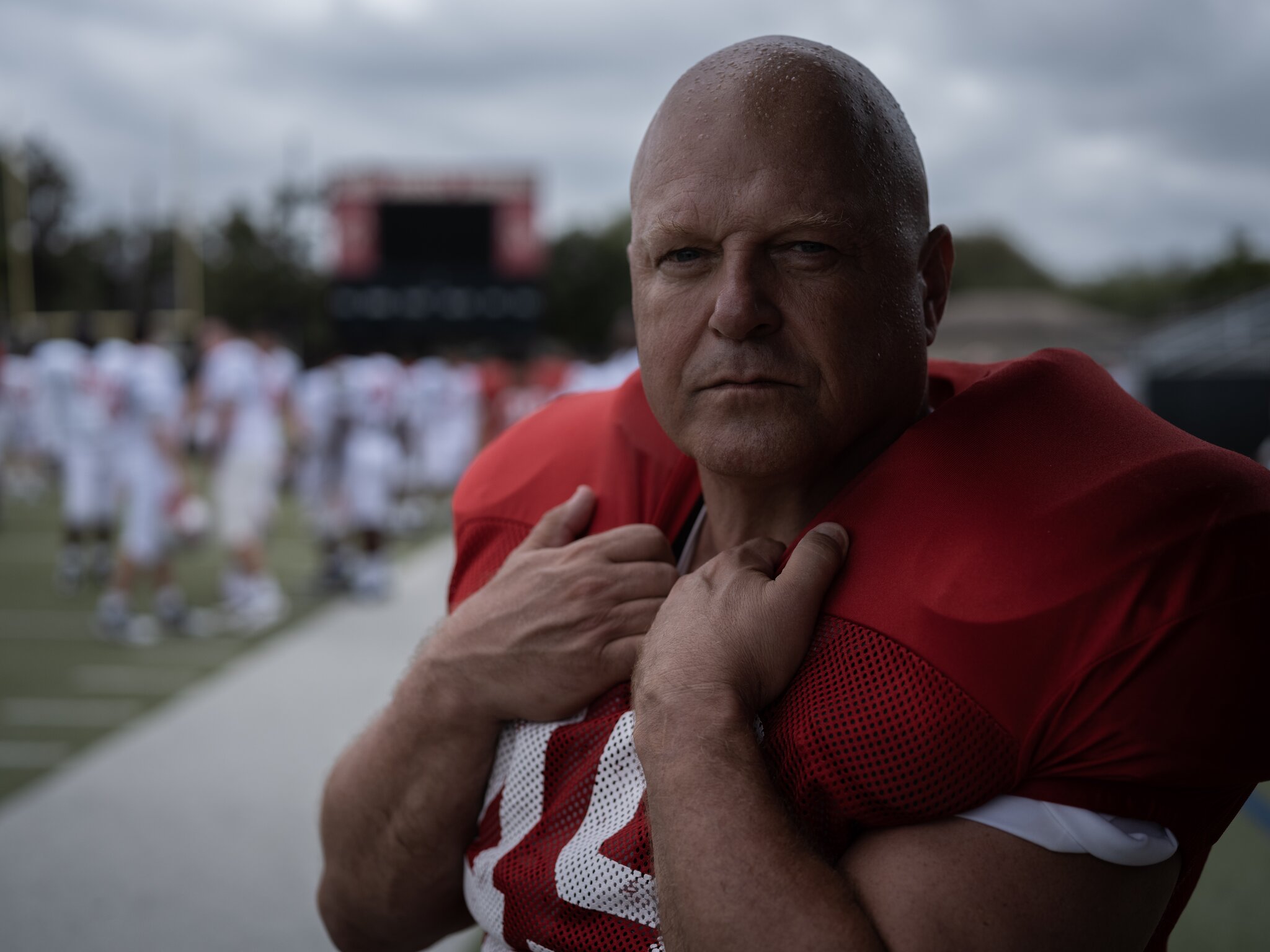 Michael Chiklis in 'The Senior'. Photo image courtesy Angel Studios
By and large, living life with regret is something we all try to avoid. But often, due to a myriad of circumstances, it captures us and won’t let go. When this happens we find ourselves lamenting our previous choices, questioning the decisions we didn’t make, and pondering how to make things right. Otherwise, we are destined to live with a foreboding feeling of sadness and disappointment.
Mike Flynt knows this feeling all too well. Thirty-five years after getting kicked off his college football team, the Odessa, Texas native was still feeling the sting of a bad on field decision that ultimately changed the entire trajectory of his adult life.
Professionally, things turned out well for Flynt. As a sought-after strength and conditioning coach, he forged a highly respectable career, one that included inventing Powerbase Fitness exercise equipment. However, despite these achievements, Flynt still couldn’t shake a niggling sense of regret.
But enough is enough.
At the age of 59, Flynt decided to defy expectations, overcome regrets, and live out his purpose. Far from a mid-life crisis, he decided to return to the gridiron for his senior year of college football eligibility. His goal was simple yet profound: prove to his family, former teammates, and himself that it’s never too late to tackle your dreams.
So inspirational is Mike Flynt’s story that it has become a major motion picture. Starring Michael Chiklis (Fantastic Four), Mary Stuart Masterson (Some Kind of Wonderful), and Rob Corddry (80 for Brady), The Senior is a story about the remarkable power of faith, the value of family, and the relentless pursuit to forgive ourselves when life doesn’t make sense.
I recently sat down with the real-life Mike Flynt to discuss his battle to overcome regret, why returning to the football field was the only way to do it, and his advice to people who are still chasing an unfulfilled dream.
Were you hesitant about the idea of having a movie made about a difficult time in your life?
I never was hesitant because a movie was never on my radar. I went back to the school that I'd been kicked out of for fighting 37 years before. My whole purpose in going back was we have those regrets in life that we can't change. We can’t change the past but we can possibly change the meaning of the past. When I found out I had eligibility left, I felt like if I could make the team that I'd been kicked off of 37 years before, and help a bunch of young men that I didn't even know, it would make up for those guys I let down all those years before. And so, when people started talking about a movie, my first thought was who cares anything about an old man going back to playing college football? I was so wrong about that assessment.
Was there a single driving force as to why you, at the age of 59, would even consider playing college football again? Was there one main thing that resonated with you that drove you to do it?
When I first met with the coach, I told him that I wanted to walk on as a linebacker and could make the team at that position. I felt I could help those young guys there to make up for the guys I let down. That was my motive. That was the only reason for me to do it. When word got out that I was going back to the state university, I was offered to other schools. They all said, ‘Hey, you can come over here.’ But they were looking at publicity. I didn't care about that. I just wanted to go back to the school that I'd been kicked out of and make amends.
You didn’t just pursue one of the positions where you wouldn’t get hit … like a kicker, punter, or long snapper. You chose to play linebacker. Had you played this position previously or did you think it was the “path of least resistance” to actually get on the gridiron as a player?
No, I was an all conference linebacker when I was kicked out. I was the leading tackler on that team with over 100 tackles a year. One time I had 24 tackles in one game. I was a good football player when I was young. And by the grace of God, I went on with my life after being kicked out. I became a strength and conditioning coach at the University of Nebraska, then the University of Houston, and finally Texas A&M. But I'd always had a philosophy about my coaching. I'd never asked one of my athletes to do something that I wasn't willing to do myself. And so I kept training, running sprints, and lifting weights for decades after I quit coaching. So when the opportunity came to play at 59, I took it. If you're not in shape to play college football, you're not going to get in shape. So, I was able to put that helmet on and go back into that line backing position. But the difference was, I was a great football player when I was young, but I never played football in a 59-year-old body before. The recovery time was considerably longer.
Knowing the skepticism that the coaching staff and other players had about you, what did you do to convince them that your motivation and aspirations were true and authentic?
First of all, the players were kind of in shock that I was there. They didn't doubt that I could do it but wondered why I was doing it. We talked about that. On the first day of two a days, the head coach told us that there were six stations that were set up in circuit fashion. He went on to say, “We are going to find out what color your blood is. Is it yellow or is it red? And if we don’t find out after station one, we will definitely know what you’ve got by the time you get to station six.” By going through all of those drills with those younger teammates, I earned their respect. They no longer questioned if I could do it. I proved to them that I was able to play.
Did you have a hard time adapting to this new breed of college student after being away from sports for so long? I have to imagine that sharing a locker room with much younger guys could be somewhat of a different experience than what you may have been expecting?
It was only as awkward as I allowed it to be. And I made up my mind that when I went back, all of the adversity, all the negative comments and statements, or the naysayers, that I was going to ignore it. I felt like I was in great physical shape and I was raised with the attitude that, hey, if you can whip me, you have to whip me. It's going to be because you're the best man. It ain't going to be because I'll let you. That's the attitude that I took back. I understand college football and what's involved in that. And so it's not something that you forget when in Texas. We start playing with full pads in the third grade. And so, it's something that if you play football and are fortunate enough to be good at it, you play for a long time. And so there's just a tremendous carry over into life and the ability to handle adversity in life because of all the adversity you overcome in football. It wasn’t a problem at all because I didn't allow it to be a problem.
What advice do you have for a person who is approaching retirement age, but still has things they want to accomplish?
I've said for years that there's a big difference between wishing and dreaming. This is because so many people will hear somebody paint or play the piano, and it's just amazing. And they'll say, ‘God, I wish I could do that. I wish I could play like that.’ Then you tell them about all the work that goes into it, the amount of practice it takes, and the sacrifices they have to make. And then they say, ‘Well, maybe I don't want to do that.’ And so, you've got to determine if in fact it's a dream or a passing fantasy. And if it's a dream, it won't go away. The more information you get about it, the more encouraged you are in tackling it. You have to be committed. I tell people to write it down. Write that dream down, but write it down in pencil because it will change. It will evolve, but it's still your dream. You just have to be committed and continue to move forward, have goals, and move toward that dream. You can’t give up.
This movie has a great cast including Mary Stuart Masterson, Rob Corddry, and of course, Michael Chiklis. In fact, I think you and Michael Chiklis actually resemble each other a bit. Were you able to meet with him prior to filming to share insights and nuances about your life that proved helpful to him in his role?
We were there for 52 days of filming. We were there for the whole thing. Michael Chiklis was the ultimate professional. He was amazing. I've told so many people this, but his commitment to my part, my life, and my story, and just selling out to the physical shape that I was in, the drills that he went through, the things that he did, I was so impressed and so grateful. And looking back at the other actors that they were considering to play me, they couldn't have pulled it off any better. He was amazing.
After people have had a chance to see The Senior what would you like audiences to take away from that experience? What is your greatest hope for the film?
I hope that people realize this from the movie, but for me, I knew I couldn't change the past and the regret that I'd lived with for all those years. But I could change the meaning of my past by doing something current in the present and substituting it for that regret that I had. And so, that was my motive in doing that. Through the whole process and through my faith, because I wasn't a Christian when I was younger. It wasn't until I was 34 years old that I made a profession of faith in Christ. But going back to play, I had that different perspective. And it was overcoming that regret in my life and chasing this dream that I've had for so many years, believing in myself and being totally committed.
That's what I hope that people walk away from the movie with. I'd have so many people come up to me when I was playing. It was in the media so much that guys would walk up to me, they'd recognize me, and offer to shake hands. Then they would say, “Are you Mike?” And I'd say, yeah, I'm Mike. And then they'd shake my hand, but they'd tell me their age. I'd have to ask them their name. They'd say, “I'm 62, or I'm 57.” They would proceed to tell me what they were doing. They were telling me about things that they had started to do since I went back to play. They thought, well, I can do this or I can do that. And so that was always so encouraging to me, that someone was benefiting from what I was doing. They were benefiting physically in their own life by picking up something that they thought maybe they could never do again.
The Senior opens in theaters nationwide this weekend.
WATCH A TRAILER FOR THE SENIOR: