The Sword of the Spirit: Your One Offensive Weapon
Count the pieces of the armor of God and you notice something quickly. Five of them are for defense. Only one is for striking back.
The belt holds you together. The breastplate guards your heart. The shoes steady your feet. The shield blocks the arrows. The helmet protects your mind. All of it is built to help you survive an attack. And then there is the last piece, the sword of the Spirit — the single item in the whole kit you can actually swing.
That ratio is not an accident. Paul is telling you something about the Christian life with the very design of the armor. Mostly you stand. But you are not left with nothing to fight back with — and what you are given may surprise you.
What the sword of the Spirit is
Paul leaves no room for guessing. He names it and then immediately tells you what it is:
"Take the helmet of salvation and the sword of the Spirit, which is the word of God." (Ephesians 6:17)
The sword of the Spirit is Scripture. The word of God. Not a feeling, not a clever argument, not your willpower — the words God has spoken, handed to you as a weapon. It is the only offensive piece in the whole armor of God, which means it deserves more attention than most of us give it.
The kind of sword Paul means
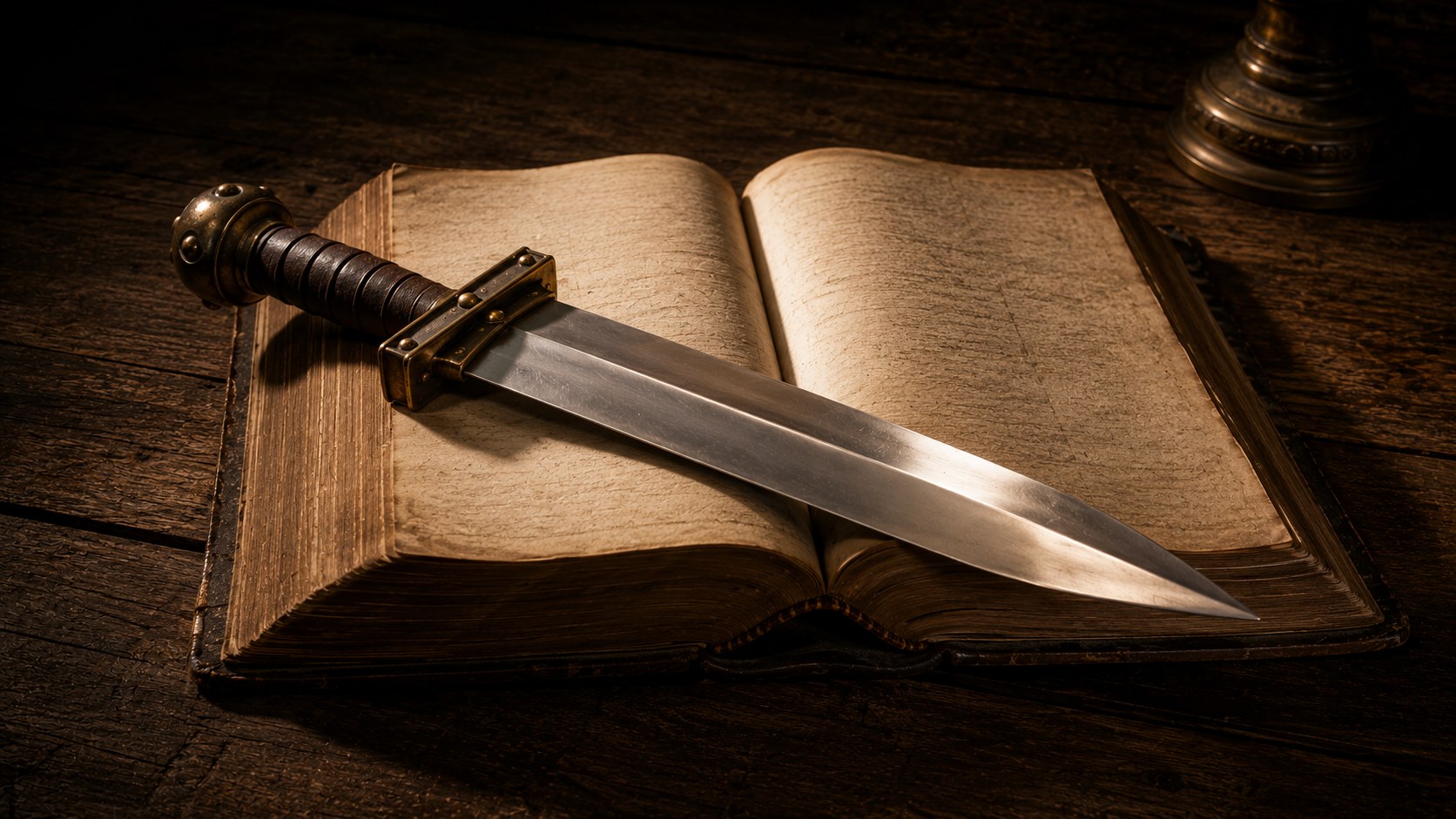
Here is a detail that sharpens the picture. The Greek word Paul uses for "sword" is machaira — not the long broadsword you might imagine, but the short, double-edged blade a Roman soldier used in close combat. It was a precision weapon, used at arm's length, where the fighting was personal.
That tells you how Scripture is meant to work. Not as a vague aura of holiness, but as a precise word for a specific moment. The right verse, at the right time, applied to the actual situation in front of you. A general feeling that the Bible is good will not help you at 11 p.m. when temptation is whispering. A specific truth you can name will.
The writer of Hebrews uses almost the same imagery:
"For the word of God is alive and active. Sharper than any double-edged sword, it penetrates even to dividing soul and spirit." (Hebrews 4:12)
Jesus showed exactly how to use it
If you want a demonstration, look at the wilderness. After forty days without food, Jesus faced three temptations from the devil himself. And his response, all three times, was not a debate. It was a blade.
"It is written," he said — and then he quoted Scripture. Each time the tempter pressed, Jesus answered with a specific verse aimed at the specific lie (Matthew 4:1-11). "Man shall not live on bread alone, but on every word that comes from the mouth of God" (Matthew 4:4). He did not improvise. He drew the sword he already carried.
Notice what that requires. You cannot quote what you have never read. Jesus could reach for the right verse instantly because the words were already in him. The sword is only useful to the soldier who has spent time with it before the fight starts.

Why it's called the sword of the Spirit
Paul does not call it the sword of the believer. He calls it the sword of the Spirit. The Holy Spirit is the one who inspired Scripture and the one who brings it to mind when you need it.
You have probably felt this. A verse you memorized years ago surfaces at the exact moment you are about to make a foolish choice. A line from a sermon comes back when grief threatens to swallow you. That is the Spirit putting the sword in your hand. Your part is to keep the words within reach — through reading, memory, meditation — so the Spirit has something to draw on. "All Scripture is God-breathed and is useful" (2 Timothy 3:16), and God does not waste his breath.
Defense and offense, working together
The sword has a natural partner in the armor: the breastplate of righteousness. A soldier who only ever blocks survives but never advances. A soldier who only ever swings, with no breastplate, is reckless and soon wounded. The believer needs both — the steadiness to stand and absorb the blow, and the readiness to answer a lie with the truth that cuts it down.
How to actually sharpen the sword
If Scripture is a weapon you fight best with what you already know, then the obvious question is practical: how do you get it into you in the first place? A few honest, unglamorous answers.
Read more than you think you need to. You cannot draw a verse you have never met. Wide, regular reading fills the storehouse the Spirit later draws from. You will not remember most of it consciously — and that is fine. It is going in deeper than you can feel.
Memorize a few verses that fight your specific battles. You know your own weak points. If anxiety is your arrow, learn a verse that answers it cold. If you struggle with worth, fix one in your memory that settles the question. Five well-chosen verses you actually know beat fifty you vaguely recognize. This is targeted sharpening, not a memory contest.
Say it out loud. Jesus did not think his answers in the wilderness; he spoke them. There is something about voicing the truth that steadies you and silences the lie in a way silent agreement does not. Speaking Scripture is closer to swinging the sword than reading it ever is.
Use it in the moment, not just in study. The point is application. When the lie comes — you'll always be like this, God is done with you, just this once won't matter — answer it with a specific word, the way you would parry an actual blade. The sword was made for the fight, not the display case.
A warning: the sword can be misused
One caution, because it matters. A sword in careless hands hurts the wrong people. Scripture, ripped from its context and aimed at someone else, becomes a way to wound rather than to defend. The devil himself quoted Scripture to Jesus in the wilderness — accurately, even — twisting it toward a lie.
So the sword of the Spirit is meant first for your own battles: against temptation, despair, and deception in your own heart. It is not primarily a tool for winning arguments or putting other believers in their place. Handle it the way Jesus did — to stand firm and to speak truth in love — and not the way the tempter did, as a clever weapon for getting your way. A weapon this sharp deserves that kind of care.
1. Scripture is a weapon, not a decoration
We frame verses and post them and stitch them on pillows, which is fine. But Paul calls the word a sword. It is meant to be used — applied, spoken, leaned on in a real moment of pressure. A sword on the wall has never won a fight.
2. You fight best with what you already know
The middle of a temptation is the wrong time to start flipping pages. The verses that help you most are the ones already living in you. This is the quiet argument for memorizing Scripture: you are sharpening a sword you will need later.
3. Truth answers lies better than willpower does
Trying to white-knuckle your way past a lie usually fails. Jesus did not say "I will resist." He said "It is written." A specific truth has a power that gritted teeth do not. Name the lie, then name the truth that undoes it.
4. The Spirit does the bringing-to-mind
You do not have to summon the right verse by sheer effort. Your job is to fill the storehouse. The Spirit's job is to hand you the right thing at the right moment. Both matter.
A prayer for the sword of the Spirit
Lord, your word is alive, and I have treated it like an ornament. Put the sword in my hand. Fill me with Scripture now, in the quiet, so that I have something to reach for when the pressure comes. When lies fly at me, remind me what is written. Teach me to answer the way Jesus did — not with my own strength, but with your word. Holy Spirit, bring the right truth to mind at the right moment. In Jesus' name, Amen.
Frequently asked questions about the sword of the Spirit
What is the sword of the Spirit?
It is the final piece of the armor of God in Ephesians 6:17, which Paul identifies directly as "the word of God" — that is, Scripture. It is the only offensive weapon in the armor.
Why is it the only offensive piece of armor?
The other five pieces are defensive, built for standing firm and absorbing attack. The sword is what lets the believer push back against lies and temptation. Its singular role highlights that the Christian life is mostly about standing, with Scripture as the one thing you strike with.
What kind of sword does Paul mean?
The Greek word is machaira, a short double-edged blade used in close, precise combat — not a long broadsword. The image suggests that Scripture works best as a specific truth applied to a specific moment, not as a vague impression.
How did Jesus use the sword of the Spirit?
During his temptation in the wilderness (Matthew 4:1-11), Jesus answered each of the devil's temptations by quoting Scripture, beginning with "It is written." He modeled exactly how the word functions as a weapon.
How do I learn to use it?
By reading and memorizing Scripture so it is already within reach, and by trusting the Holy Spirit — for whom it is named — to bring the right word to mind when you need it. Hebrews 4:12 describes the word as living and active for this very reason.
For the verse in context, see Ephesians 6 on Bible Hub, and read the wilderness account at Bible Gateway.