The Whole Service Is the Worship
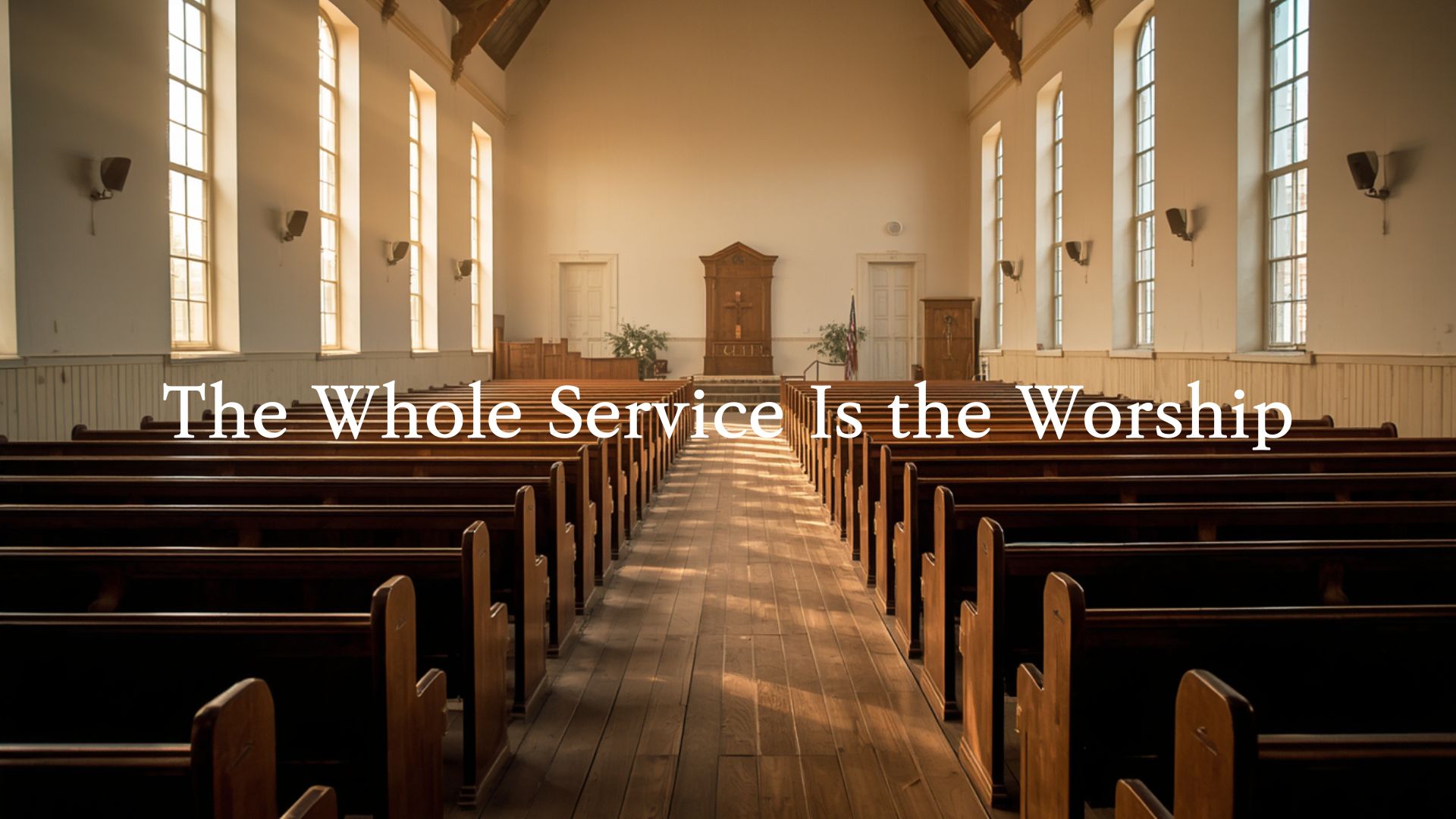
There's a feeling I've had in certain services that I've never quite known how to name.
It's not boredom, exactly. It's more like waiting. You're sitting in the service — or standing at the front — and somewhere in the back of your mind is the sense that the real thing hasn't started yet. The songs feel like runway. So does the prayer, even the offering — all of it just building toward the moment when the preacher steps to the pulpit, something in the room shifts, and you think: okay, here we go.
I've felt this from the front as a worship leader. I've felt it in the congregation. And at some point I had to sit with the uncomfortable question of what, exactly, that feeling was telling me.
Because if the songs and prayers feel like they're getting us ready for worship — they probably are. And if that's true, something has gone wrong at the level of what we think worship actually is.
The problem isn't unique to any one tradition. It shows up in two opposite places.
In music-centered churches, worship is whatever happens before the sermon. The band plays, the room lifts, the atmosphere builds — and then someone says "let's transition into a time of the Word" and the energy deflates a little, as if the real thing just ended and the educational portion is beginning. Worship was the music. The sermon is something else.
In sermon-centered churches — and I've spent significant time in them — it works the other way. The sermon is the main event. Everything else is warm-up. You can feel it in how the service is structured: forty-five, fifty-five minutes of preaching, fifteen minutes of everything else. You can feel it in how the other roles are treated. The person leading the songs, the one offering the intercessory prayer, the deacon taking the offering — they're executing support functions. The preacher is doing the worship.
Both assumptions are wrong. But they share the same root error: the idea that worship is one thing — one emotional experience, or one act of proclamation — rather than the shape of an entire encounter with God.
The early church gathered around two movements: the Liturgy of the Word and the Liturgy of the Table. The church has since named the full shape more explicitly — what we now call the fourfold pattern: God calls his people together. God speaks through Scripture and proclamation. God gives himself at the Table. God sends his people back into the world. Four movements. One act of worship.
The theological grammar underneath all of it is what I'd call the Revelation-Response pattern — the single most consistent structure of worship across the whole of Scripture. God reveals himself. We respond. Every element of the service is either God speaking to us, or us responding to him. Every element. Not just the sermon. Not just the songs.
Which means the call to worship is worship — not the throat-clearing before it. The Scripture reading is worship. So is the song the congregation sings after the sermon, when they're answering what they just heard rather than waiting for it. So is the benediction, the offering, the prayer that brings the world's needs before God.
When a service is organized around this logic, every person serving in it carries genuine weight. Think about the person leading the congregation in intercessory prayer. They're not warming up the preacher or filling time before the real thing begins — Christ himself always lives to intercede, and the congregation is being drawn into that. What they're leading is one of the most Christlike acts a body can perform. The song leader, meanwhile, isn't generating atmosphere; they're placing in the congregation's mouth the theology the congregation needs to inhabit for the rest of the week. And the person receiving the offering? That's not logistics. That's the moment the congregation consecrates their material lives to God. Different acts. All of them worship.
I want to be clear: the sermon matters enormously. The proclamation of the Word is one of the most irreplaceable things that happens in Christian worship — the living God addressing his people through a human voice. The congregation needs to receive it as such.
But the sermon is the proclamation movement of an encounter that has multiple movements. It isn't the encounter itself. When we treat it as if it is, something predictable happens: everything else becomes filler. Filler gets rushed or delegated to whoever's available. And slowly the people leading the songs, the prayer, the offering begin to feel what they are — peripheral. Support staff. In the way of the real thing.
I've watched that happen. And I've felt the tiredness it produces — not just in the congregation, but in everyone serving in the service.
So what changes when you understand the whole service as the worship?
For the preacher who has been treating the songs as warm-up, it means recognizing that the congregation has already been in an encounter with God by the time you step to the pulpit. For the person leading intercession, it means stepping forward not as a support act but as someone doing something irreplaceable in the body's life before God. For everyone: the service has a shape, and every element of that shape is doing something. When you know that, you show up with a different kind of attention. Not just when the sermon starts — from the first word to the last.
The service doesn't get longer. But it gets heavier — in the good way. Weighted with what it actually is.
What part of your worship service have you been treating as filler — and what might change if you approached it as a full act of worship?