The Worship Wars
I have a confession to make.
I love the old hymns. Not just as artifacts or historical curiosities, but genuinely — the density of them, the way a single verse can carry more theology than three contemporary choruses. I grew up singing "How Great Thou Art" and the Doxology and "Be Thou My Vision," and something in me still responds to them the way you respond to a language you learned as a child.
I also love a lot of what came after. Raise your hand if you've ever stood in a room singing "Blessed Be Your Name" or "In Christ Alone" and felt something real happen. Not performance. Something real.
I say this because I want to be honest about where I stand before I try to tell this story. The worship wars — that's what people actually called them — divided real churches, fractured real friendships, and left real damage. I wasn't there for the worst of it. But I've lived long enough in the church to have felt its aftershocks.
Here's what happened, in the simplest version.
By the 1980s, the Pentecostal and charismatic movements we traced in the last post had been producing a new kind of music for decades — guitars, keyboards, simple repeated phrases, songs that felt less like hymns and more like, well, songs. The Jesus Movement of the late '60s and '70s pushed this into evangelical spaces. Maranatha! Music. Vineyard. And then a wave of worship leaders who had grown up in that culture began producing music at scale. Congregations, especially younger ones, wanted that sound on Sunday morning.
The traditional churches said no.
Not everywhere. Not all at once. But the no was real, and it was felt.
The arguments on the traditional side were not nothing. Hymns had doctrinal density; choruses were shallow, repetitive, theologically thin. The new music prioritized individual feeling over corporate declaration, borrowed its sound from entertainment, and turned the sanctuary into a stage.
The arguments on the contemporary side were not nothing either. The church had always absorbed the music of its age — Luther set hymns to folk melodies people already knew, as we saw a few posts ago. I remember being told, early in my worship-leading years, that the congregation needed time to "accept" a song before it could really become worship — and thinking: accepted by whom, exactly?
Both sides were making real arguments.
But here's what I've come to believe: the real fight wasn't about music theory or liturgical principle. It was about identity.
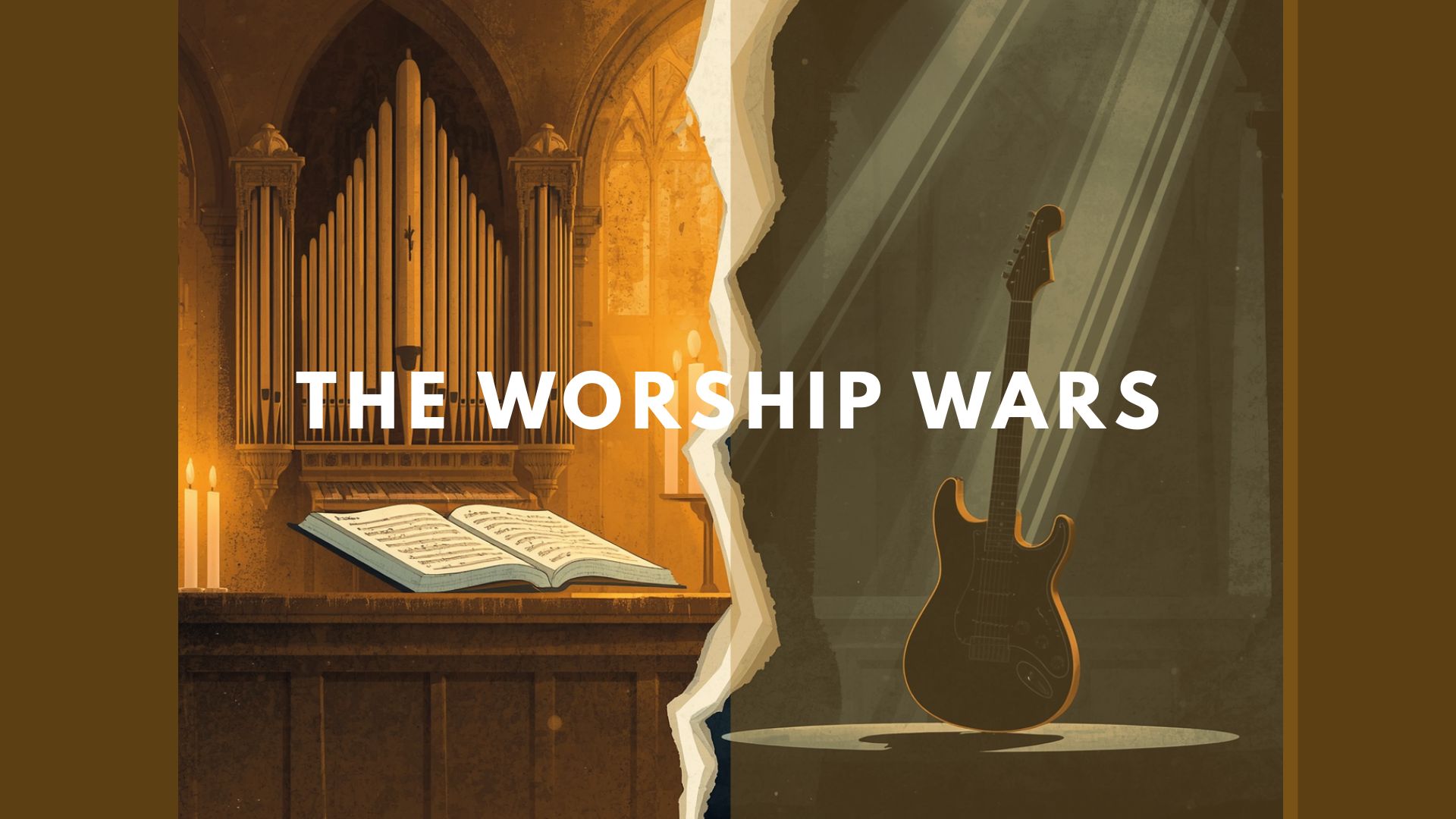
Walk into a traditional church in 1985 and hear "How Great Thou Art" on the organ, the choir in robes, the hymnals in the pew racks — and you were standing inside a particular vision of what the church is. Ordered. Continuous with centuries of practice. Connected to what happened a hundred years ago.
Walk into a contemporary service and hear electric guitars, a praise band, song lyrics on a screen — and you were standing inside a different vision, one that felt alive and immediate and like it belonged to the present moment.
The conflict wasn't about whether the seventh chord belonged in a sanctuary. It was about which of those visions was more true. And underneath that: which generation's formation mattered more.
The people who grew up on hymns weren't just defending music. They were defending the version of Christianity that had shaped them. The people pushing for contemporary worship were insisting that their formation — the things that had moved them toward God — was equally valid.
The argument had "music" written on the label. But what was inside was much older and harder.
The casualties were real.
Churches split. Families left. Pastors resigned. By the mid-1990s, many churches had adopted what was being called "blended worship" — trying to hold both, often satisfying no one. Others went fully contemporary. Others drew a hard line. Things broke apart in a lot of places.
Here's what I think actually happened in all of that: the worship wars forced a conversation the church had been avoiding.
What is worship for? Who is it for? And when we say "this is how we've always done it," are we honoring something sacred, or protecting something comfortable?
Neither side was always right. The contemporary movement produced music that was often theologically thin — the triumph of personal emotional experience over corporate doctrinal declaration was a real loss. But tradition can be alive, genuinely connected to the past in a way that feeds the present — or it can be inertia with a theological argument attached. Telling a generation that their experience of God was less valid because it didn't arrive in the right musical package wasn't faithfulness. It was gatekeeping.
I've been in rooms — not many, but some — where it actually worked. Where the old and the new were held together not because someone found a clever liturgical formula, but because the people in the room had decided to love each other more than they loved being right.
Those rooms felt different. They felt like something was actually happening.
And I've wondered sometimes whether that's because those people had stopped arguing about what they were producing and started paying attention to what they were receiving. Both sides in the worship wars were, in their own way, trying to protect something they'd been given — and both lost sight of the fact that worship isn't ours to protect. It comes to us before we offer it back.
Maybe that's what neither side quite said out loud.
The wars ended, more or less. In much of American evangelicalism, the contemporary model won. But the questions it raised didn't go away. They just went quiet — waiting, I suspect, for the next time the church has to decide what Sunday morning is actually for, and whether the people already inside can bear to make room for those who aren't.