Wake-Up Call: Your Church Group Chat Is a Cybersecurity Vulnerability — Here's What to Do About It
AI-powered scams are targeting faith communities, and most congregations have no idea
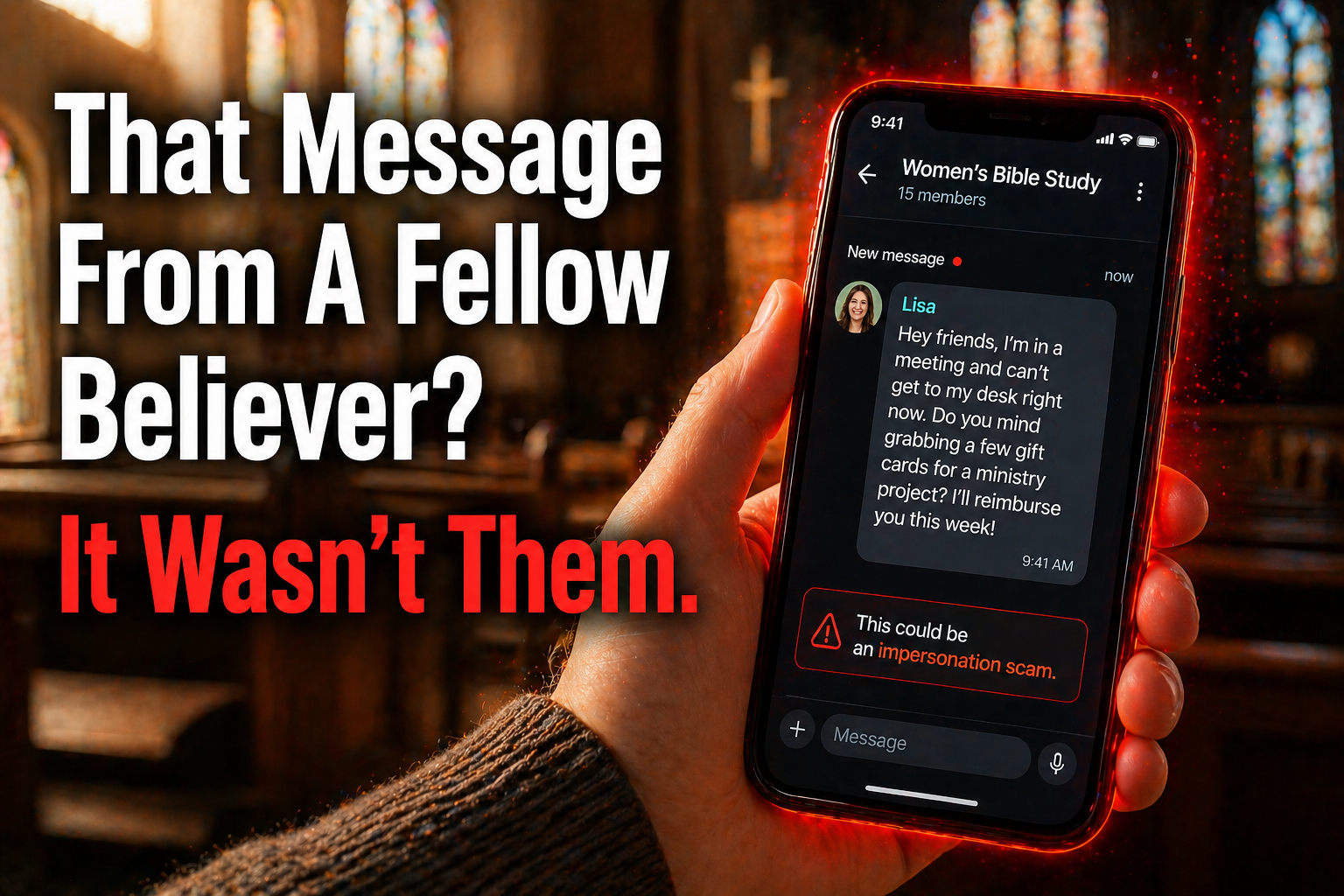
It happened on a Sunday morning, twenty minutes before the 11 o'clock service. A woman in our church's small group texted me in a panic. She'd received a message through the group chat — appearing to be from the pastor — asking members to urgently purchase gift cards for a visiting missionary who had lost his wallet overseas. The message was warm, personal, and used phrases she recognized from his actual emails.
The pastor was standing twenty feet away from her, adjusting his microphone.
Someone had cloned enough of his digital voice to fool a person who had known him for seven years. That's the world we're living in now.
Why Faith Communities Are Prime Targets
I want to be direct with you, because I've spent years studying both AI systems and their social implications: churches are among the most attractive targets for AI-enhanced cybercrime, and they are among the least prepared.
Here's why. Churches operate on trust. That's not a bug — it's the feature. You're supposed to believe the best about your brothers and sisters in Christ. You're supposed to respond generously to need. You're supposed to act quickly when someone is in distress. Every single one of those beautiful qualities is a social engineering attack surface waiting to be exploited.
According to the FBI's Internet Crime Complaint Center, losses from online fraud exceeded $21 billion in 2025 — a 26% increase over the prior year. Business email compromise alone — which uses spoofed identities to impersonate trusted figures and request financial transfers — accounted for the largest share of those losses. AI has not created this threat, but it has lowered the cost and skill required to execute it by orders of magnitude.
"AI has collapsed the cost and effort of launching increasingly sophisticated attacks, making every unpatched or outdated system a realistic target. — Bain & Company, 2026"
With today's AI tools, a bad actor can:
▌ Threat 1: Generate a convincing text message in the exact style of your pastor using only a few samples of his previous communications
▌ Threat 2: Clone a voice convincingly with as little as 3 minutes of recorded audio — available from any sermon podcast
▌ Threat 3: Create deepfake video of a church leader making fraudulent requests, using publicly available footage
▌ Threat 4: Impersonate a giving platform, ministry partner, or mission organization with a spoofed email and fake website
The Theology of Digital Vigilance

Jesus didn't tell his disciples to be naive. 'Be wise as serpents and innocent as doves' (Matthew 10:16) is not a contradiction — it's a commission. The wisdom he calls us to includes understanding the world we're actually in, not the world we wish we were in.
Paul writes in Ephesians 5:15 to 'walk carefully, not as unwise, but as wise, making the best use of the time, because the days are evil.' Digital discernment is not a secular skill that competes with faith. It is faithfulness applied to the communication channels of our moment.
Protecting your congregation from AI-powered scams is an act of love. It is part of what it means to be a good shepherd in 2026.
Practical Steps Every Church Can Take This Week
1. Establish a 'No Financial Requests Through Messaging Apps' Policy — and Post It Publicly. One sentence on your bulletin, website, and group chat pinned message: 'Our church will never request gift cards, wire transfers, or urgent financial assistance through text or group messaging.' That single policy eliminates the most common attack vector.
2. Create a Verbal Verification Culture. Train your congregation: if any digital message involves urgency and money, the response is always a phone call — not a text reply, not a WhatsApp message, an actual voice call to a number you already have saved. AI voice cloning is getting better, but real-time conversation with someone you know intimately is still the most reliable verification method available.
3. Designate a 'Digital Safety Shepherd.' Every congregation needs someone — a tech-savvy elder, deacon, or volunteer — whose role includes watching for scam patterns and educating the congregation. This doesn't require an IT degree. It requires someone who takes it seriously and knows whom to call.
4. Protect Older Congregants Specifically. Pew Research and multiple cybercrime reports consistently identify adults over 65 as the most targeted demographic for financial fraud. If your congregation has seniors — and most do — make digital safety education a regular part of your ministry to them. This is intergenerational discipleship for the digital age.
5. Run an Annual 'Digital Security Sunday.' Take fifteen minutes once a year — maybe in October, which is Cybersecurity Awareness Month — to walk the congregation through the current threat landscape. Keep it accessible, not alarming. The goal is awareness, not anxiety.
When the Church Looks Like the World's Safest Neighborhood
Here's the painful irony: churches present themselves as communities of trust and openness, and those are genuinely good things. But without digital hygiene, that openness functions like leaving every door unlocked in a neighborhood where burglary is on the rise.
The same Claude Mythos model that Anthropic refused to release publicly — because of its unprecedented ability to find and exploit vulnerabilities — exists on a threat landscape that also includes countless less sophisticated but perfectly functional tools for targeting church communities. We don't need Mythos-level AI to run a convincing pastor impersonation scam. We need a few audio clips and a free voice-cloning app.
The good news, and I mean this genuinely, is that the defenses are not complicated. The UK's National Cyber Security Centre confirmed that Mythos itself cannot reliably attack organizations with well-hardened defenses. 'Well-hardened' for a church doesn't mean enterprise-grade firewalls. It means policies, awareness, and a culture of verification.
The serpent was subtle. The disciples were warned. That's still the model.
References:
FBI Internet Crime Complaint Center (IC3) — Annual Report 2025: https://www.ic3.gov/AnnualReport/Reports
Bain & Company — Claude Mythos and the AI Cybersecurity Wake-Up Call: https://www.bain.com/insights/claude-mythos-and-ai-cybersecurity-wake-up-call/
Crossmap Blog - Faith Tech: https://blogs.crossmap.com/faithtech
#ChurchCybersecurity #AIScams #DigitalDiscipleship #FaithAndTech #PhishingPrevention #CongregationSafety #ChristianAI #OnlineSafety