What We're Actually Doing with the Offering
I'll be honest with you.
After more than twenty years of leading worship, the offering is still the most awkward moment in the service for me.
Not because I think it's wrong. Not because I don't believe in giving. But because I've watched it — week after week, from the platform — and I've never quite known what it actually is. The music pauses, or the preacher says a few words about generosity, or an usher appears with a plate or a bag. People reach into pockets or purses or just sit quietly. And then it's over. We move on.
I've seen it treated as a transaction: here's what we need, here's how you help. I've seen it buried in announcements, sandwiched between two worship songs like an administrative interruption. I've heard people say "my whole life is an offering to God, I don't need to put money in a bag to prove it" — and I've understood that instinct, even if I've never been sure it's quite right. I've even sensed, a few times, something uncomfortably close to: I enjoyed the sermon, so here's what that's worth.
None of those feel like worship to me. But I've struggled to articulate what the offering is instead.
Here's what I think we're missing.
The offering isn't primarily a financial act. It's a response act.
The fourfold pattern of Christian worship — Gather, Word, Table, Send — runs in one direction: God gives first, and only then do we have anything to give back. The offering doesn't belong to the transaction side of that conversation. It belongs to the response side — it comes after God has spoken in the Word and given himself at the Table, and it answers what was received there.
That reframes everything. The offering isn't in the service because the church needs money (though it does). It's in the service because a congregation that has genuinely received something has something to respond with — and the response can take material form just as much as it takes musical form.
Paul makes the connection explicit in Romans 12:1. "Therefore," he says — and that therefore reaches back across eleven chapters of what God has done — "offer your bodies as a living sacrifice. This is your true and proper worship." What you do with your labor, your money, your material life is not separate from worship. It is what worship looks like when it leaves the sanctuary.
This is why the Old Testament Grain Offering matters more than we usually notice.
The Grain Offering in Leviticus wasn't about blood sacrifice. It was flour, oil, and salt — the products of human labor. The worshiper was saying, with real material things: Even my labor is yours. What I made with these hands this week — it came from you. The offering wasn't proving generosity. It was acknowledging ownership.
That's a very different thing from "we have ministry needs and your contribution helps."
What's underneath the offering theologically isn't giving to God what we've earned. It's returning to God what was always his. The harvest, the labor, the paycheck — these come through land he created, a body he made, skills and opportunities he provided. The offering is the moment in the gathered service where we make that truth visible — not as a statement of financial generosity, but as a statement of theological reality.
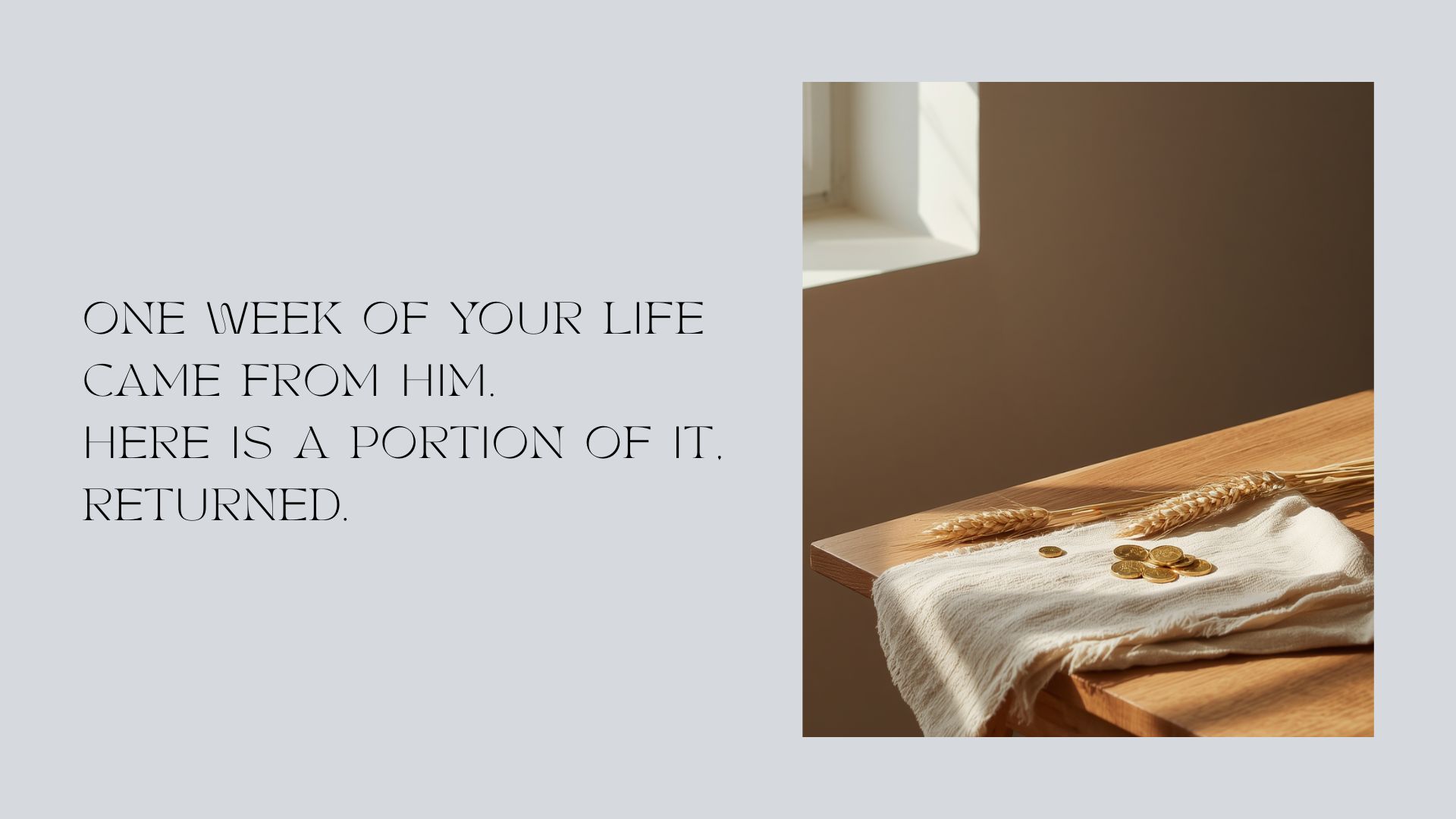
One week of your life came from him. Here is a portion of it, returned.
And even this returning isn't something we manufacture on our own. The Spirit folds our small act of giving into the self-offering Christ has already made — which means the offering, like the rest of worship, is carried by something larger than our own effort or intention.
This is where both of our common worship cultures get stuck — and they get stuck differently.
In music-centered worship culture, the offering often feels like a break in the action. The songs were doing something real. The room was engaged. And then — offering. It lands like a commercial interruption: practical, necessary, but theologically disconnected from what came before and after. The implicit message is that the real worship was the music, and the offering is the logistical reality we have to deal with.
In sermon-centered worship culture, the problem runs the other direction. The sermon is the center of gravity. Everything before it is preparation; everything after it is conclusion. The offering, wherever it falls, is understood through one lens: this is how the church sustains its ministry. That's true. But when financial necessity is the only frame we give people for the offering, we've reduced a worship act to a funding mechanism. And somewhere in that reduction, you get the instinct I described at the beginning — the offering as a kind of payment for what was received. The sermon was good, so here is what that's worth.
Both cultures have made the same mistake. They've severed the offering from what preceded it — from the grace just named, from the Word just opened. When that connection is gone, the offering becomes awkward. Of course it does. You've taken a response out of its conversation.
So what changes in practice?
For whoever leads or introduces the offering: the words you say before the plate passes matter more than we think. Not because you're selling something, but because you're orienting the congregation toward what they're actually doing. "As we give this morning, we're returning a portion of what God entrusted to us this week" is a different frame than "we'll now receive the morning offering." One sentence. Completely different theological weight.
For worship planners and preachers: the offering should land in the service like a response, not an interruption. Where it's placed — and what's said before and after it — either connects it to the theological arc of the service or severs it. If the offering regularly feels like an awkward break, that's worth examining. The problem may not be the congregation's attitude toward money. It may be that no one has ever shown them what they're doing.
For everyone who gives: you are holding out a portion of one week's life to the God who gave you that week — saying, with something material and real, what is harder to say in words: It was yours. It still is. I know that.
That's not awkward. That's one of the most honest things we do all week.
I haven't fully resolved the awkwardness I mentioned at the beginning. I don't think a few theological sentences will fix something that's been treated as administrative for decades. Formation takes time.
But I've stopped thinking the awkwardness is unavoidable.
The offering doesn't feel like worship because we stopped treating it as worship. When something has been reduced for long enough, people forget it ever was anything else. What we've inherited is not the shape of the offering itself — it's the reduction.
The shape is still there, underneath. Waiting to be recovered.
How is the offering introduced in your church's worship service — and what does that introduction assume it is? What would you say differently if you were introducing it as a response to grace rather than a financial contribution?