Why Does “Bible Verses for Anxiety” Spike Before Dawn?
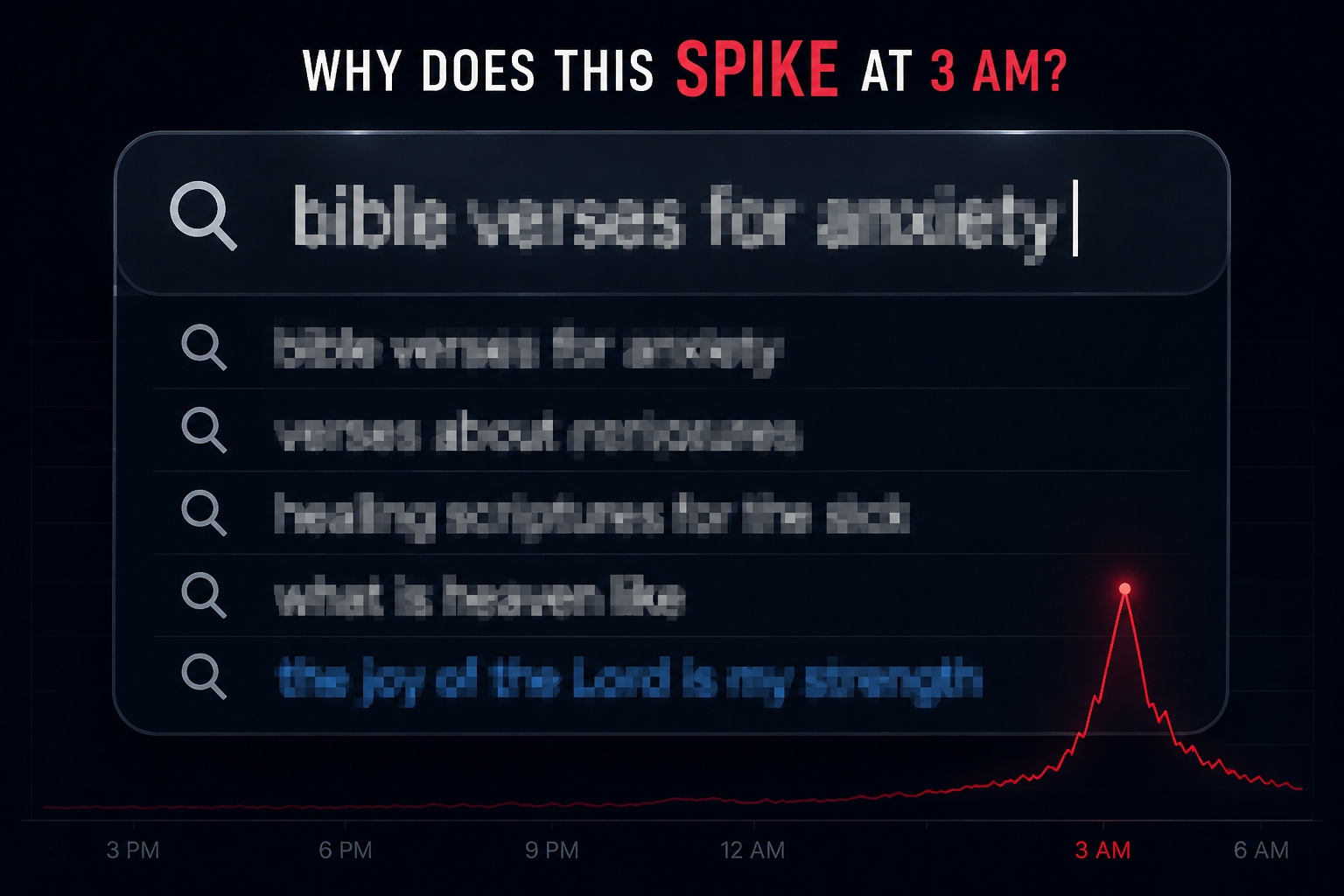
There’s a strange pattern in search data.
Queries like “bible verses for anxiety” tend to spike late at night, especially in the quiet hours before dawn. What’s fascinating is that people who seemed perfectly fine during the day suddenly find themselves typing things like:
“Verses about nervousness”
“Healing scriptures for the sick”
“What is heaven like?”
“The joy of the Lord is my strength”
Why the early hours of the morning?
Psychologists say that as external stimuli fade at night, the thoughts we suppressed during the day begin to surface. During the day, we are occupied by work, notifications, people, and endless videos. But at 3 AM, the world goes quiet.
And suddenly, the big questions hit:
Death.
The future.
Loneliness.
Emptiness.
Interestingly, it’s not just non-believers doing these searches. In many cases, it’s people who have been in the church for a long time. They know the worship songs, they know the verses, and they’ve celebrated Easter dozens of times—yet, out of nowhere, the questions arise:
“Why am I still afraid of death?”
“If I believe, why am I so anxious?”
“Why do I feel so drained and unmotivated?”
Many Christians hide these questions. We feel like faith means always being “bold” and “unshakable.” But the Bible is much more realistic than we give it credit for. David wept through the night, Elijah ran for his life, and the disciples were terrified of the future.
The Bible doesn’t describe believers as “anxiety-free humans.” Instead, it is filled with stories of people who were trembling but still holding onto God. That’s why Christianity is so strikingly grounded in reality.
The Real Meaning Behind “The Joy of the Lord”
Perhaps that’s why one particular verse is being searched more than ever: “The joy of the Lord is my strength.”
The irony is that those searching for this verse usually aren't the “happy” ones. It’s the exhausted ones. The people who go to church but feel spiritually dry; who pray but feel God is distant; who smile on the outside while crumbling on the inside.
This verse actually originates from a time of extreme hardship. After the Babylonian exile, the Israelites returned to a ruined Jerusalem. The walls were broken, their lives were a mess, and they felt like a failed nation. As they listened to God’s Word, they began to weep because the scriptures acted as a mirror to their broken reality.
But in that moment, God gave them an unexpected word:
“Do not grieve, for the joy of the Lord is your strength.”
— Nehemiah 8:10
We see a similar heart in the prophet Habakkuk:
“Though the fig tree does not bud and there are no grapes on the vines... yet I will rejoice in the Lord, I will be joyful in God my Savior.”
— Habakkuk 3:17-18
This isn't a command to “pretend you're okay.” Habakkuk’s world was falling apart. In modern terms, his entire foundation for life was collapsing. He didn’t say, “It's all fine.” He said, “In spite of this, I will choose to find my joy in the Lord.”
Joy is Not a Denial of Reality
Biblical joy isn’t about denying your circumstances; it’s about holding onto a God who is bigger than your circumstances. This kind of joy is only possible when we believe that God—not us—is the one leading our lives.
We feel anxious when we try to take full responsibility for our own flawed and fragile lives. But when we realize that an all-knowing, all-powerful God is at the helm, we experience a peace and freedom we could never achieve on our own.
Even Jesus felt this. Before the cross, in Gethsemane, He said, “My soul is overwhelmed with sorrow to the point of death.” Yet, in His fear, He trusted the Father. With that strength, He walked the path of the cross. He took on sin, fear, and death in a human body that felt pain just like ours.
The core of Christianity isn't that only “strong people” can get to God.
It’s the opposite.
He comes for the weary.
The fearful.
The broken.
Jesus spent His life walking toward people just like that.
So, if “the joy of the Lord” doesn't feel like a reality to you today, that’s okay. Biblical joy isn't just a “happy feeling.” The cross is proof that God didn't watch our suffering from a distance—He stepped directly into it.
Even if you aren't strong right now, God is already standing right beside you in your weakness.