Why the Table Keeps Getting Pushed Out
Years ago, at a church I no longer attend, I remember taking communion on an ordinary Sunday and being undone by it.
Nothing dramatic had happened that week. I wasn't in crisis. But I understood, in a way I hadn't quite let myself understand before, what I was holding in my hands. It wasn't a symbol asking me to summon a feeling, or an exercise in remembering something correctly. It was Christ himself, giving himself to me again — the same grace that had saved me, now placed directly into my body. I didn't produce that moment. I received it. I've led worship for over twenty years, written songs about grace, taught the theology of it in a classroom — and still, that Sunday at the table is one of the clearest places I've ever felt the difference between hearing about grace and being handed it.
I think about that Sunday whenever I hear a preacher, in some other church, explain why communion doesn't happen often. Once I did. He said something like: the sermon is where we're truly fed — think of it as invisible bread. The Word does what the Table does, only better, because it feeds the mind and the heart at once. Communion, in that church, is reserved for a few high points in the year. Maybe three Sundays out of fifty-two.
He wasn't being careless. He believed what he said. And that's exactly what makes it worth stopping on.
"Invisible bread" is a good phrase, actually. It's just describing the wrong thing.
The sermon does feed the congregation — Scripture proclaimed and explained is real nourishment, and nothing in this post is arguing otherwise. But the reason the Table exists is not to duplicate what the sermon already does in a different medium. It's to do something the sermon structurally cannot do. A sermon is heard. The Table is received. One works through your ears and your understanding. The other works through your hands, your mouth, your body — the whole of you, not just the part of you that follows an argument.
Paul writes that in this meal, "you proclaim the Lord's death until he comes" (1 Corinthians 11:26). Proclaim. The Table is not an illustration added to make the point land. It is itself an act of proclamation — a different kind of preaching, done with bread instead of words, aimed at people who don't only think, but eat and remember and belong.
But it's doing more than proclaiming. A few verses earlier, Paul asks: "Is not the cup of thanksgiving for which we give thanks a participation in the blood of Christ? And is not the bread that we break a participation in the body of Christ? Because there is one loaf, we, who are many, are one body, for we all share the one loaf" (1 Corinthians 10:16-17). Participation — koinonia, the same word used for the fellowship of the early church. The Table isn't only telling the congregation something true about the past. It's constituting them, right now, as one body, by having them physically share one loaf. That's not a function the sermon can perform, however good the sermon is. You cannot be preached into one body. You can be fed into one, at a table you actually share.
It's worth remembering, too, that the Table used to be exactly that — a shared meal, not a wafer passed in silence down a row of seats. Something of that has already been lost on the way to where most of us practice communion now. Reducing it further to a rare, symbolic add-on doesn't elevate the sermon. It just leaves a hole where an entire form of the gospel's address to us — and an entire enactment of the congregation's unity — used to be.
This shows up in two directions, and I want to be honest that I've mostly lived on one side of it.
In sermon-centered worship — the world I've just described — the Table gets treated as an appendage. It survives, when it survives, because someone remembers to schedule it, not because the service is structurally incomplete without it. When time runs short, communion is what gets moved, shortened, or quietly dropped for the week. The logic isn't hostility toward the Table. It's that nothing in the service is actually waiting on it. The sermon can stand alone; the Table cannot, in this frame, stand at all without the sermon's permission.
In music-centered worship, the distortion looks different but lands in the same place. Communion becomes an emotional high point — reserved for the Sunday the setlist is building toward something, a moment engineered to land at the peak of a worship set rather than occupying its own structural position every week. Or it becomes optional in a more literal sense: an extra element added to a service that's otherwise complete without it, available if there's room, dropped if the transitions run long. In both cases, the Table's meaning gets borrowed from whatever else is happening around it — the sermon's authority, or the music's emotional arc — rather than the Table having its own weight to bring.
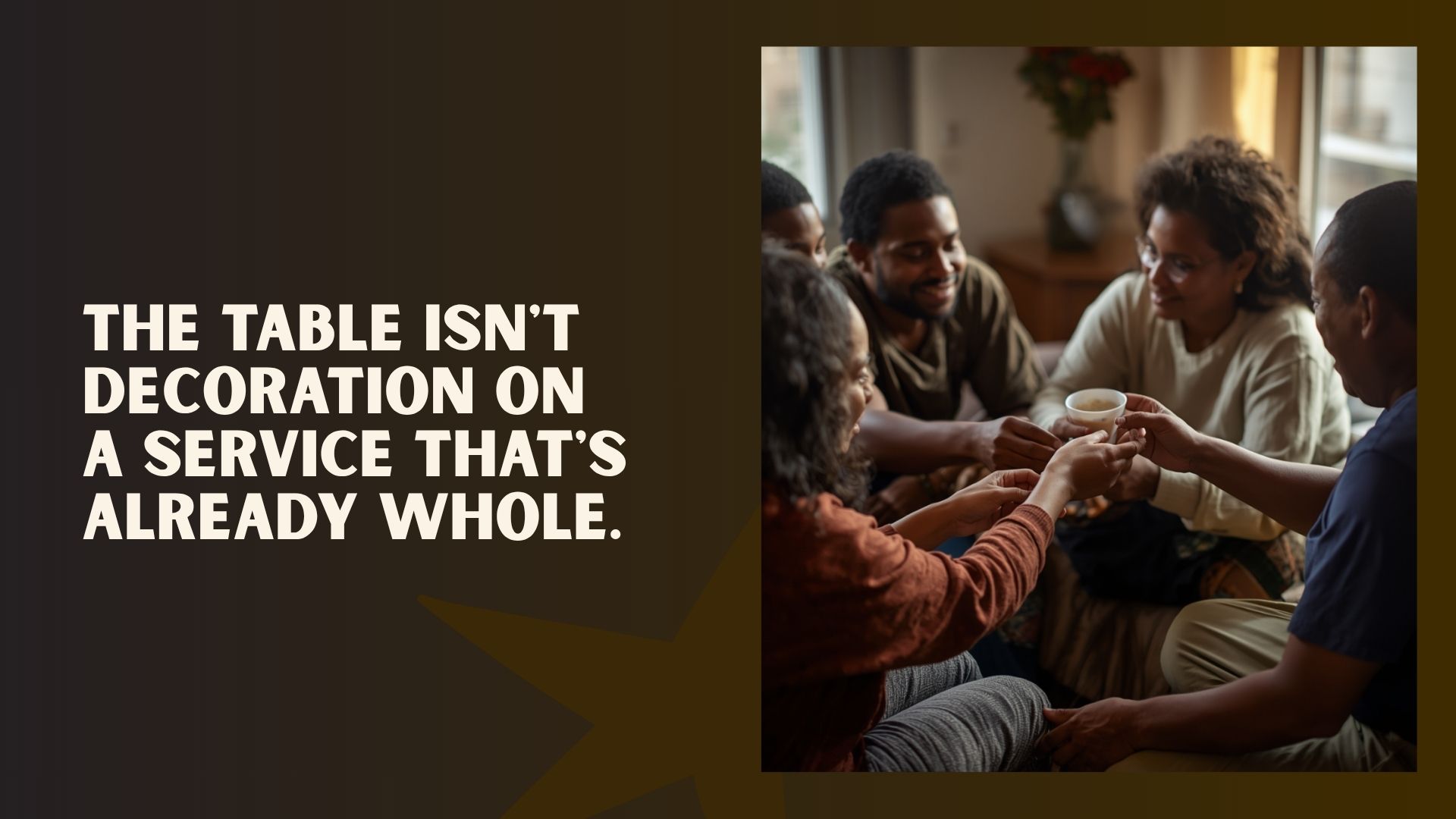
Both distortions agree, without saying so, on the same premise: that the Table is decoration on a service that's already whole. And I want to be careful here, because it's tempting to blame that premise on a specific theology of what happens in the bread and the cup — usually Zwingli's, since his view that the elements are a memorial, a sign rather than a presence, is the one most American evangelicals have inherited, often without knowing it. But that's not quite fair to Zwingli. Whether you believe Christ is bodily present, spiritually present, or symbolically remembered in the meal is one question. How often the church should gather at the Table is a different question — and nothing about believing the elements are a sign actually requires treating the sign as optional.
The clearest proof of that is Calvin, who didn't hold Zwingli's view at all. Calvin believed Christ is truly, spiritually present in the Supper — and he still wanted it celebrated every single week. When Geneva's city council would only permit quarterly communion, he called it one of the greatest failures of his own reform. So the infrequency most of us take for granted isn't really a conclusion any particular eucharistic theology forces on us. It's an inherited habit that outlived the theological reasoning — if there ever was any — behind it.
None of this means every church needs to land on Calvin's preferred number. I'm not trying to argue every congregation should be celebrating the Table weekly. What I am saying is narrower: whatever frequency your church has landed on should be something someone actually decided, for reasons someone could state out loud — not a default that nobody remembers choosing.
So what changes, practically, once you see it this way?
For those who plan worship: the question isn't how often the Table should appear on your calendar. It's whether your church's current frequency was actually decided by someone, for stated theological reasons — or whether it's just what's always been done. Is the Table standing in its own right — its own act of proclamation, its own means of participation — or is it functioning as a seasonal accent? The answer shows up less in your bulletin and more in what happens when your service runs long and something has to go.
For preachers: the sermon and the Table are not competitors for the congregation's attention, and one is not a more efficient version of the other. They do different work. A congregation that only hears about grace, sermon after sermon, is missing the specific thing that happens when grace is placed in your actual hands.
For everyone who serves at the Table — servers, those who prepare the elements, those who lead the words of institution: you are not staffing an intermission. You're presiding over one of the places where the gospel gets preached with food instead of language, to a body that needs to receive it, not just understand it.
I don't have a tidy resolution to offer here, because I'm still working out what it means for my own church to take that "invisible bread" logic and actually test it against what the Table is for. But I know what that Sunday, years ago, told me the Table is capable of doing when it's given its full weight. I haven't been able to unknow it since.
How often does your church celebrate the Lord's Supper — and do you know why? Is that frequency a theological conviction, or an inherited habit no one has examined?