An Evening to Set the Day's Weight Down: A Cup of Chamomile Tea
 A quiet cup of chamomile tea brings a gentle pause to a warm August evening, offering a simple moment to slow down, rest, and enjoy the peaceful beauty of summer.
When our bodies are worn out and our hearts feel heavy, we tend to reach for something warm to drink.
At the end of a busy day, pausing for a moment to steep flower petals in hot water can become a small kind of rest in itself.
One plant that's been part of traditional teas and home remedies across Europe and the Middle East for a long time is chamomile. With its gentle apple-like scent and soft yellow bloom, this small daisy-like flower remains one of the most widely consumed herbal teas in the world today.
When looking at plants through a Christian lens, there's an important balance worth keeping. We can enjoy nature gratefully as a gift from God, without expecting any single plant or food to deliver an outsized cure.
The Wisdom of Enjoying What God Has Allowed in Nature
Scripture doesn't treat our bodies as something to be handled carelessly.
1 Corinthians 6:19 (KJV) reminds us: "What? know ye not that your body is the temple of the Holy Ghost which is in you, which ye have of God, and ye are not your own?"
Caring for your health was never just about trying to live longer — it can be understood as part of a stewardship-minded life, wisely caring for the body God has entrusted to us.
Drinking a warm cup of tea, resting enough, eating good food, and paying attention to your body's signals can all be part of that kind of self-care.
Chamomile tea fits into that picture too. It's not some special cure — it's simply one of the many plants God created, enjoyed comfortably as part of everyday life.
What Exactly Is Chamomile?
Chamomile is a small flower in the daisy family, and the dried blooms are steeped in hot water to make tea.
It's been used traditionally across Europe and the Middle East for thousands of years, and today it's particularly well known around the world as a tea people drink before bed.
Chamomile contains a flavonoid called apigenin, which is being studied for its potential to act on certain receptors in the brain and support relaxation.
There's an important distinction worth making here, though.
The fact that something has been used for a long time and the fact that all of its effects have been solidly proven medically are two different things.
What's Actually Known About Chamomile
The National Center for Complementary and Integrative Health (NCCIH) has reviewed the research on chamomile several times.
There are some reasonably encouraging small studies on anxiety relief. An 8-week randomized controlled trial in adults with generalized anxiety disorder found that those taking a chamomile extract showed a meaningfully greater reduction in anxiety symptoms than those on placebo, and a follow-up study over 38 weeks suggested the effect held up to some degree over time.
The evidence for insomnia, on the other hand, is much more limited. A 2019 systematic review found only one study specifically looking at insomnia, and that study found no clear benefit for the sleep disorder itself.
So rather than concluding "chamomile tea will help you sleep," it's more accurate to think of it as a cup of tea that may help settle your mind rather than a proven sleep aid. In fact, much of the calming effect people notice may come less from the chamomile itself, and more from the ritual of slowly drinking something warm and winding down from the day before bed.
 A warm cup of chamomile tea offers a quiet moment of rest at the end of the day, reminding us to slow down and appreciate the simple gifts of everyday life.
Chamomile Is Generally Safe, But a Few Things Are Worth Knowing
NCCIH notes that chamomile is likely safe when consumed in the amounts typically found in tea and food.
That said, there are a few things worth remembering.
If you have allergies. Chamomile belongs to the daisy family, so anyone allergic to ragweed, chrysanthemums, or daisies may react to chamomile as well. Severe allergic reactions, including anaphylaxis, have been reported in rare cases.
If you're on blood thinners. Interactions between chamomile and warfarin have been reported, so if you're on an anticoagulant, it's worth checking with your doctor before making it a daily habit.
If you're taking sedatives or sleep medication. Chamomile may increase drowsiness when combined with other sedating medications.
If you're pregnant or breastfeeding. There isn't enough reliable safety data available, so it's safer to check with your doctor first.
None of this means you need to be afraid of chamomile tea itself. It's simply worth remembering that "natural" doesn't automatically mean "safe for absolutely everyone."
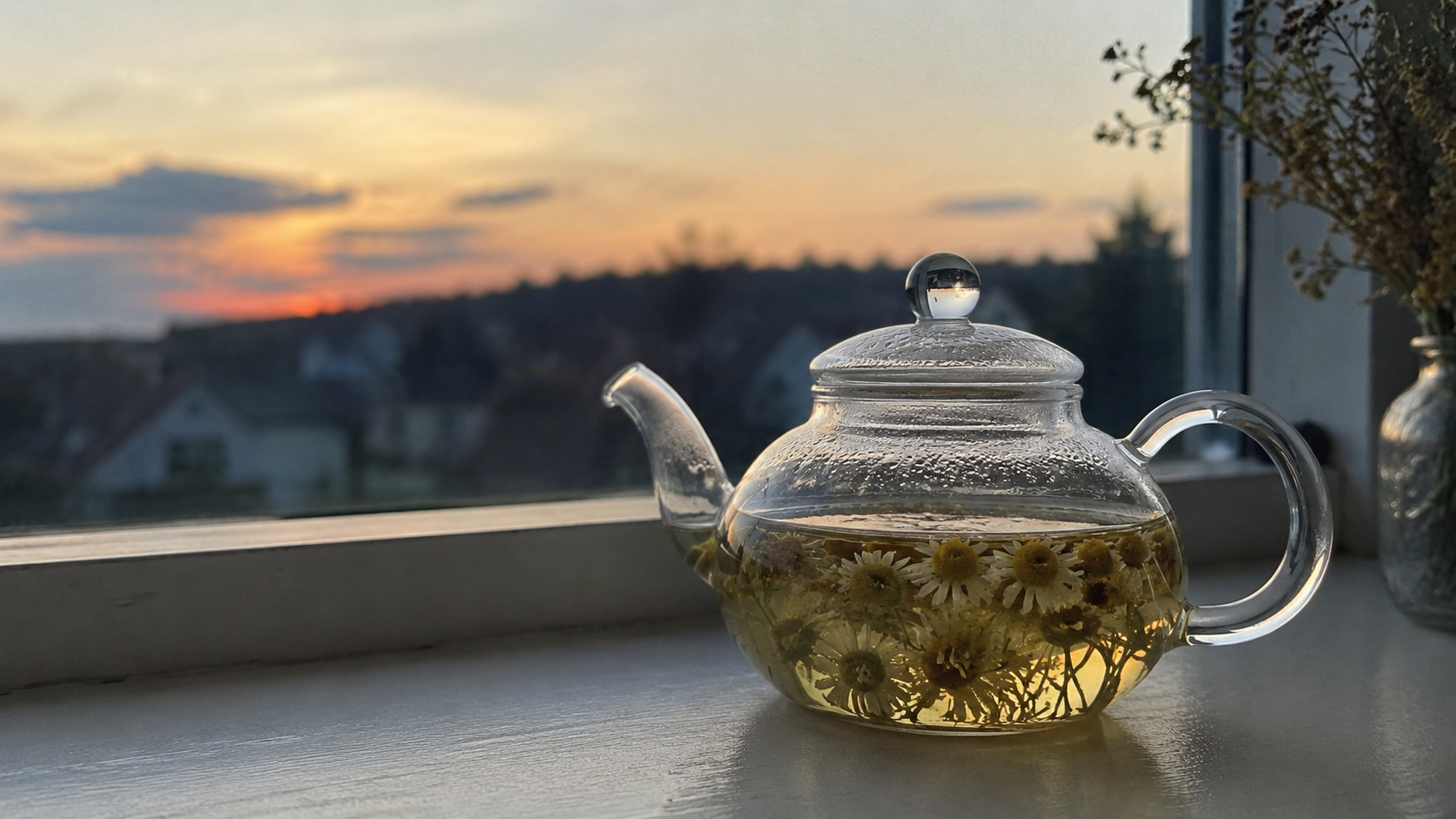 Chamomile tea steeps quietly by the window as the day fades, capturing a peaceful moment of stillness, gratitude, and unhurried rest.
The Genuine Rest a Cup of Tea Can Offer
If you're going to drink chamomile tea, it's better to approach it as a moment of ease rather than a treatment for anything specific.
Slowly drinking a warm cup, looking back over your day, putting your phone down for a moment, letting your body and mind rest.
It's worth using that short window of time to pray, too.
Lord, thank You for watching over me again today.
That single sentence of prayer may offer deeper rest than the tea itself.
We often go looking for better food, better supplements, or the newest health trend to deal with our exhaustion.
But it's not just the body that needs rest — our souls need it too.
Jesus said:
"Come unto me, all ye that labour and are heavy laden, and I will give you rest." (Matthew 11:28, KJV)
Christian rest was never just about releasing physical tension. Deeper rest begins when we set down the belief that we have to carry everything ourselves, and hand our worries and exhaustion over to God.
Caring for Your Health Is Part of a Life of Faith Too
Taking an interest in your health is a good thing.
But there's no need to expect any single food or herbal tea to fully protect your health on its own.
God has given us not just nature, but medicine, science, and the knowledge of doctors as well.
So if anxiety or insomnia persists and becomes severe, it's wiser to seek the medical care you actually need rather than relying on tea or supplements alone.
A healthy diet, enough sleep, exercise, rest, medical care, and prayer — none of these compete with one another. Together, they can all help sustain your life.
An Evening to Set the Day's Weight Down
Chamomile isn't some miracle herb.
But it can become an occasion to pause for a while over a warm cup of tea.
And in that moment, feeling its gentle fragrance and warmth, why not give thanks for the ordinary day God has allowed you?
If you'd like to try it, [an organic chamomile tea like this one] is a simple, caffeine-free way to build this small evening habit (affiliate link — I may earn a small commission at no extra cost to you).
Health was never something we could fully control on our own.
That's exactly why it matters to treasure our body and life, day by day.
A warm cup of tea, and a short prayer.
May this become a small time to let your tired body rest today, and to hand the weight of your heart over to God as well.
"Casting all your care upon him; for he careth for you." (1 Peter 5:7, KJV)
Enjoy the small comfort nature offers with gratitude — and remember that our ultimate peace and hope were never found in nature or food, but in the God who cares for us.
 A warm drink, an open Bible, and a quiet evening create space to rest, reflect, and find peace in God’s Word after a long day.
This article is intended as general health information and is not a substitute for individual diagnosis or treatment. If you have an allergy to ragweed or daisy-family plants, are taking blood thinners or sedatives, or are pregnant or breastfeeding, please consult a healthcare professional before making chamomile tea a regular habit.