Are You Running from Death?
I. We All Find Our Own Ways to Pretend Death Doesn't Exist
Birth, aging, sickness, death — everyone knows this is the arc of life, yet almost no one is willing to sit down and talk about it honestly.
This is especially true in Eastern culture. At birthday banquets we toast to long life and boundless fortune; at funerals we lower our voices; in everyday conversation, the word "death" is avoided whenever possible. The First Emperor of China exhausted the resources of an empire searching for the elixir of immortality. The monk Xuanzang trekked across continents in pursuit of sacred truth. Beneath all of that — wasn't it the same thing? A terror of death buried deep in the bone, and a longing for eternity that refuses to be extinguished?
But the ways we cope with that fear look very different from person to person.
Some say: Death is far away — no need to think about it now. Just live while you're young; deal with it when you're old. So death becomes permanently "a problem for later" — until it suddenly appears right in front of you.
Some say: When you die, that's it. The light goes out and nothing remains. In that case, why not make the most of this life — money, pleasure, status. That's the main theme; everything else is noise.
Some can't quite articulate anything. They just carry a quiet, unnamed dread — too afraid to look at it directly, yet unable to truly let it go.
Others go further: fortune tellers, spirit mediums, anything that might offer some sense of control over the unknown. The result is usually the opposite — they sink deeper, and find themselves less free than before.
Which of these do you recognize? Or which one is you?
II. Does the Light Really Just Go Out?
The death of the body is real. "You are dust, and to dust you shall return." No one can argue with that.
But is the body all there is to a person?
Across nearly every civilization, East and West, throughout all of human history, people have left behind accounts of what lies beyond death. That is not a coincidence. It points to something shared at the deepest level of human consciousness: we are not simply bodies that decay and disappear.
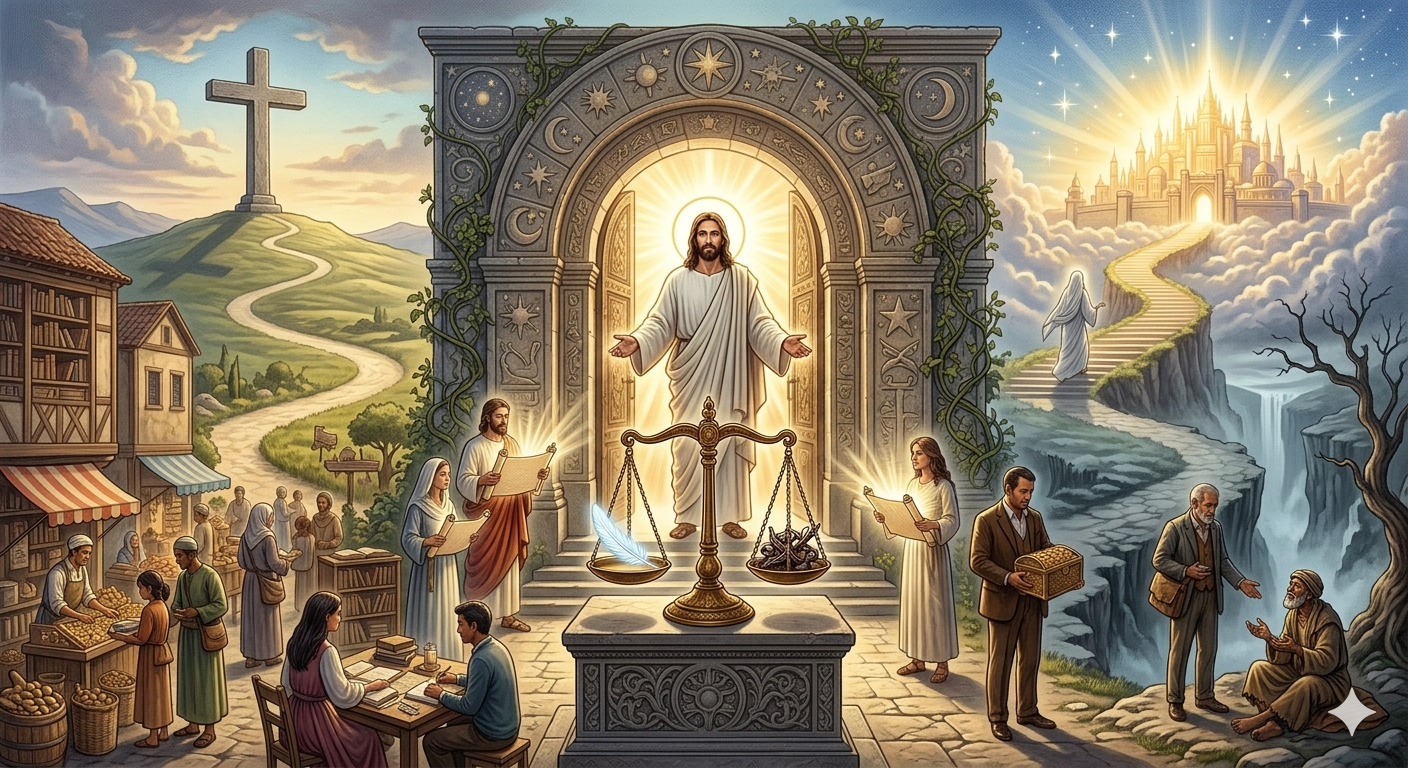
Jesus once told a story about a rich man and a poor man who, after dying, found themselves in completely different places. The story makes three things clear:
First, death is not an ending — it is a door. And on the other side of that door, something real exists.
Second, there is a judgment after death. Not by other people, but by a final and ultimate judge. Everything we accumulate in this life will be weighed in that moment.
Third, your position in this world does not determine your position in the next. The wealthy man who wanted for nothing found himself in anguish after death. The beggar who sat at his gate found himself at rest. Status, wealth, reputation — none of these are the currency that opens that door.
III. Death Has Two Outcomes
Not all deaths are the same.
In one, a person leaves this world and their soul enters darkness — taken by whatever powers they gave themselves to during their lifetime. Whatever you spend your life serving, when death comes, it comes to collect.
In the other, someone is waiting. Jesus said: "I go to prepare a place for you… where I am, there you may be also." For those who have welcomed the Lord of life, death is not a fall into the void. It is coming home.
These two outcomes are not determined by fate. They are determined by the choices you make while you are still alive.
IV. Meditating on Death Changes the Way You Live
There is a kind of person who lives each day with a quiet clarity: this is not the end. There will be a reckoning.
Not a life lived in fear — but a life lived wide awake. They know who they are. They know who they are living for. They understand that their time and their resources are not truly their own — they are a trust, and one day they will be returned.
Jesus said that no one knows the day or the hour when it will come. But that is precisely the point. Because we don't know, every day deserves to be lived as though it might be that day.
Not with anxiety. With seriousness.
That kind of seriousness makes a person reluctant to waste time, reluctant to wrong the people around them, reluctant to hide behind "I'll deal with it later" — because "later" has never come with a guarantee.
V. Death Has Already Been Broken — by One Person
There was a man in history who died, and three days later was alive again.
Not legend. Not metaphor. His disciples saw it with their own eyes, spent the rest of their lives bearing witness to it, and many of them gave their lives for it.
If that is true, it means this: death is not an unsolvable ending. It is a road that someone has already walked through — and walked back.
Jesus died on a cross and shattered the power of death. His resurrection was not only about him. It opened a way for everyone willing to follow — a way through death, and into life that does not end.
"Where, O death, is your victory? Where, O death, is your sting?"
Someone once said that the day they truly began to live was the day they first looked death honestly in the face.
Maybe today is that day for you.