Arginine: Why So Many Men in Their 40s Are Asking About It — A Christian's Wisdom for Caring for Health
There was a time when pushing yourself a little too hard was fine, as long as you got a solid night's sleep and bounced back. Plenty of men in their 40s notice that recovery just doesn't work that way anymore.
Fatigue lingers longer after a late night at work. Recovery after a workout takes noticeably more time. Some days, even a full night's sleep doesn't leave you feeling rested — and naturally, health and fitness start getting more attention.
That's probably part of why midlife brings more interest in vitamins, magnesium, and omega-3s — and lately, arginine keeps coming up too.
It's drawn particular interest among men in their 40s who exercise regularly.
So what exactly is arginine? And how should a Christian think about supplements like this one?
 A middle-aged man takes a moment to recover after a strength-training session. For adults in their 40s and beyond, regular exercise, proper recovery, balanced nutrition, and adequate rest remain essential foundations for maintaining strength and overall health.
What Exactly Is Arginine?
Arginine is one of the amino acids your body uses.
It's involved in several physiological processes, and one of the better-known ones is its connection to nitric oxide production.
Because nitric oxide plays a role in relaxing blood vessels, arginine comes up often in discussions of blood flow and exercise supplements.
That's why some people who train at the gym or do weight training take an arginine product before working out.
That said, taking arginine doesn't automatically produce a big, immediate improvement in strength or exercise performance for everyone. Research on exercise performance is genuinely mixed — some meta-analyses suggest a positive effect is possible, but results haven't been consistent across all studies.
The actual effect of any supplement or nutrient depends heavily on individual factors — diet, activity level, overall health, and dosage.
Why People Who Exercise Look Into Arginine
Arginine is a fairly familiar name among gym-goers.
Some people say taking it before a workout helps with that so-called "pump" feeling during training.
It draws particular interest from people who train consistently with weights or strength exercises.
But here too, what matters is that a supplement can't replace exercise itself.
Maintaining muscle and stamina ultimately comes down to consistent exercise, enough protein, and adequate sleep and rest.
A supplement is best treated as a supporting tool for those basic habits — not a substitute for them.
Why Does Interest Grow After 40?
Turning 40 tends to make people more sensitive to what their bodies are signaling.
Fatigue can set in more easily than before, and recovery after exercise can take noticeably longer.
That naturally draws attention to nutrients like vitamins and minerals, magnesium, vitamin D, omega-3s, and arginine.
For people specifically interested in exercise and fitness, ingredients like arginine or citrulline come up often.
But relying too heavily on any single nutrient isn't a wise approach to health.
Our bodies aren't sustained by one supplement — health depends on a genuine balance of diet, exercise, sleep, stress management, and rest working together.
Citrulline Often Comes Up Alongside Arginine
Search around for arginine, and you'll frequently run into another name: citrulline.
Both are discussed in relation to nitric oxide production, and they're sometimes combined in the same exercise supplement.
But more ingredients in a product doesn't automatically make it better.
[A single-ingredient citrulline product] is worth considering first for some people, since citrulline tends to be gentler on the stomach than arginine itself and converts gradually into arginine in the body (affiliate link — I may earn a small commission at no extra cost to you).
When choosing a product, it's worth checking the actual dosage and ingredient list, and consulting a professional if you have a health condition or are taking medication.
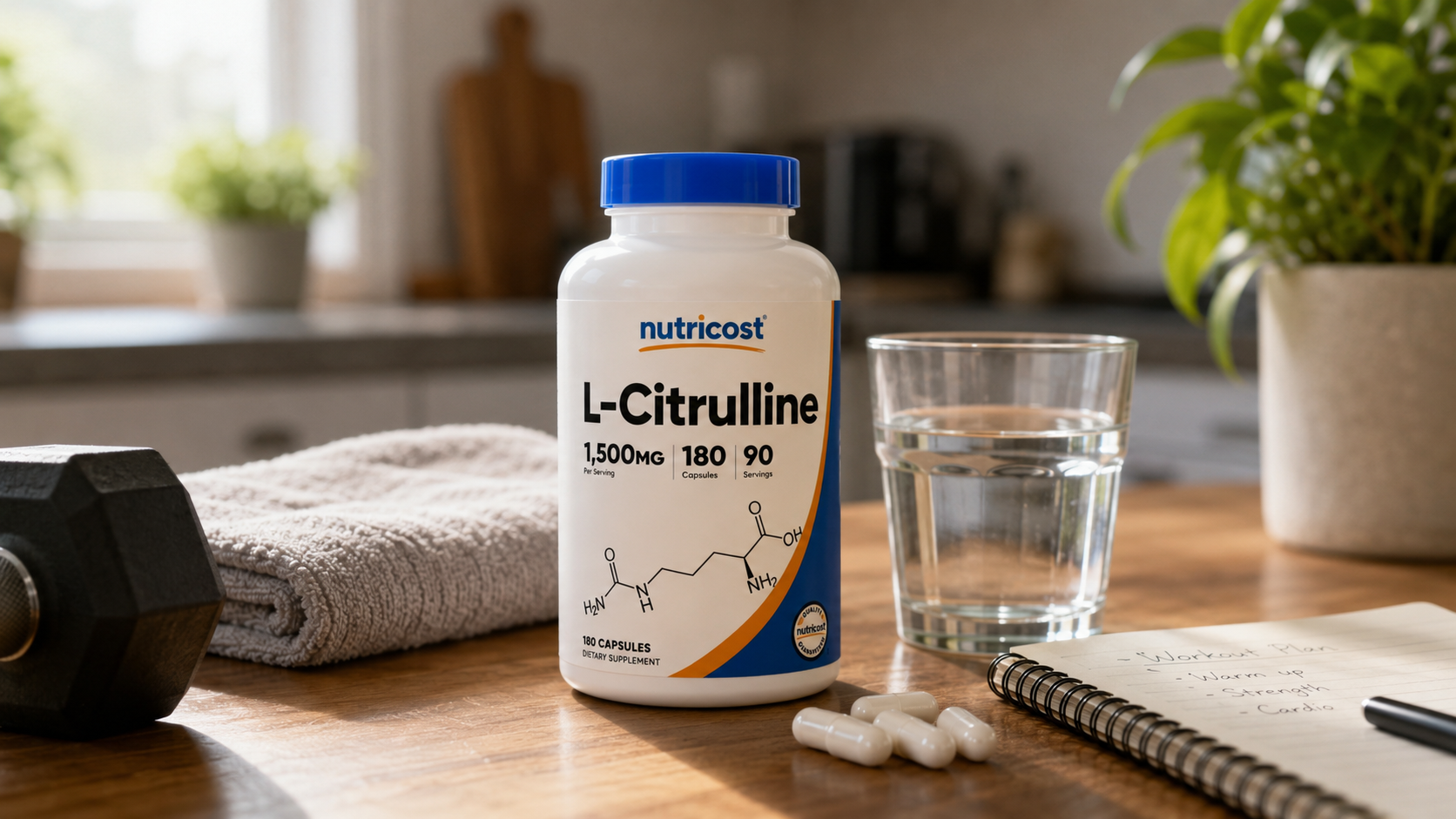 L-citrulline supplements are often used by people interested in exercise performance and blood flow. They are best viewed as a complement to regular exercise, balanced nutrition, adequate rest, and responsible health management.
If You're on Blood Pressure Medication, Special Caution Is Needed
There's something that genuinely needs to be addressed directly when talking about arginine.
Arginine can relax blood vessels and lower blood pressure. So if you're already taking blood pressure medication — particularly antihypertensives or ACE inhibitors — combining it with arginine can cause your blood pressure to drop more than it should. This particular combination is often classified as a "major" drug interaction in medical references, and it's not something to combine on your own.
The same caution applies if you're taking nitrate medications for angina, or erectile dysfunction medications like sildenafil (Viagra) — combining either with arginine can cause a dangerously sharp drop in blood pressure. Since medications like these aren't uncommon among men in their 40s, this is genuinely worth checking carefully.
There's also a risk of elevated potassium levels if arginine is combined with potassium-sparing diuretics.
If you're currently taking any medication, please check with your prescribing doctor or a pharmacist before starting arginine or any related supplement.
Taking More Doesn't Make You Healthier
Once health becomes a priority, it's tempting to want to add several supplements at once.
But taking more of something doesn't proportionally improve your health.
Arginine, too, can cause stomach discomfort or headaches in some people, and — as covered above — genuinely requires extra caution if you have a specific condition or take medication.
Looking for what's good for your body matters. But restraint is its own form of wisdom for protecting your health.
For Christians, Health Management Is Part of Stewardship
Scripture doesn't treat our bodies carelessly.
The apostle Paul describes our bodies as "the temple of the Holy Ghost" in 1 Corinthians 6:19 (KJV): "What? know ye not that your body is the temple of the Holy Ghost which is in you, which ye have of God, and ye are not your own?"
There's no need to read this as pressure to consume more supplements.
It's better understood as an invitation to care carefully for the body God has entrusted to us, while guarding against both neglect and obsession.
Christian health management was never just about living longer or looking younger.
It's preparation — for caring for family with a healthy body, carrying out what's entrusted to you, serving your neighbors, and faithfully fulfilling the calling God has given you for a long time to come.
So exercising, adjusting your diet, and taking a supplement when it's needed can all be understood through the lens of stewardship over the body you've been given.
Excessive Worry About Health Is Also Worth Guarding Against
On the flip side, becoming obsessed with health is worth thinking through too.
Constantly searching for the next piece of health information, feeling anxious over the smallest physical discomfort, endlessly chasing a better or more powerful supplement — that pattern can actually rob you of peace of mind.
Health is an important area to manage, but it was never something we could fully control.
What we can do is faithfully care for our bodies day by day, while remembering that ultimate authority over our life and health belongs to God.
Just as Jesus said, "Take therefore no thought for the morrow" (Matthew 6:34, KJV), health management, too, needs the peace of faith alongside wisdom.
What's Worth Checking Before Arginine
Before buying arginine, it's worth reviewing your own lifestyle first.
Are you sleeping enough? Moving your body regularly? Eating too irregularly? Pushing through more stress than you should?
Sometimes, a 30-minute walk, going to bed an hour earlier, drinking enough water, cutting back on drinking, and eating a balanced diet matter more as a starting point than a new bottle of supplements.
And for a Christian, there's one more thing worth adding.
A moment, in the middle of a busy day, to stop and pray — to set down the weight on your heart before God.
Because it's not just physical fatigue that needs care. Emotional fatigue does too.
In the End, What Matters Most Is Balance
Arginine is one of many nutrients worth knowing about if you're interested in exercise and health management.
But it isn't some special solution that takes responsibility for your health.
Good meals, consistent exercise, enough sleep, proper rest, and stress management come first — with supplements used as a supporting tool when genuinely needed.
And if you're a Christian, there's one more thing worth remembering.
Health was never a possession to be proud of — it's a gift entrusted to us by God.
Rather than making a healthy body the ultimate goal of life, gratefully caring for the body God has allowed and using that health to love family and neighbors and carry out your calling — that may be the balanced Christian posture toward health.
Before reaching for a scoop of arginine, take a moment to look at your own life today.
Walk a little more. Rest a little earlier. Eat with gratitude. Set the weight on your heart down before God.
That might be the most important starting point for protecting your health past 40.
 An evening walk offers a simple way to support physical and mental well-being. For adults in midlife, regular movement, time outdoors, and moments of quiet reflection can be an important part of maintaining a balanced and healthy lifestyle.
This article is intended as general health information and is not medical advice for diagnosing or treating any condition. If you take blood pressure medication, nitrate medications, erectile dysfunction medications, diuretics, or have an existing health condition, please consult a healthcare professional before taking arginine or any related supplement.