Blessed Assurance: The Story of Fanny Crosby's Faith
When Fanny Crosby lost her sight as an infant, few could have imagined what God would do through her life.
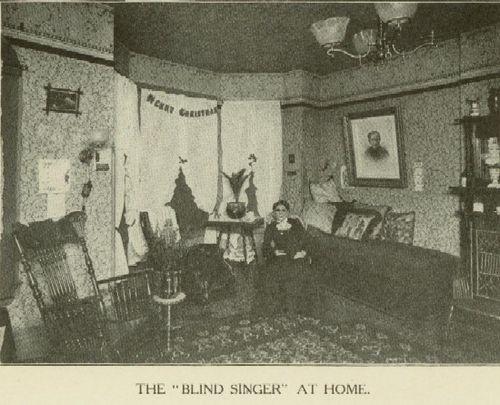 Fanny Crosby at home, 1906
Though she never regained her sight, Crosby became one of the most beloved hymn writers in Christian history. Her hymns, including Blessed Assurance, have encouraged generations of believers around the world.
A Life Shaped by Faith
Born in 1820 in New York, Frances Jane Crosby lost her sight as a baby after an illness affected her eyes. Her father died before she was a year old, and her mother worked to support the family. Raised largely by her grandmother, Fanny learned to imagine the world through her descriptions of sunsets, trees, and birds.
By age eight, she had already written a poem declaring, “Oh, what a happy soul am I! Although I cannot see.” That joy and faith stayed with her throughout her life. She went on to become a prolific hymn writer, penning thousands of hymns, including Blessed Assurance, To God Be the Glory, and Pass Me Not, O Gentle Savior.
Rather than dwelling on what she could not see, Crosby focused on what God had given her. She once expressed gratitude for her blindness, saying that the first face she hoped to see would be that of her Savior. Her life became a testimony to a faith that looked beyond what was visible.
The Birth of a Beloved Hymn
The story behind Blessed Assurance began in 1873 when Crosby visited her friend Phoebe Palmer Knapp, a composer and musician. Knapp played a new melody and asked what it suggested to her.
Crosby immediately responded, “Blessed assurance, Jesus is mine!” Those words became the opening line of the hymn, with Crosby writing the lyrics and Knapp the music.
The result was a hymn built around a simple but powerful message: the joy and peace of knowing that we belong to Christ.
Confidence That Goes Beyond Circumstances
The message of Blessed Assurance was not simply something Crosby wrote. It reflected the way she lived.
She knew what it meant to face limitations and uncertainty, yet her confidence was not based on what she could control. Her faith rested on Christ.
That may be one reason the hymn has remained so meaningful for generations. Its words remind us that Christian assurance does not depend on perfect circumstances. It comes from knowing whom we belong to.
This is my story, this is my song,
Praising my Savior all the day long.
For Fanny Crosby, those words were more than poetry. They were a testimony.
“For we live by faith, not by sight.” (2 Corinthians 5:7)
More than 150 years later, its message remains simple and powerful: our confidence is not found in what we can see, but in the One we trust.
Read previous: Great Is Thy Faithfulness: The Quiet Life of a Faithful Pastor