Everton FC History: The Spiritual Discipline of Football and the Modern Church (Part 2)
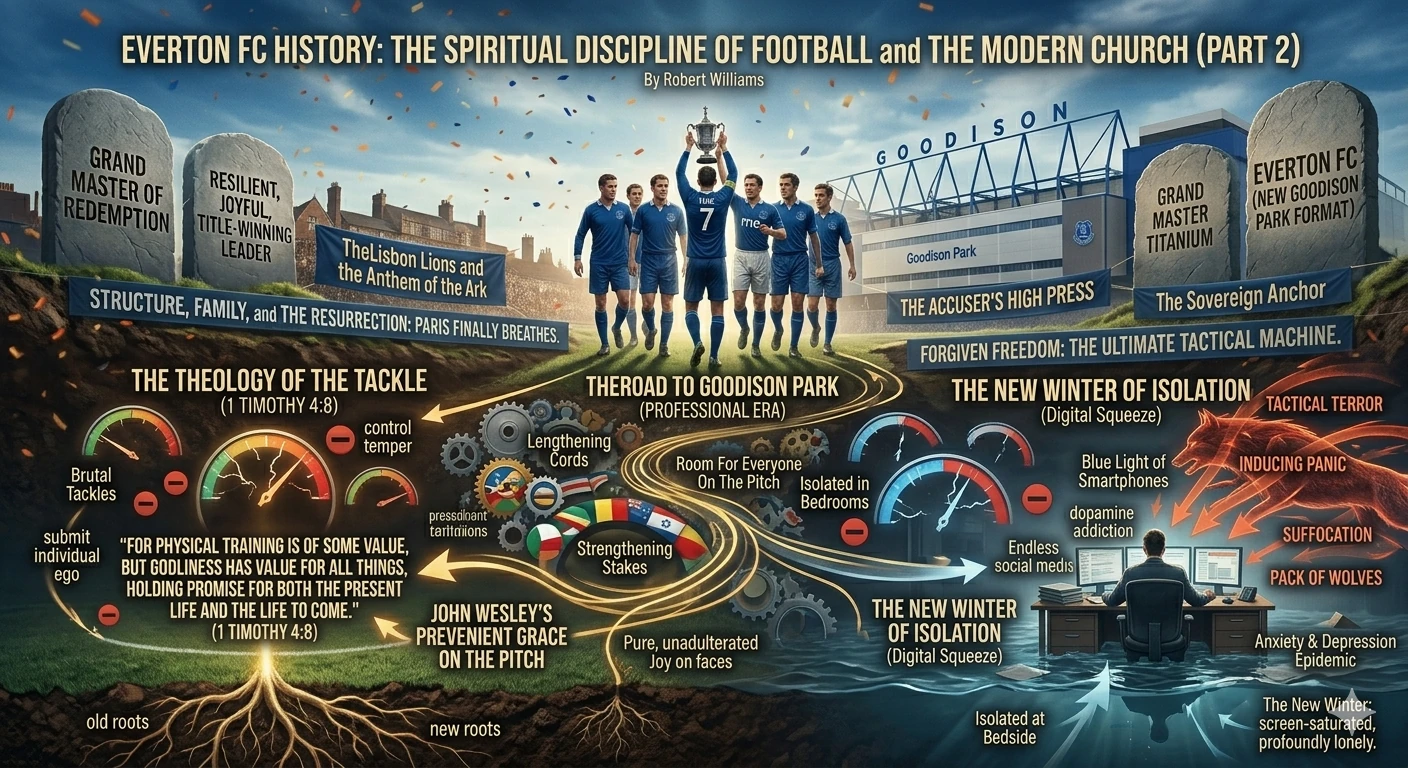
Welcome back to the concluding chapter of our Everton FC feature on 'The 91st Minute'. In Part 1, we explored how a Methodist church in 1878 created St. Domingo's FC—the team that would become Everton—as a mechanism of 'prevenient grace' to keep the young men of Liverpool out of the pubs during the harsh winter. Today, we follow the club as it transitions from a local parish team to a professional footballing giant. More importantly, we will examine the deep theological connection between physical discipline and spiritual growth, and ask a devastating question: How is the modern Church responding to the "new winter" facing today's youth?
Outgrowing the Parish: The Road to Goodison Park
The success of St. Domingo’s FC was so rapid and explosive that it completely outgrew its parish boundaries within a year. Renamed Everton FC in 1879, the club quickly transformed from a ragtag group of Sunday School boys playing on the rough grass of Stanley Park into a formidable sporting institution.
As crowds swelled into the tens of thousands, the club moved to an enclosed ground called Anfield. Yes, that Anfield. Everton actually occupied Anfield long before Liverpool FC even existed. However, following a bitter dispute over rent in 1892, Everton made a massive, historic decision. They abandoned Anfield, crossed Stanley Park, and built Goodison Park—the first major purpose-built football stadium in England.
They had officially entered the professional, commercial era. Yet, even as the club grew into a global brand, we must not lose sight of the original philosophy that was forged on those freezing, muddy winter afternoons by Rev. Ben Swift Chambers. They were not just playing a game; they were forging character.
The Theology of the Tackle
In the late 19th century, many Christians embraced a concept known as "Muscular Christianity." They believed that physical weakness and idleness bred moral decay. Football was not merely a distraction; it was a rugged, outdoor classroom for discipleship.
Think about the sheer discipline required to play football in the 1880s. The balls were heavy, waterlogged leather. The pitches were ankle-deep in freezing mud. Tackles were brutal. In that environment, a young man learned vital spiritual lessons that a classroom lecture could never teach him. He learned how to control his temper when he was fouled. He learned how to submit his individual ego to the tactical needs of the team. He learned endurance, resilience, and brotherhood.
The Apostle Paul understood this profound connection between the body and the soul, often using athletic training as a metaphor for spiritual maturity:
"For physical training is of some value, but godliness has value for all things, holding promise for both the present life and the life to come." (1 Timothy 4:8, NIV)
The founders of Everton FC knew that while physical training was ultimately secondary to eternal godliness, it was still valuable. A young man who learns how to discipline his body on a football pitch is far better equipped to discipline his soul against the temptations of the world.
The New Winter of Isolation
The story of Everton’s origins presents a massive, uncomfortable challenge to the modern Church.
In 1878, the "winter" that threatened the youth of Liverpool was defined by street gangs and local pubs. Today, the youth in our churches are facing a completely different, yet equally deadly winter. Our modern winter is digital.
Today’s teenagers are not necessarily freezing on street corners; they are isolated in their bedrooms, bathed in the blue light of smartphones. They are facing an epidemic of anxiety, depression, and dopamine addiction fueled by endless social media scrolling and digital isolation. The modern winter is quiet, screen-saturated, and profoundly lonely.
If Rev. Chambers were alive today, he would look at this crisis with the same fierce pastoral urgency he had in 1878. He would not just preach a sermon about the dangers of the internet and then send the youth back to their isolated screens. He would build an alternative.
Blowing the Whistle for the Next Generation
We must ask ourselves: What is our "football" today?
What is the proactive, compelling, physical, and communal alternative that the Church is offering to a generation drowning in digital isolation? Are we willing to step out of our comfortable sanctuaries and create spaces where young people can sweat, laugh, fail, and build face-to-face brotherhood and sisterhood?
Everton FC stands as a towering, 40,000-seat reminder that the Church is at its best when it aggressively pursues the marginalized and the wandering. We cannot afford to be passive. The winter is here, and the youth are shivering. It is time for the modern Church to put on its boots, step out into the mud, and blow the whistle.